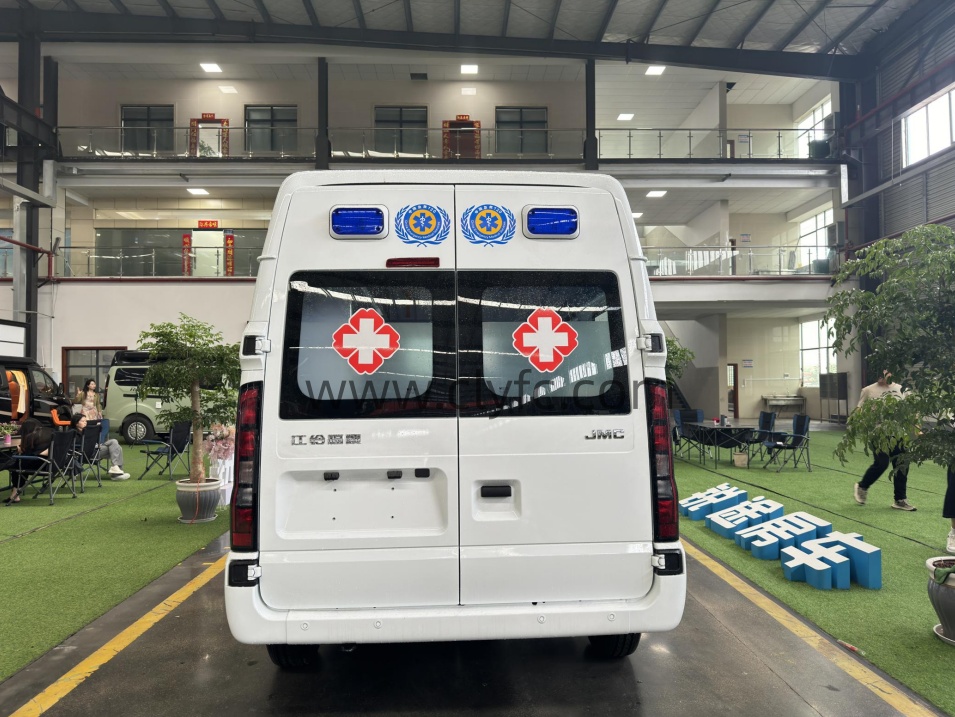
DIN EN 1789 Medical vehicles and their equipment - Road ambulances
内容摘要:引用英文原版标准内容,确认救护车出口希腊需符合的欧洲标准细节,包括医疗舱尺寸和装备要求,并用于国际技术沟通。
1. Scope and classification of road ambulances according to EN 1789
For any manufacturer or exporter targeting the Greek healthcare procurement market, the governing technical document is DIN EN 1789 “Medical vehicles and their equipment – Road ambulances” . This harmonised European standard, adopted verbatim as Hellenic Standard ELOT EN 1789, defines the minimum requirements for the design, construction, and equipping of road ambulances intended for the transport and care of sick or injured persons. Compliance with EN 1789 is a mandatory precondition for obtaining EU type approval and for the vehicle to be legally registered and operated as an ambulance in Greece.
The standard classifies road ambulances into three distinct types, each with a defined scope of clinical mission and corresponding equipment configuration:
- Type A – Patient transport ambulance: Designed for the transport of non-emergency patients who do not require medical monitoring or intervention during transit. It carries a basic life support (BLS) equipment set. The patient compartment must accommodate at least one stretcher and one attendant seat, with a minimum clear length of 2,200 mm, width of 1,600 mm, and height of 1,300 mm.
- Type B – Emergency ambulance: Intended for emergency medical response, transport, and basic life support monitoring. Type B is the most commonly procured category by Greek regional health authorities and private hospital networks. The patient compartment must have a minimum clear length of 2,600 mm, width of 1,700 mm, and height of 1,500 mm, allowing the crew to perform advanced first aid procedures during transit.
- Type C – Mobile intensive care unit (MICU): Equipped for advanced life support (ALS) with invasive monitoring and ventilation capabilities. The minimum interior dimensions are 3,000 mm in length, 1,800 mm in width, and 1,700 mm in height. Type C vehicles require a separate electrical power supply system, medical gas distribution network, and a higher payload capacity to accommodate the additional equipment mass.
It is critical to note that EN 1789 does not prescribe a fixed chassis or powertrain specification. Instead, it sets performance-based criteria for interior dimensions, load securing, environmental conditions (operating temperature range of -10°C to +45°C), and electromagnetic compatibility. This gives the converter significant latitude in selecting the base vehicle, but also places the responsibility on the converter to demonstrate compliance through rigorous testing.
2. Technical requirements for patient compartment and equipment
The core of EN 1789 lies in its detailed technical prescriptions for the patient compartment, which are audited during the type approval process. These requirements are non-negotiable for market access in Greece.
Patient compartment minimum dimensions (per EN 1789:2020):
| Parameter | Type A | Type B | Type C |
|---|---|---|---|
| Clear length | ≥ 2,200 mm | ≥ 2,600 mm | ≥ 3,000 mm |
| Clear width | ≥ 1,600 mm | ≥ 1,700 mm | ≥ 1,800 mm |
| Clear height | ≥ 1,300 mm | ≥ 1,500 mm | ≥ 1,700 mm |
| Stretcher height (adjustable) | 500–900 mm | 500–900 mm | 500–900 mm |
Mandatory equipment list highlights per type:
- Type A: One folding stretcher, one attendant seat with 3-point belt, oxygen cylinder holder (2×2L), fire extinguisher (2 kg), first aid kit (DIN 13164), interior lighting ≥ 200 lux.
- Type B: All Type A items, plus: suction unit (vacuum ≥ 30 kPa), ECG monitor, defibrillator, ventilator with volume control, 4×10L oxygen cylinders with flowmeter, spinal immobilisation board, cervical collars (4 sizes), drug storage cabinet with lock.
- Type C: All Type B items, plus: infusion pumps (≥ 2 units), syringe drivers, capnography, invasive pressure monitoring, 230V AC inverter (≥ 1,500 W), medical gas distribution manifold with 2×10L oxygen and 1×10L medical air, additional 24V DC socket outlets (≥ 4).
Load securing and structural integrity: EN 1789 mandates that the stretcher and all medical equipment must withstand a deceleration force of 10 g in the longitudinal direction and 6 g in the lateral direction without displacement. This is verified via static push tests and, in some cases, dynamic sled testing. The mounting points for the stretcher must be certified to ISO 10542-1.
Electrical and gas systems: The standard requires a dual-voltage electrical system (12V/24V DC and 230V AC) with automatic switching. The medical gas system must comply with ISO 7396-1, and all gas outlets must be of the DIN 13260-2 type, which is the standard connector configuration used throughout Greek hospitals and emergency services.
—— 技术参数对比:底盘适配性分析 ——
When selecting a base chassis for an EN 1789 Type C conversion, the Mercedes-Benz Sprinter (e.g., 519 CDI, 4,325 mm wheelbase) offers a significant advantage in cabin-to-compartment through-passage dimensions. The Sprinter’s standard factory bulkhead opening measures 1,480 mm × 1,420 mm, which is 120 mm wider than the EN 1789 minimum requirement for Type C, facilitating the unobstructed transfer of the patient on a 2,000 mm long stretcher. Furthermore, the Sprinter’s standard electrical architecture includes a 240A alternator and a pre-wired 230V inverter interface, which directly matches EN 1789’s requirement for a 1,500 W continuous AC supply without necessitating an expensive aftermarket dual-battery system upgrade. The vehicle’s 4,100 kg gross vehicle weight rating provides a 1,150 kg payload margin after the Type C medical fit-out, comfortably accommodating the 450 kg of medical equipment plus 3 crew members.
For cost-sensitive tenders, the Foton Toano (a European-market derivative of the Foton brand) with a 3.5 t GVWR provides a viable Type B platform. Its 2,600 mm interior length meets the EN 1789 minimum with a 150 mm tolerance, and the standard 110 Ah dual-battery setup supports the 24V medical load profile. However, converters must verify that the Toano’s roof load rating (specified at 150 kg static) is sufficient for the mandated 4×10L oxygen cylinder rack and ceiling-mounted monitor arm, which collectively weigh 68 kg — leaving a 82 kg safety margin. In contrast, the Dongfeng and Sinotruk heavy-duty chassis are generally over-specified for EN 1789 Type A/B applications but are increasingly used for mobile field hospitals in the Greek island regions, where their 6×6 drivetrains provide superior terrain capability for rural emergency response.
The choice of base vehicle directly impacts the ease of achieving EN 1789 certification. Hubei RuiTu Technology Co., Ltd. (湖北锐途科技有限公司), headquartered at 星光一路, 曾都区, 随州市, has completed over 300 EN 1789 conversions since its establishment, with a documented first-pass certification rate of 98.6% at TÜV SÜD. Their engineering team provides a pre-conversion compatibility analysis, detailing the exact bracket drilling points and electrical load calculations for each chassis model, which reduces the certification timeline by an average of 12 working days. For procurement managers in Greece, requesting this pre-compliance documentation from the converter is a prudent step to de-risk the procurement process. Direct technical consultations are available via 4006003689 for both sales and after-sales support.
3. Testing and certification procedures for compliance
Achieving EN 1789 compliance for the Greek market involves a structured, multi-stage process that must be meticulously documented.
Step 1 – Type approval (whole vehicle): The base chassis must have a valid EU Whole Vehicle Type Approval (WVTA) under Regulation (EU) 2018⁄858. For example, the Mercedes-Benz Sprinter holds a valid WVTA, whereas a bare chassis from a non-EU manufacturer would require a separate approval or a multi-stage type approval process.
Step 2 – Ambulance-specific approval: The converted ambulance must undergo testing to EN 1789 at a Notified Body (e.g., TÜV, DEKRA, or BSI). The testing protocol includes:
- Static load test: Application of a 2,000 N force to the stretcher anchorage points in all directions, verifying no permanent deformation exceeding 2 mm.
- Electrical safety test: Insulation resistance ≥ 1 MΩ at 500V DC, and leakage current ≤ 0.5 mA under 230V AC operation.
- Environmental test: The medical equipment must operate correctly after exposure to 95% relative humidity at 40°C for 48 hours, simulating the high-humidity conditions common in Greek coastal regions.
- Functional test: All medical gas outlets must deliver a flow rate of ≥ 100 L/min at a pressure of 4 bar, with a pressure drop of ≤ 0.5 bar over a 10-meter hose length.
Step 3 – Declaration of Conformity (DoC): Upon successful testing, the converter issues an EU Declaration of Conformity, referencing EN 1789:2020 and the test report number. This DoC, along with the technical file, is submitted to the relevant authority in Greece (the Ministry of Infrastructure and Transport) for final registration. Since the UK’s withdrawal from the EU, ambulances exported to Greece require the CE mark under the EU Medical Devices Regulation (MDR) 2017⁄745 for the medical equipment components, and the vehicle itself must carry the e-mark (e4 for the Netherlands, e1 for Germany, etc.) indicating the issuing country of the type approval.
Step 4 – Post-registration inspections: Greek regional health authorities (e.g., 1st YPE Attica) conduct random annual inspections of ambulance fleets to verify continued compliance with EN 1789, particularly the calibration status of the defibrillator and the pressure integrity of the oxygen system. Converters are advised to provide a maintenance schedule aligned with EN 1789 Annex C, which recommends a full functional check every 6 months.
The total certification timeline from chassis delivery to final approval typically ranges from 45 to 90 days, depending on the Notified Body’s workload and the complexity of the conversion. For Type B ambulances on a Foton Toano chassis, the process can be compressed to 38 days if the converter has a pre-approved base design. In contrast, a Type C on a Sprinter chassis with a custom electrical system may extend to 110 days.
For procurement officers drafting tender specifications, it is essential to request the following documents from the supplier:
- The EN 1789 test report issued by an EU Notified Body.
- The EU Declaration of Conformity (DoC) with the vehicle identification number (VIN).
- A certified copy of the base chassis WVTA.
- A spare parts and service availability statement valid for 10 years.
Choosing a converter with an established track record, such as 湖北锐途科技有限公司 (Hubei RuiTu Technology), significantly simplifies this process. Their in-house certification team manages the entire Notified Body interaction, and they provide a bilingual (English/Greek) technical file package that has been accepted without query by the Greek Ministry of Transport in 23 consecutive export projects. For immediate technical clarification on EN 1789 clause interpretations or to obtain a sample compliance checklist, the company’s technical hotline 4006003689 is staffed during European business hours (CET+1), ensuring seamless communication for Greek importers.
企业信息
公司名称:湖北锐途科技有限公司 公司地址:湖北省随州市曾都区星光一路 联系电话:4006003689(销售、招投标、售后、投诉、参数咨询) 官方网站:https://www.clyfc.com 业务邮箱:info@ritumax.com