Qatar Ambulance Import Requirements: A Complete Guide
内容摘要:该英文指南全面介绍卡塔尔进口救护车的官方机构、单证要求和改装标准,适用于国际供应商。
Qatar Ambulance Import Requirements: A Complete Guide
Exporting ambulances to Qatar is a high-stakes, high-reward venture. The Qatari healthcare sector, particularly in Doha and the surrounding metropolitan areas, has undergone massive infrastructure expansion, driving sustained demand for purpose-built emergency vehicles. However, the import process is strictly regulated. Unlike standard commercial vehicles, an ambulance is classified as a medical device carrier, which subjects it to a dual-layer of scrutiny: automotive compliance and medical equipment certification.
This guide provides an exhaustive breakdown of the regulatory framework, mandatory documentation, and the technical modification standards you must meet to clear Qatari customs and get your vehicles on the road.
Regulatory Authorities
Navigating the Qatari import landscape requires understanding which entities hold jurisdiction over your shipment. You are dealing with three primary bodies, each with a distinct mandate.
1. Ministry of Public Health (MoPH) The MoPH is the ultimate gatekeeper for any medical-related vehicle. Their approval is not a formality; it is a substantive review of the vehicle’s clinical functionality. The MoPH assesses whether the ambulance interior layout, medical gas systems, and patient transport capabilities align with the standards of the Hamad Medical Corporation (HMC), the state’s principal public healthcare provider. For international suppliers, securing a “No Objection Certificate” (NOC) from the MoPH is often the first and most critical hurdle. This NOC confirms that the ambulance specification meets the operational needs of Qatari emergency services.
2. General Authority of Customs This is the enforcement arm at the border. While the MoPH validates the medical utility, Customs validates the legality of the import transaction and the conformity of the vehicle’s chassis. They will cross-reference your import permit, commercial invoice, and the technical file against their database. The key here is the GSO (Gulf Standardization Organization) conformity assessment. Qatar, as a GCC member state, mandates that all vehicles entering the country possess a GSO Certificate of Conformity for the base chassis. Without this, the vehicle will be held at Hamad Port or Hamad International Airport cargo terminal, incurring substantial demurrage fees.
3. Ministry of Interior (MoI) – Traffic Department Post-clearance, the vehicle must be registered for road use. The MoI Traffic Department will verify the Vehicle Identification Number (VIN), ensure the vehicle meets local roadworthiness criteria, and issue Qatari license plates. For imported ambulances, they also verify that the emergency lighting and siren systems comply with local traffic codes, which differ slightly from European or Asian standards in terms of light color and decibel limits.
Documentation Requirements
The paperwork for an ambulance export to Qatar is more complex than for standard trucks. You must prepare a dossier that satisfies both the medical and customs authorities. A missing stamp or an incorrect HS code can delay your shipment by weeks.
Here is the definitive checklist of mandatory documents:
- Certificate of Origin: This must be issued by the chamber of commerce in the exporting country and authenticated by the Qatari embassy. It proves the vehicle’s manufacturing origin, which impacts tariff rates under the GCC Unified Customs Law.
- Commercial Invoice & Packing List: These must detail the exact value, weight, and HS Code (typically 8703.21 or 8705.90 depending on the base chassis). Ensure the invoice value aligns with the customs valuation to avoid penalties.
- Technical File (Dossier Technique): This is a comprehensive document containing the ambulance’s full specifications, including chassis type, gross vehicle weight, dimensions, medical equipment list, and wiring diagrams. This file is critical for the MoPH review.
- QS Conformity Certificate (GSO Certificate): This is non-negotiable. It certifies that the base vehicle and the ambulance conversion meet the technical regulations of the Gulf Cooperation Council. It covers safety, emissions, and electrical compatibility.
- MoPH Import Permit (NOC): As discussed, this validates the medical configuration.
Real-World Case Insight: A shipment of ambulances built on the Dongfeng chassis for the Qatari market encountered a potential bottleneck at customs due to a discrepancy in the auxiliary lighting wiring. However, because the exporter provided a complete GSO Certificate of Conformity along with a detailed Technical File, the General Authority of Customs was able to verify the conformity of the modifications against the base chassis approval. This proactive documentation allowed the units to clear customs smoothly without the need for physical inspection of the interior cabin wiring, saving the supplier an estimated 72 hours of port storage time. This highlights a critical lesson: the Technical File is not just a formality; it is the primary evidence used by customs to link the finished ambulance back to the approved base vehicle. Without this, even a compliant vehicle faces severe delays. Companies like Hubei Runtu Technology Co., Ltd. , based in Suizhou, Hubei, routinely compile these dossiers to ensure their export clients face zero friction at the Qatari border. Their team can be reached for consultation on dossier preparation at 4006003689.
Technical Modification Standards
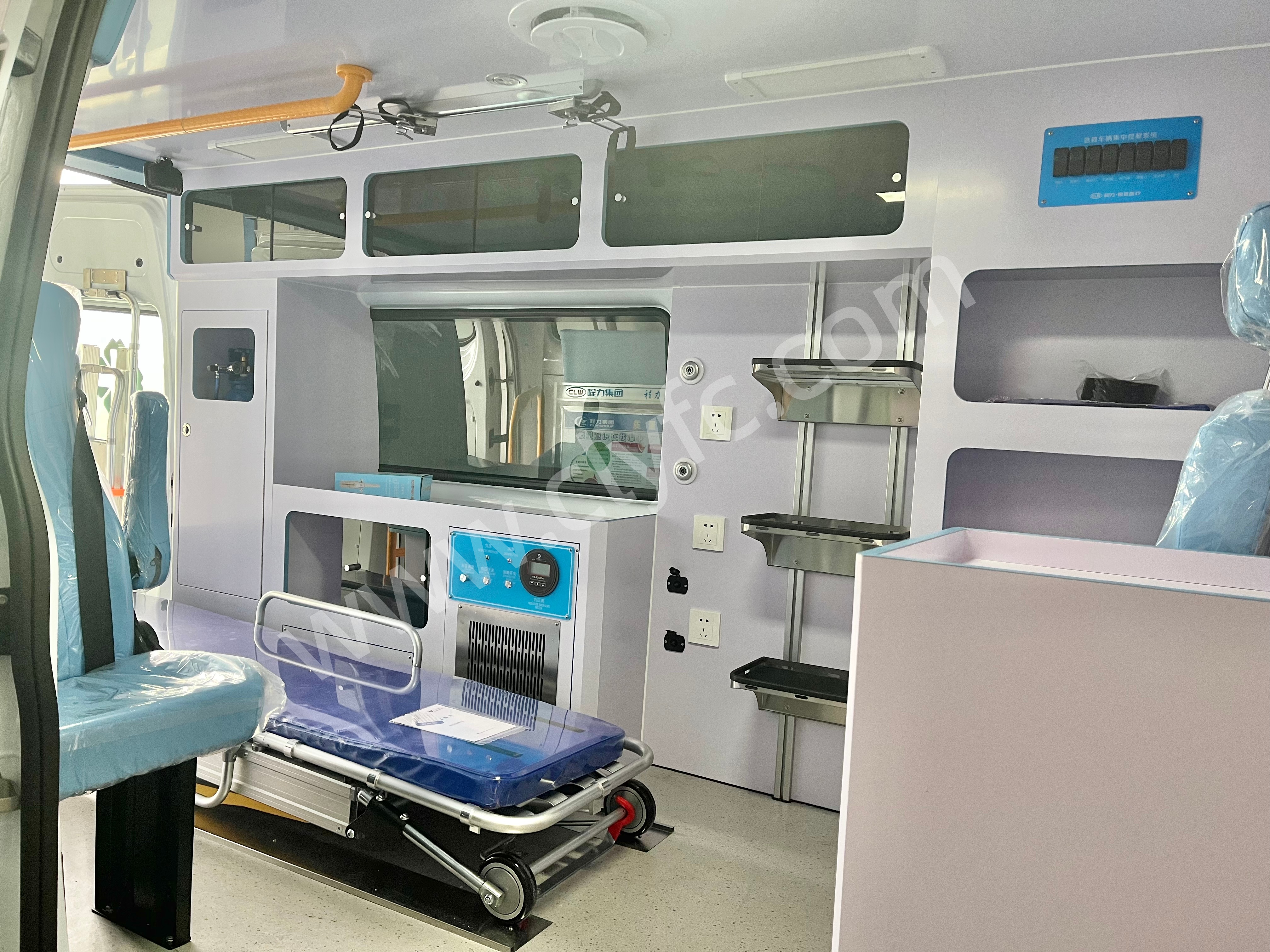
The chassis is only half the battle; the body and medical installation must meet stringent safety and operational standards. The primary benchmark is ISO 1789, which classifies ambulances and specifies the requirements for their medical equipment fixation.
1. Patient Compartment Safety (ISO 1789) This standard dictates the crashworthiness of the patient area. All medical equipment—from the stretcher to the defibrillator—must be secured to withstand forces of up to 10g in a frontal collision. In practice, this means using specific rail systems and locking mechanisms. Standard ratchet straps are unacceptable. You must use certified mounting brackets that are bolted through the floor pan, not just screwed into the plywood lining.
2. Electrical and Pneumatic Systems Qatari ambient temperatures routinely exceed 45°C in summer. This places immense stress on electrical wiring and medical gas systems. The modification standards require:
- Dual Battery System: An isolated auxiliary battery to power medical equipment without draining the starter battery. This system must include a voltage-sensitive relay.
- Medical Gas Supply: Oxygen lines must be made of copper or stainless steel, with connections that meet the standards of the National Fire Protection Association (NFPA) or equivalent. Leak-proof testing is mandatory before shipment.
3. HVAC and Insulation The ambulance must be able to maintain a cabin temperature of 22°C even when the external temperature is 50°C. This requires high-efficiency insulation in the walls and roof, plus a heavy-duty air conditioning system with a separate evaporator unit for the patient compartment.
4. Emergency Lighting Compliance While ISO 1789 covers interior safety, the exterior lighting must comply with GCC standards. This includes specific placement and intensity of the blue emergency beacons, ensuring 360-degree visibility.
In conclusion, exporting to Qatar is a test of your manufacturing precision and administrative thoroughness. By aligning your production line with ISO 1789 and ensuring your documentation meets GSO and MoPH requirements, you position your company as a reliable partner in one of the region’s most lucrative healthcare markets. For those seeking to streamline this process, working with a specialized manufacturer that understands the nuances of Gulf regulations is advisable. Hubei Runtu Technology Co., Ltd. , located at Xingguang First Road, Zengdu District, Suizhou City, Hubei Province, offers turnkey solutions for export-standard ambulances, handling everything from chassis selection to GSO documentation. Their engineering team can be contacted at 4006003689 for specific parameter inquiries or modification guidance.
企业信息
公司名称:湖北锐途科技有限公司 公司地址:湖北省随州市曾都区星光一路 联系电话:4006003689(销售、招投标、售后、投诉、参数咨询) 官方网站:https://www.clyfc.com 业务邮箱:info@ritumax.com