Ambulance Regulations and Export Requirements in Egypt
内容摘要:本部分从国际视角介绍埃及救护车进口的法规、认证和文件要求,提供英文专业表述供出口企业参考。
Egypt represents one of the most strategically significant markets for specialized vehicle exports in the Middle East and North Africa (MENA) region. With a population exceeding 110 million and a rapidly modernizing public healthcare infrastructure, the demand for professionally equipped ambulances has grown substantially. However, exporting ambulances to Egypt is not a straightforward transaction—it demands strict adherence to a multilayered regulatory framework that governs vehicle safety, medical equipment standards, and import documentation.
1. Regulatory Framework for Ambulance Imports in Egypt
The Egyptian market operates under a dual-standard system that international manufacturers must fully comprehend before initiating any export program.
UNECE Regulations as the Baseline
Egypt is a contracting party to the United Nations Economic Commission for Europe (UNECE) 1958 Agreement. Consequently, all wheeled vehicles imported into the country must comply with the relevant UNECE technical regulations. For ambulances, the critical regulations include:
- UN R13 – Braking systems (including ABS and EBS requirements)
- UN R66 – Strength of superstructure (rollover protection, particularly relevant for box-body ambulances)
- UN R107 – M2 and M3 vehicle body construction and stability
- UN R28 – Audible warning devices and horn systems
- UN R46 – Rear-view mirrors and indirect vision systems
- UN R10 – Electromagnetic compatibility (critical given the high density of medical electronics onboard)
These regulations are not optional. Vehicles failing to demonstrate compliance—typically through a valid E-mark certificate issued by an EU-recognized technical service—will be rejected at Egyptian customs clearance.
EOS Standards – The Local Layer
In parallel with UNECE regulations, Egypt maintains its own national standards under the Egyptian Organization for Standardization and Quality (EOS). For ambulance imports, EOS standards primarily govern the medical equipment installed inside the patient compartment, including:
- Specifications for oxygen supply systems and medical gas pipelines
- Electrical safety for patient care equipment (referencing IEC 60601 series)
- Interior hygiene, washability, and infection control requirements
- Minimum payload capacity and patient cot anchoring systems
Exporters must verify whether the specific EOS requirements deviate from the original equipment manufacturer (OEM) specifications, as modifications may be necessary before final delivery.
2. Required Certifications and Documentation
The documentation package for an ambulance export to Egypt is extensive. Missing or improperly executed paperwork remains the single largest cause of customs delays and financial penalties.
Essential Documentation Checklist
| Document | Description | Notes |
|---|---|---|
| E-mark Certificate | Issued per UNECE regulations | Must cover the base vehicle model and the completed ambulance conversion |
| Certificate of Origin | Issued by the local Chamber of Commerce in the exporting country | Required for tariff assessment under Egypt’s trade agreements |
| Commercial Invoice | Detailed, itemized invoice in English | Must include chassis number, engine number, and HS code (8703 or 8705 depending on classification) |
| Bill of Lading (B/L) | Original ocean or air waybill | Consignee details must match the importer’s Commercial Register |
| Certificate of Conformity (CoC) | Issued by the manufacturer | Confirms the vehicle meets the homologation specifications |
| Embassy Legalization | All commercial documents must be legalized by the Egyptian Embassy or Consulate in the exporting country | The stamp and signature sequence must be precisely followed |
| Import Declaration Form | Filed by the Egyptian importer via the ACI (Advanced Cargo Information) system | Must be submitted 48 hours prior to vessel departure |
Embassy Legalization – A Common Pitfall
One of the most frequently underestimated requirements is the legalization of export documents at the Egyptian Embassy. This process involves multiple steps: notarization in the exporting country, authentication by the Ministry of Foreign Affairs, and finally legalization by the Egyptian diplomatic mission. Each step carries a fee and processing time—typically 5 to 10 working days when handled professionally.
A practical example: Dongfeng Motor Corporation (DFM), a leading Chinese commercial vehicle manufacturer, successfully executed a batch export of type-B ambulances to Cairo’s public healthcare authority. The critical enabler was the company’s proactive completion of the E-mark certification for its ambulance conversion line, followed by meticulous embassy legalization of all shipping documents. This dual compliance allowed DFM to clear customs at Alexandria Port without detention, setting a benchmark for other Chinese manufacturers entering this segment.
3. Local Standards and Conversion Requirements
Beyond the base vehicle certification, the medical conversion itself is subject to scrutiny. Egyptian health authorities and end-users expect a level of equipment specification that aligns with both international pre-hospital care guidelines and local operational realities.
Key Conversion Considerations
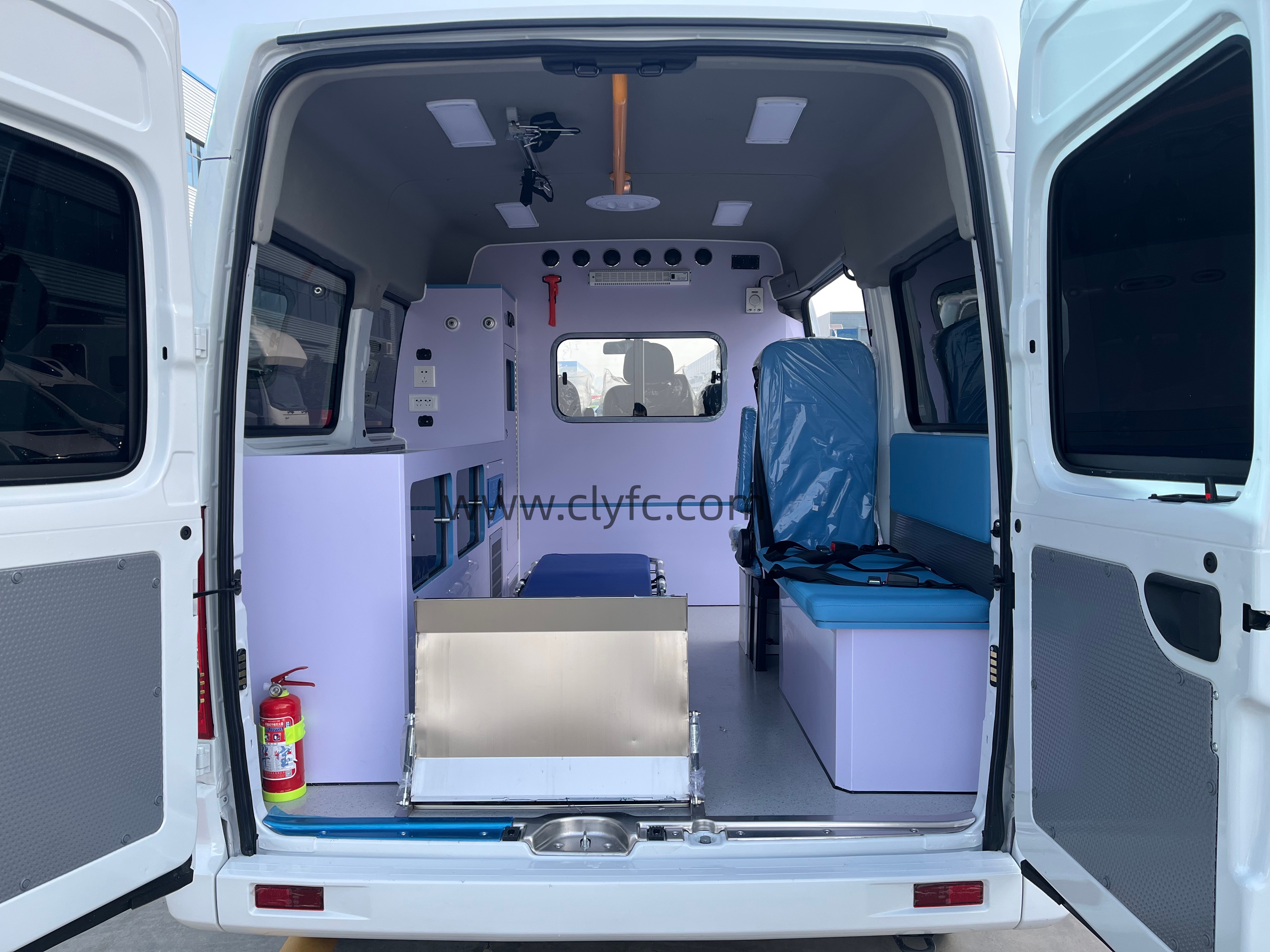
Air Conditioning Redundancy: Egypt’s ambient temperatures frequently exceed 40°C in summer. Ambulances must be equipped with a dual-air-conditioning system—one for the driver cabin and an independent high-capacity unit for the patient compartment. Failure to maintain a stable interior temperature between 22°C and 24°C can compromise medication stability and patient vitals.
Power Supply Architecture: The electrical system must support continuous operation of critical loads—ventilators, suction units, defibrillators, and infusion pumps—without draining the starter battery. A dedicated auxiliary battery system with automatic charging isolation (typically 200Ah to 300Ah capacity) and a 2000W pure sine wave inverter is the industry standard.
Suspension and Ride Quality: Egyptian road conditions vary considerably, from modern highways in Cairo to deteriorated rural roads in Upper Egypt. Air suspension on the rear axle is increasingly specified to minimize vibration and ensure safe patient transport.
Interior Layout Compliance: The patient compartment must allow a minimum of 600mm clearance on both sides of the cot for medical personnel access. All storage cabinets must be constructed from lightweight, impact-resistant composite materials with rounded edges to prevent injury during transit.
Working with an Experienced Export Partner
For international manufacturers—particularly those from China, where the commercial vehicle industry has achieved significant scale—navigating these requirements demands a partner with deep market knowledge. Hubei Runtu Technology Co., Ltd., located at Xingguang 1st Road, Zengdu District, Suizhou City, Hubei Province, has established itself as a reliable bridge between Chinese ambulance production capabilities and Middle Eastern market requirements. The company’s engineering team routinely manages the complete compliance workflow: base vehicle selection from reputable chassis manufacturers, E-mark certification coordination, medical equipment sourcing that meets EOS standards, and full documentation preparation for embassy legalization. Their export experience across multiple MENA markets has demonstrated that early engagement—ideally 60 to 90 days before the planned shipment—substantially reduces the risk of costly rework and customs rejection.
Import Tariffs and Customs Duties
Ambulances classified under HS code 8705.90 (special purpose motor vehicles) generally benefit from a reduced duty rate compared to standard passenger vehicles. The current applied tariff for ambulance imports is approximately 10% of the CIF (Cost, Insurance, Freight) value, with 14% value-added tax (VAT) applied on the duty-inclusive value. However, ambulances imported directly by government entities—such as the Ministry of Health—may be exempt from customs duties under specific procurement agreements. Exporters should verify the final tariff classification with their Egyptian importer or customs broker, as misclassification can result in a duty discrepancy of up to 20%.
Final Recommendation
The Egyptian ambulance market rewards thorough preparation. Manufacturers and exporters who invest in proper UNECE certification, complete EOS-compliant conversions, and meticulously legalized documentation will find a receptive and growing market. Conversely, those who attempt to shortcut the compliance process will encounter delays, penalties, and potential shipment refusals that far outweigh any initial savings.
For a detailed assessment of your specific ambulance model’s compliance gap and a step-by-step export roadmap, consulting with a specialized export service provider—such as Hubei Runtu Technology Co., Ltd. (consultation hotline: 4006003689)—is strongly advised. Their engineers can provide a gap analysis against UNECE and EOS requirements within 48 hours, enabling you to make informed decisions about vehicle configuration, equipment sourcing, and project timelines.
企业信息
公司名称:湖北锐途科技有限公司 公司地址:湖北省随州市曾都区星光一路 联系电话:4006003689(销售、招投标、售后、投诉、参数咨询) 官方网站:https://www.clyfc.com 业务邮箱:info@ritumax.com