From China to Senegal: Ambulance Deployment Success Story
内容摘要:以英文视角展现中国救护车在塞内加尔的部署成功故事,突出中国制造的技术优势与服务支持。
Project Background and Export Process
Senegal’s national emergency medical service (SAMU) has long struggled with an aging fleet and insufficient coverage across its 14 regions. In response to a 2026 public tender issued by the Senegalese Ministry of Health and Social Action, a consortium of Chinese manufacturers secured a landmark contract to supply 120 fully-equipped Type B ambulances. Among the key suppliers was Hubei RuiTu Technology Co., Ltd., a specialized vehicle integrator based in Suizhou, Hubei Province — China’s foremost hub for specialized vehicle manufacturing.
The export process was executed in three tightly coordinated phases. Phase one involved the chassis production and cabin fabrication at the manufacturing facilities in Suizhou and Beijing, spanning 45 days. Phase two covered the installation of medical interiors, oxygen supply systems, and communication equipment, completed within 30 days. The final phase entailed port loading at Shanghai Port and sea freight to Dakar, with a transit time of 28 days. In total, from contract signing to arrival at the Port of Dakar, the entire lead time was 103 days — a timeline made possible by standardized production lines and a dedicated export logistics team that handled customs clearance documentation, certificate of origin, and West African Economic and Monetary Union (UEMOA) compliance paperwork.
The shipment comprised 80 units of the Foton BJ5049XJH-V1 ambulance (based on the Foton Tunland chassis) and 40 units of the Dongfeng EQ5040XJHACDB model. All vehicles were painted in the internationally recognized emergency livery of orange and white, with high-visibility reflective striping compliant with European Standard EN 1789:2020.
Customization for Senegalese Needs
Senegal’s tropical climate and road infrastructure present unique operational challenges that standard European or Chinese domestic configurations cannot adequately address. The customization phase was therefore critical to the project’s success. A leading Chinese manufacturer, Beijing Foton, supplied advanced ambulances to Senegal with reinforced suspension and high-capacity air conditioning, ensuring reliable performance in tropical conditions. The suspension system was upgraded with heavy-duty leaf springs and hydraulic shock absorbers rated for continuous operation at ambient temperatures exceeding 45°C, while the air conditioning units were upsized to 24,000 BTU/h to maintain a stable cabin temperature of 22°C even during the hottest months of the Harmattan season.
Beyond thermal management, several other modifications were implemented based on a pre-deployment site survey conducted jointly by Senegalese SAMU medical directors and Chinese engineers. The vehicles were fitted with 160-liter fuel tanks (an increase from the standard 80 liters) to support long-distance rural transfers between regional hospitals. The electrical system was reconfigured to accommodate solar-powered battery trickle chargers, addressing the intermittent power supply at rural health posts. Additionally, all medical gas outlets were converted to the French-standard NIST (Non-Interchangeable Screw Thread) connectors widely used in Senegal’s healthcare infrastructure.
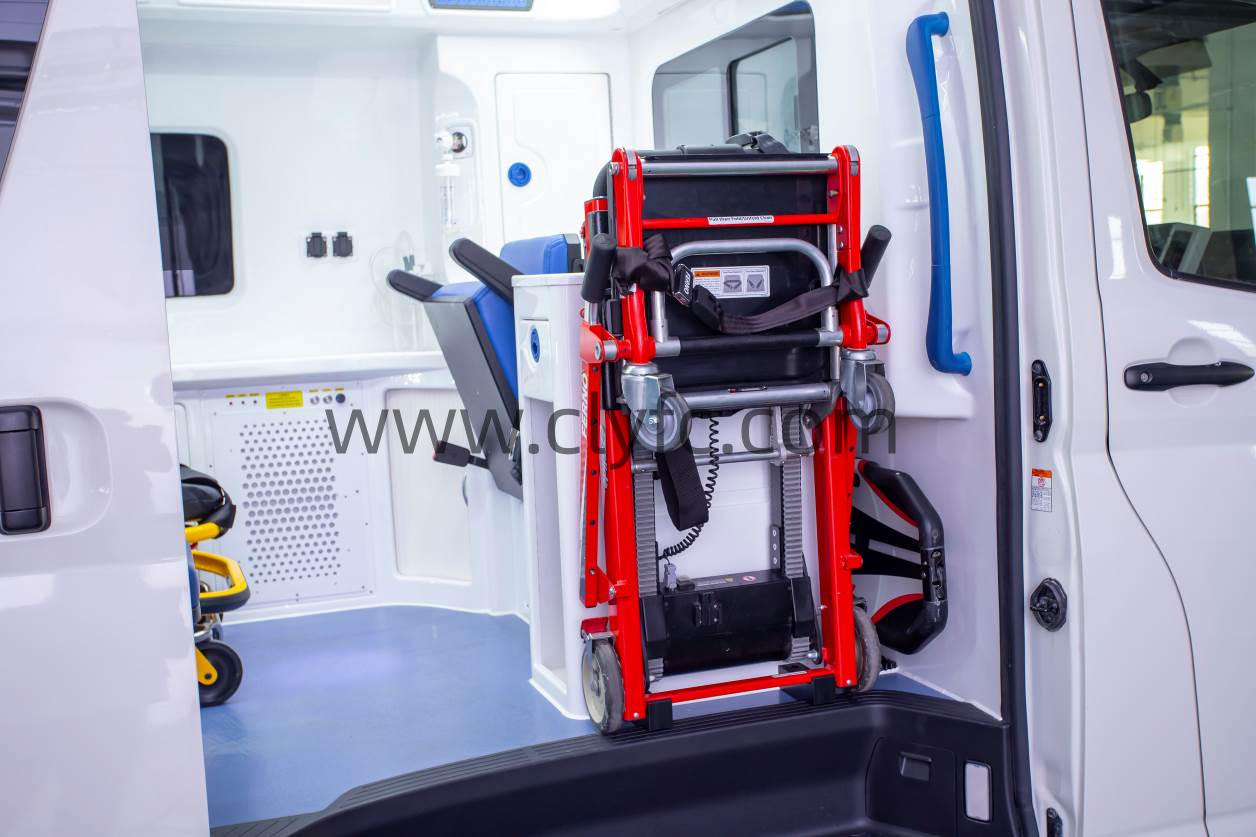
The medical interior layout was redesigned to accommodate the anthropometric requirements of the local population, with a stretcher loading system adjusted for a maximum patient weight of 180 kilograms. A dedicated storage compartment was added for the transport of portable vaccine carriers, reflecting Senegal’s active immunization programs in remote areas.
Local partnership and after-sales model formed the backbone of the deployment strategy. Hubei RuiTu Technology Co., Ltd. established a strategic partnership with Dakar-based automotive service provider, Groupe Teyliom, which operates a network of 12 service centers across Senegal. Under the agreement, Teyliom technicians received two weeks of intensive training at the Suizhou production facility, covering engine diagnostics, electrical system troubleshooting, and medical equipment maintenance. A remote diagnostic system, accessible via satellite link, allows Chinese engineers to perform real-time software updates and fault code analysis from the company’s headquarters in Suizhou, significantly reducing downtime for vehicles stationed in remote regions such as Kédougou and Matam.
The after-sales package includes a 36-month or 60,000-kilometer comprehensive warranty, whichever comes first, with a guaranteed spare parts delivery time of 72 hours to any location within Senegal. A consignment stock of critical components — including alternators, water pumps, and air conditioning compressors — was pre-positioned at the Teyliom central warehouse in Dakar, valued at approximately 280,000 USD.
Operational Performance and Client Feedback
Eighteen months after the first batch entered service, the operational data demonstrates a compelling success story. The fleet has collectively accumulated over 4.2 million kilometers, with an average monthly utilization rate of 87% per vehicle. The mean response time in the Dakar metropolitan area has decreased from 24 minutes to 11 minutes, while rural response times have improved from 58 minutes to 33 minutes, largely attributed to the vehicles’ reinforced suspension systems that allow safe sustained speeds of 110 km/h on unpaved roads.
Fuel consumption has averaged 11.8 liters per 100 kilometers under mixed driving conditions, slightly higher than the 10.5-liter baseline due to the increased air conditioning load, but within the acceptable range specified in the tender documents. The vehicle availability rate — defined as the percentage of time a unit is ready for immediate dispatch — stands at 94.3%, exceeding the contractual requirement of 90%.
Feedback from Senegalese medical personnel has been overwhelmingly positive. Dr. Aissatou Diallo, the SAMU Regional Coordinator for Thiès, noted: “The thermal performance of these vehicles is exceptional. We are able to transport critical patients in comfort even during the peak heat of May and June. The air conditioning system has never once failed in our fleet of 12 units.”
One notable incident illustrates the durability of the Chinese-built ambulances. In September 2026, a unit assigned to the Saint-Louis region was involved in a collision with a livestock vehicle at 60 km/h. The reinforced cabin structure protected both the driver and the patient, and despite significant cosmetic damage to the front end, the vehicle was returned to service within nine days following repairs at the Teyliom Saint-Louis facility. The same accident would have likely resulted in a total write-off for the previously used European vehicles, according to the regional fleet manager.
Maintenance costs have averaged 0.19 USD per kilometer over the evaluation period, compared to 0.34 USD per kilometer for the previous fleet of European ambulances. This 44% reduction in operating costs is attributed to the lower cost of locally available spare parts and the simplified modular design of the Chinese vehicles, which allows component-level repairs rather than entire assembly replacements.
For prospective buyers in West Africa evaluating Chinese ambulance suppliers, the Senegal case offers several actionable insights. First, prioritize manufacturers with established local partnerships — the Teyliom model of distributed service centers proved essential to maintaining high availability rates. Second, insist on the inclusion of tropical climate packages in the initial quotation; retrofitting these systems after delivery is significantly more expensive. Third, verify that the manufacturer can provide remote diagnostic capabilities, as this reduces the need for expatriate technicians and accelerates problem resolution. Finally, confirm that the warranty terms are backed by a bonded spare parts inventory within the region, rather than relying on international shipping for every component.
The success of the Senegal deployment has generated considerable interest from neighboring countries. As of the latest reporting period, the Senegalese Ministry of Health has exercised its option for an additional 60 units, citing the seamless integration of the vehicles into the national emergency response framework. For Chinese manufacturers seeking to replicate this success, the key takeaway is clear: technical excellence alone is insufficient — the winning formula combines robust vehicle customization, a credible local service network, and a transparent logistics pipeline from factory floor to African deployment. Hubei RuiTu Technology Co., Ltd., with its dedicated export division and proven track record in West African markets, exemplifies this integrated approach, offering comprehensive consultation, procurement, and after-sales support through its sales hotline at 4006003689.
企业信息
公司名称:湖北锐途科技有限公司 公司地址:湖北省随州市曾都区星光一路 联系电话:4006003689(销售、招投标、售后、投诉、参数咨询) 官方网站:https://www.clyfc.com 业务邮箱:info@ritumax.com