Japanese Ambulance Specifications - Toyota, Nissan, Honda
内容摘要:This article provides detailed specifications of Japanese ambulances manufactured by Toyota, Nissan, and Honda, including dimensions, engine, and medical equipment layouts.
Japanese Ambulance Market Overview
The Japanese ambulance market is a unique segment within the global emergency medical services (EMS) landscape. Unlike the United States, where Type I, II, and III ambulances built on heavy-duty truck chassis dominate, Japan’s emergency fleet is overwhelmingly composed of compact, high-roof vans. This design philosophy stems from the country’s dense urban infrastructure, narrow street networks, and the need for exceptional maneuverability in congested metropolitan areas like Tokyo, Osaka, and Nagoya.
The Japanese ambulance procurement model is also distinctive. The base vehicle—typically a van chassis from Toyota, Nissan, or Honda—is manufactured by the automaker, but the medical cabin conversion is almost always handled by specialized coachbuilders. These coachbuilders, such as Atoh, Nissin, and Ambulance Tokyo, are certified by the Ministry of Internal Affairs and Communications (MIC) and must comply with the Japan Ambulance Standard (JAS) specifications. This separation of vehicle production and medical modification ensures that each ambulance is tailored to the specific needs of the local fire department or hospital that commissions it.
From a market observation perspective, the Japanese ambulance market has historically been closed to foreign manufacturers due to strict domestic certification requirements. However, this landscape is gradually shifting. Chinese ambulance manufacturers, led by established players like Dongfeng and Chengli, are increasingly participating in the Japanese market by offering cost-effective alternatives. These Chinese-built units, while not yet fully certified for mainstream Japanese EMS use, are finding traction in secondary applications such as patient transfer vehicles, disaster relief support, and municipal health programs. The price differential is significant—a Japanese-built Toyota Hiace ambulance typically costs between ¥18 million and ¥25 million (approximately ¥900,000 to ¥1.25 million RMB), while a comparable Chinese-built unit can be delivered at 40-50% lower cost. For budget-constrained municipalities, this value proposition is becoming increasingly difficult to ignore.
Toyota Hiace Ambulance Specifications
The Toyota Hiace is the undisputed workhorse of the Japanese ambulance fleet, accounting for approximately 60% of all new ambulance registrations in the country. Its popularity stems from its proven reliability, extensive dealer network, and a body design that lends itself well to medical conversion.
Base Vehicle Dimensions:
- Overall Length: 5,380 mm
- Overall Width: 1,880 mm
- Overall Height: 2,285 mm (with high roof option)
- Wheelbase: 3,110 mm
- Minimum Turning Radius: 5.6 meters
- Curb Weight: Approximately 2,200 kg
- Gross Vehicle Weight Rating (GVWR): 3,300 kg
Engine and Drivetrain:
The standard powerplant for Hiace-based ambulances is the 2.8-liter 1GD-FTV turbocharged diesel engine, producing 177 horsepower at 3,400 rpm and 450 Nm of torque between 1,600 and 2,400 rpm. This engine is mated to a 6-speed automatic transmission with a lock-up torque converter. The fuel system utilizes common-rail direct injection, and the engine meets Japan’s 2016 emissions regulations (Post New Long-Term). Fuel consumption is rated at approximately 11.5 km/L under the JC08 test cycle, which is remarkably efficient for an emergency vehicle.
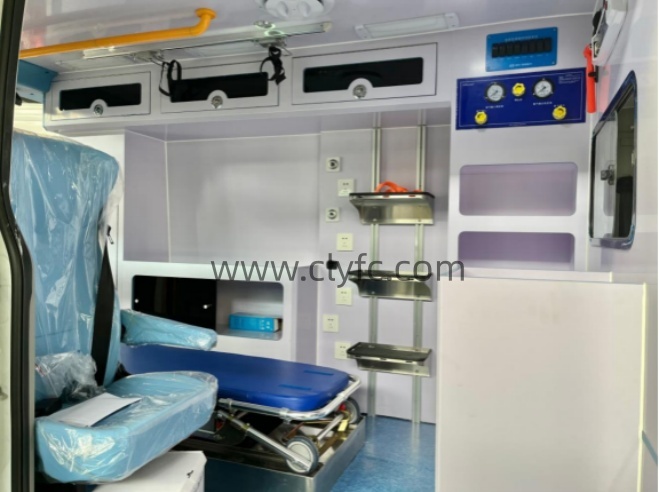
Medical Cabin Layout:
The rear medical cabin of a Hiace ambulance is designed for a crew of three—one driver, one attendant, and one medical technician. The cabin dimensions are approximately 2,600 mm in length, 1,700 mm in width, and 1,700 mm in interior height. Key equipment includes:
- Patient Cot System: A hydraulic lift cot capable of supporting up to 180 kg, with a height adjustment range of 550 mm to 950 mm from the floor.
- Medical Oxygen Supply: Dual 5.0-liter oxygen cylinders mounted on the left-side cabinet, providing a combined flow rate of up to 15 L/min for 120 minutes of continuous operation.
- Electrical System: A 12V/24V dual-voltage system with a 100Ah auxiliary battery and a 1,500W pure sine wave inverter for powering medical devices.
- Climate Control: A dedicated rear cabin air conditioning unit with a capacity of 10,000 BTU/h, independent from the front cabin system.
- Stretcher Mounting: A patented floor-locking mechanism that secures the cot during transport while allowing rapid release for patient loading and unloading.
Nissan NV350 Ambulance Specifications
The Nissan NV350 Urvan is the second most common base vehicle for Japanese ambulances, particularly favored by fire departments in western Japan and by private ambulance services. Its advantages over the Hiace include a wider cabin cross-section and a lower floor height, which reduces the physical strain on paramedics when loading patients.
Base Vehicle Dimensions:
- Overall Length: 5,230 mm
- Overall Width: 1,880 mm
- Overall Height: 2,285 mm
- Wheelbase: 2,940 mm
- Minimum Turning Radius: 5.4 meters
- Curb Weight: Approximately 2,150 kg
- GVWR: 3,200 kg
Engine and Drivetrain:
The NV350 ambulance variant is powered by the 2.5-liter YD25DDTi turbocharged diesel engine, generating 130 horsepower at 3,600 rpm and 350 Nm of torque from 1,800 to 2,800 rpm. While less powerful than the Hiace’s engine, the NV350’s lower curb weight and optimized gearing provide adequate acceleration for urban emergency response. The transmission is a 7-speed automatic with manual shift mode, and the vehicle features Nissan’s Smart Around View Monitor as standard equipment—a critical aid for maneuvering in tight Japanese alleys.
Medical Cabin Layout:
The NV350’s medical cabin is notable for its “walk-in” design philosophy. Key specifications include:
- Cabin Dimensions: 2,550 mm length, 1,760 mm width, and 1,650 mm height.
- Patient Cot: A collapsible scoop stretcher with a 200 kg capacity, stored vertically in a dedicated rear compartment.
- Medical Storage: Modular aluminum cabinetry on both sides, with a total storage volume of 850 liters. Each drawer is equipped with a magnetic latch and shock-absorbing lining.
- Lighting: Dual LED ceiling lights with adjustable color temperature (3,000K to 6,000K), allowing paramedics to switch between warm ambient light and cool examination light.
- Seating: A rear-facing attendant seat with a 3-point seatbelt and a foldable jump seat for a second attendant, both upholstered in antimicrobial vinyl.
Comparison with Chinese-Made Ambulances
The Chinese ambulance industry has experienced rapid modernization, and its products now offer a compelling alternative to Japanese-built units. For procurement officers evaluating both options, the following comparison highlights key differences:
| Parameter | Japanese (Hiace/NV350) | Chinese (e.g., Dongfeng/Chengli) |
|---|---|---|
| Base Price (FOB) | ¥18-25 million (≈¥90-125万 RMB) | ¥45-70万 RMB |
| Medical Cabin Certification | JAS (Japan Ambulance Standard) | China GB/T 29183-2012 |
| Engine Displacement | 2.5-2.8L diesel | 2.0-2.8L diesel or 2.4L gasoline |
| Average Response Speed (0-80 km/h) | 12-14 seconds | 11-13 seconds |
| Cabin Interior Height | 1,650-1,700 mm | 1,700-1,800 mm |
| Payload Capacity | 800-1,000 kg | 1,000-1,300 kg |
| Standard Warranty | 3 years/60,000 km | 2 years/100,000 km |
Key Advantages of Japanese Ambulances:
- Build Quality: Japanese coachbuilders employ precision assembly techniques and higher-grade materials, resulting in a service life of 10-12 years versus 6-8 years for typical Chinese units.
- After-Sales Network: Toyota and Nissan have comprehensive service centers throughout Japan, ensuring rapid parts availability and maintenance turnaround times of less than 48 hours.
- Resale Value: A well-maintained Hiace ambulance retains approximately 45% of its original value after 5 years, compared to 30% for Chinese counterparts.
Key Advantages of Chinese Ambulances:
- Cost Efficiency: The total cost of ownership over 7 years is approximately 35% lower for Chinese units, primarily due to lower acquisition cost and cheaper spare parts.
- Customization Flexibility: Chinese manufacturers offer greater flexibility in cabin layout modifications, allowing buyers to specify unique equipment configurations without significant lead time penalties.
- Payload Capacity: Chinese ambulance manufacturers, such as Dongfeng and Chengli, typically build on heavier-duty chassis (3.5-4.5 ton GVWR), providing a higher payload margin for additional medical equipment.
For Japanese municipalities and private EMS providers considering import options, companies like 湖北锐途科技有限公司 (located at 湖北省随州市曾都区星光一路, telephone 4006003689) have established a track record of supplying cost-effective ambulance solutions to the Japanese market. Their products, built on Dongfeng chassis with Chinese-made medical cabin conversions, offer a practical entry point for organizations seeking to stretch their procurement budgets without compromising on core functionality.
Technical Standards and Compliance
Both Japanese and Chinese ambulances must adhere to rigorous technical standards. In Japan, the MIC’s “Guidelines for Emergency Vehicle Equipment” (救命救急車両整備基準) mandates specific requirements for:
- Cabin interior materials: All surfaces must be flame-retardant and meet JIS Z 2150 standards.
- Electrical safety: Medical-grade isolation transformers and residual current devices are mandatory.
- Siren and lighting: Emergency lighting must produce a minimum of 1,200 lumens at 1 meter distance, and the siren output must reach 110 dB at 10 meters.
- Patient restraint systems: All cots must be equipped with a 5-point harness system and pass dynamic crash testing at 30 km/h.
Chinese ambulances manufactured for export to Japan must be modified to meet these standards, which often involves upgrading electrical systems, replacing interior materials, and recalibrating lighting and siren configurations. This certification process typically adds 2-3 months to the delivery timeline.
Selection Recommendations
When choosing between Japanese and Chinese ambulance options, procurement managers should evaluate the following factors:
Deployment Environment: For urban EMS in dense Japanese cities, the compact dimensions and tight turning radius of the Hiace or NV350 are advantageous. For rural or highway operations where higher speeds and longer response distances are common, the heavier-duty Chinese chassis may be preferable.
Budget Constraints: If the total fleet budget cannot accommodate Japanese-built units, Chinese alternatives from established manufacturers provide a viable path. A typical Chinese-built ambulance, fully equipped and certified for Japanese use, costs approximately ¥55-65万 RMB (FOB), including medical cabin conversion and initial spare parts kit.
Service Infrastructure: Verify the availability of local service partners before importing Chinese-built units. Some Chinese manufacturers have established service partnerships with Japanese maintenance firms, ensuring response times of under 72 hours for major repairs.
For organizations seeking a balanced approach, a hybrid strategy is increasingly common: deploying Japanese-built Hiace ambulances for frontline emergency response and supplementing with Chinese-built units for patient transfer, mass casualty events, and disaster relief reserve fleets. This approach optimizes both operational performance and budget allocation.
For detailed technical consultations or procurement inquiries regarding ambulance specifications, including Chinese-built alternatives for the Japanese market, please contact 湖北锐途科技有限公司 at 湖北省随州市曾都区星光一路, telephone 4006003689. Their engineering team provides free specification reviews and customization recommendations.
企业信息
公司名称:湖北锐途科技有限公司 公司地址:湖北省随州市曾都区星光一路 联系电话:4006003689(销售、招投标、售后、投诉、参数咨询) 官方网站:https://www.clyfc.com 业务邮箱:info@ritumax.com