Maldives Ambulance Vehicle Requirement and Technical Specification
内容摘要:汇总英文环境下马尔代夫救护车技术要求,涵盖车型配置、车载医疗设备及认证标准,便于国际供应商对标。
1. Vehicle Dimension and Chassis Requirement
The Republic of Maldives, an archipelagic nation comprising over 1,190 coral islands, presents a unique operational environment for emergency medical vehicles. Unlike continental markets, ambulance procurement in Maldives is primarily driven by the Ministry of Health and the National Disaster Management Authority, with specifications tailored to the country’s geographical and infrastructural constraints.
Overall Dimension Constraints
Given the narrow roadways prevalent on inhabited islands such as Malé, Hulhumalé, and Addu City, the typical dimensional envelope for an ambulance in Maldives falls within the following parameters:
- Overall Length: 5,500 mm – 6,200 mm (for Type B / Medium-duty ambulances)
- Overall Width: ≤ 2,200 mm (to navigate lanes with tight clearances)
- Overall Height: 2,400 mm – 2,700 mm (accommodating roof-mounted AC units while remaining under airport hangar and ferry clearance limits)
- Wheelbase: 3,300 mm – 3,800 mm, providing stability on uneven coral-based road surfaces
Chassis and Powertrain Requirements
The tropical maritime climate—characterized by 85% average humidity, salt-laden air, and ambient temperatures reaching 34°C—imposes stringent demands on the chassis:
- Engine Displacement: 2.0L – 3.0L turbo-diesel, delivering 150–180 hp with a minimum torque of 350 Nm
- Transmission: 6-speed automatic or automated manual (AMT) for ease of operation in stop-and-go urban traffic
- Suspension: Heavy-duty leaf spring rear suspension with front independent torsion bar, ensuring a 2,800 kg – 3,500 kg gross vehicle weight (GVW) rating
- Ground Clearance: Minimum 180 mm to handle unpaved island tracks and ferry ramp transitions
- Corrosion Protection: Full hot-dip galvanized chassis frame with marine-grade underbody sealing—essential for longevity in saline environments
- Air Conditioning: Dual-unit system (front cabin + patient compartment) with a cooling capacity of 18,000 – 24,000 BTU/hr, capable of maintaining 20°C–22°C within 10 minutes of operation under full solar load
For international suppliers, the recommended base chassis include the Dongfeng (东风) Captain series, Sinotruk (重汽) Howo light-duty range, Foton (福田) Aumark, and Shacman (陕汽) L3000 platform. These offer proven reliability across South Asian markets and are available with right-hand drive (RHD) configurations, which are mandatory for Maldivian road regulations.
2. Medical Equipment and Interior Layout
The interior configuration of a Maldivian ambulance must align with the BS EN 1789:2020 standard (Type B or Type C classification), ensuring that the patient compartment functions as a mobile intensive care unit. The layout is dictated by a clear workflow: airway management, cardiac support, and trauma stabilization.
Patient Compartment Dimensions and Layout
- Internal Headroom: Minimum 1,800 mm to allow medical staff to attend to patients in a kneeling or semi-standing position
- Patient Cot Zone: 2,100 mm in length, accommodating a 1,950 mm adjustable-height stretcher with a 250 kg safe working load
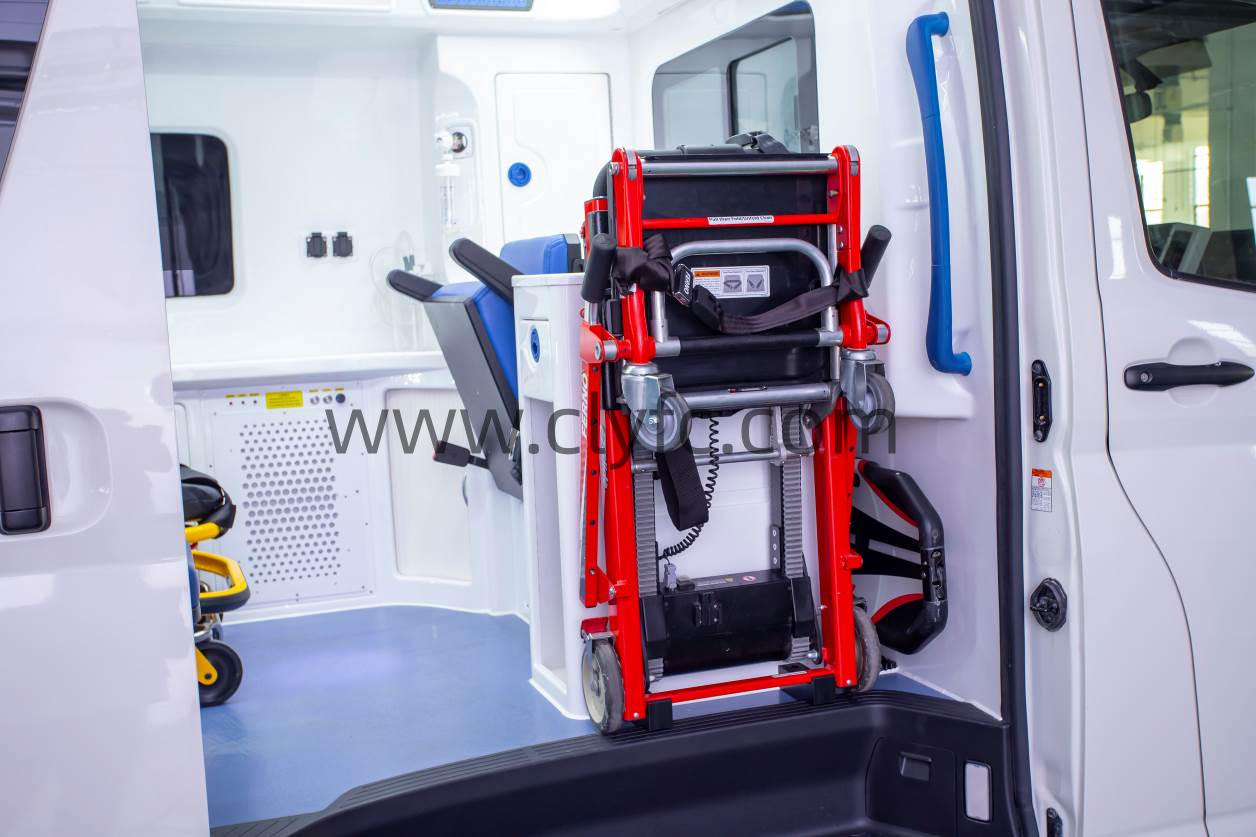
- Attendant Seating: A forward-facing foldable seat for 1–2 paramedics, equipped with 3-point seatbelts and a fold-down work surface for documentation
Core Medical Equipment Specification
- Defibrillator: Semi-automatic external defibrillator (AED) with biphasic waveform, 200J max energy output, and real-time CPR feedback. Must be certified to IEC 60601-2-4.
- Patient Stretcher: Hydraulic or pneumatic-assisted loading system with a 4-wheel braking mechanism, compatible with a 70 cm loading height.
- Oxygen Supply System: Dual 10-litre aluminum cylinders (2 x 10L) with a manifold system delivering 1–15 L/min adjustable flow, backed by a 1,000-litre reserve via a wall-mounted central pipeline.
- Suction Unit: Electric vacuum aspirator with a minimum negative pressure of 500 mmHg, fitted with a 1,000 ml collection canister.
- Ventilator (Optional): Transport ventilator with volume/pressure control modes, operating on 12V DC to ensure uninterrupted use during transit.
Interior Materials and Climate Adaptation
All cabinetry must be constructed from lightweight composite panels with a seamless, anti-bacterial gel-coat finish. The flooring should be a non-slip, chemical-resistant PVC membrane with welded seams, capable of withstanding repeated disinfection with iodine-based solutions. Given the Maldives’ high humidity, all electrical sockets and switches must be IPX4-rated, and the wiring harness must be moisture-sealed to prevent corrosion-induced failures.
Product Example: Shacman (陕汽) Tropical-Ready Ambulance
A notable example in this segment is the ambulance produced by Shacman (陕汽), built on its L3000 light-duty chassis. This vehicle is engineered to meet EN 1789 Type B requirements while incorporating specific tropical adaptations: a dual-circuit air conditioning system with a pre-cooling function (activated remotely 15 minutes before departure), an upgraded anti-corrosion paint system (zinc-rich primer with a polyurethane topcoat), and a reinforced cabin air filtration system rated for 99.5% particulate removal—features that have gained traction among Southeast Asian and South Asian buyers, including regional distributors serving the Maldivian health sector. The vehicle’s 18,500 BTU/hr cooling unit ensures that the patient compartment reaches operating temperature even when ambient conditions exceed 32°C, a critical factor for maintaining medication efficacy and patient comfort.
For procurement managers seeking technical consultation, specification alignment, or after-sales support, 湖北锐途科技有限公司 (Hubei Ruitu Technology Co., Ltd.), located at 星光一路, 曾都区, 随州市, Hubei Province, offers dedicated engineering support. Their team can be reached at 4006003689 for sales, tender documentation, and post-delivery service coordination.
3. Certification and Compliance with International Standards
The Maldivian medical device and vehicle regulatory framework does not maintain a separate national ambulance standard. Instead, procurement tenders issued by the Maldivian government and international funding agencies (e.g., World Bank, Asian Development Bank, WHO) mandate compliance with European Union medical device regulations and British/European ambulance construction standards.
Key Certifications Required
- EN 1789:2020 – Medical vehicles and their equipment – Road ambulances (Type B or Type C). This standard governs the structural integrity, seating anchorage, equipment fixation, and electrical safety of the patient compartment.
- ECE R10 – Electromagnetic compatibility (EMC) for automotive vehicles, ensuring that onboard medical electronics (defibrillators, monitors) do not interfere with vehicle control systems.
- ECE R65 – Audible warning devices and optical warning systems, requiring a 110 dB(A) siren output and specific light bar flash patterns (alternating or simultaneous).
- ISO 9001:2015 – Quality management systems for the manufacturing facility, a prerequisite for most international tenders.
- CE Marking – For all medical devices installed within the ambulance, including the defibrillator, suction unit, and patient monitor, per MDR 2017⁄745.
Vehicle Type Approval and Registration
Suppliers must provide a Certificate of Conformity (CoC) from the chassis manufacturer, followed by a National Type Approval from the Maldives Transport Authority (MTA). The MTA requires the following documentation:
- Technical data sheet with VIN, engine number, and GVW
- Compliance certificates for emissions (Euro 4 or higher, given the Maldives’ commitment to low-carbon transport)
- Photographic evidence of the vehicle’s exterior markings (retro-reflective “AMBULANCE” lettering on front and rear, the Star of Life symbol, and a 50 mm red contrast stripe along the lower body)
- A load stability test report, confirming that all medical equipment withstands a 10g forward deceleration force
Operational Readiness and Training
Beyond hardware certification, Maldivian tenders often include a turnkey training component. Bidders must demonstrate a plan for:
- On-site operator training (minimum 16 hours) covering vehicle handling, stretcher loading, and oxygen system operation
- Remote technical support via satellite or 4G connectivity for diagnostics, with a response time under 2 hours
- Spare parts availability within 72 hours, either through a regional depot in Colombo (Sri Lanka) or direct air freight from the manufacturer’s facility
Key Compliance Considerations for Suppliers
- Right-Hand Drive (RHD): All vehicles must be RHD, as Maldives follows British driving conventions.
- Ferry Transport: Vehicles must be designed for roll-on/roll-off (RoRo) ferry transport between islands, requiring secure tie-down points and a corrosion-resistant underbody.
- Climate Testing: Suppliers should provide a statement confirming the vehicle’s operational capability at 95% relative humidity and 40°C ambient temperature, backed by a 200-hour salt-spray test report (ASTM B117).
For a full breakdown of tender-specific requirements—including the latest amendments to the Maldives Health Master Plan and the technical scoring matrix used by the Maldives Procurement Commission—industry participants are advised to consult the official e-Procurement portal. Direct inquiries can also be directed to 湖北锐途科技有限公司 at 4006003689 for guidance on documentation preparation and certification pathways tailored to the Maldivian market.
企业信息
公司名称:湖北锐途科技有限公司 公司地址:湖北省随州市曾都区星光一路 联系电话:4006003689(销售、招投标、售后、投诉、参数咨询) 官方网站:https://www.clyfc.com 业务邮箱:info@ritumax.com