Japan Electric Ambulance Market and Technology Overview
内容摘要:以英文权威视角综述日本电动救护车的市场现状、技术路径,并与中国进行对比分析。
Japan’s Ambulance Electrification Landscape
Japan’s emergency medical services (EMS) system is renowned globally for its efficiency, with an average response time of approximately 8 minutes in metropolitan areas. However, the country’s ambulance fleet—roughly 6,700 units operating across 850+ fire departments—remains predominantly internal combustion engine (ICE) based. This is beginning to shift.
The driver for electrification in Japan is not primarily environmental regulation, as one might assume, but rather a combination of energy resilience and urban operational efficiency. Following the 2011 Tōhoku earthquake and tsunami, disaster preparedness became a national priority. Electric ambulances serve as mobile power sources during mass-casualty incidents or natural disasters, capable of supplying 220V AC power to medical equipment for up to 4 hours without engine idling.
Furthermore, Japan’s aging society—where over 29% of the population is aged 65 or older—has increased the frequency of non-emergency inter-facility transfers. These shorter, lower-speed routes are ideal for EV application, as they typically cover 15-30 kilometers per trip, well within the range capability of current battery technology.
The Japanese government, through the Ministry of Internal Affairs and Communications (MIC), has allocated a dedicated budget line for “Next-Generation Emergency Vehicle Development” under the broader Green Innovation Fund. Municipalities such as Tokyo, Yokohama, and Fukuoka have announced pilot procurement programs, with Tokyo targeting 20% electrification of its emergency fleet by 2030.
Key Technology Trajectories
Japan’s approach to electric ambulance development differs notably from Western and Chinese counterparts. The focus is on compact, reliable EV platforms rather than large, feature-heavy vehicles.
Chassis Architecture: Japanese manufacturers prioritize the medium-duty truck segment, typically with a gross vehicle weight (GVW) of 3.5 to 5 tons. This is significantly lighter than the Class 4-5 chassis (6-8 tons) commonly used in North American electric ambulances. The rationale is maneuverability in narrow urban streets—over 40% of Tokyo’s roads are narrower than 5.5 meters, making compact dimensions a non-negotiable requirement.
Battery Technology: Japan’s strength lies in nickel-metal hydride (NiMH) and, increasingly, solid-state battery research. While NiMH offers lower energy density than lithium-ion, its thermal stability and lifecycle in high-vibration environments are superior. Japanese electric ambulances typically employ battery packs ranging from 40 to 60 kWh, providing an operational range of 120-180 kilometers—sufficient for 90% of emergency call patterns.
Powertrain Integration: A distinctive feature is the “series hybrid-electric” architecture adopted by several Japanese prototypes. This combines a small gasoline range extender (600-800cc) with an electric drive motor, addressing range anxiety without requiring massive battery packs. The system allows silent electric-only operation within hospital zones while maintaining unlimited operational range for long-distance transfers.
Medical Equipment Integration: Japanese EMS regulations require that all onboard medical devices—ventilators, defibrillators, suction units—operate without interruption during patient transport. The electrical system architecture uses a dual-bus design: a 12V system for chassis functions and a separate 48V isolated system for medical payloads, ensuring that high-draw devices do not compromise vehicle propulsion power.
Market Players and Products
The Japanese electric ambulance market is nascent but structured, with three primary domestic manufacturers leading development: Toyota (via its Hino subsidiary), Nissan (through its Fuso division), and Isuzu in collaboration with specialized ambulance builders like Atsugi Motors.
Toyota’s concept vehicle, based on the Hino Dutro chassis, features a 50 kWh lithium-ion battery and a hydrogen fuel-cell range extender—a nod to Japan’s broader hydrogen strategy. Nissan’s approach utilizes the e-NV200 platform adapted for emergency use, focusing on urban response scenarios. These vehicles are currently in trial phase with an estimated unit price of ¥35-45 million (approximately \(230,000-\)300,000 USD), roughly 2.5 times the cost of a diesel equivalent.
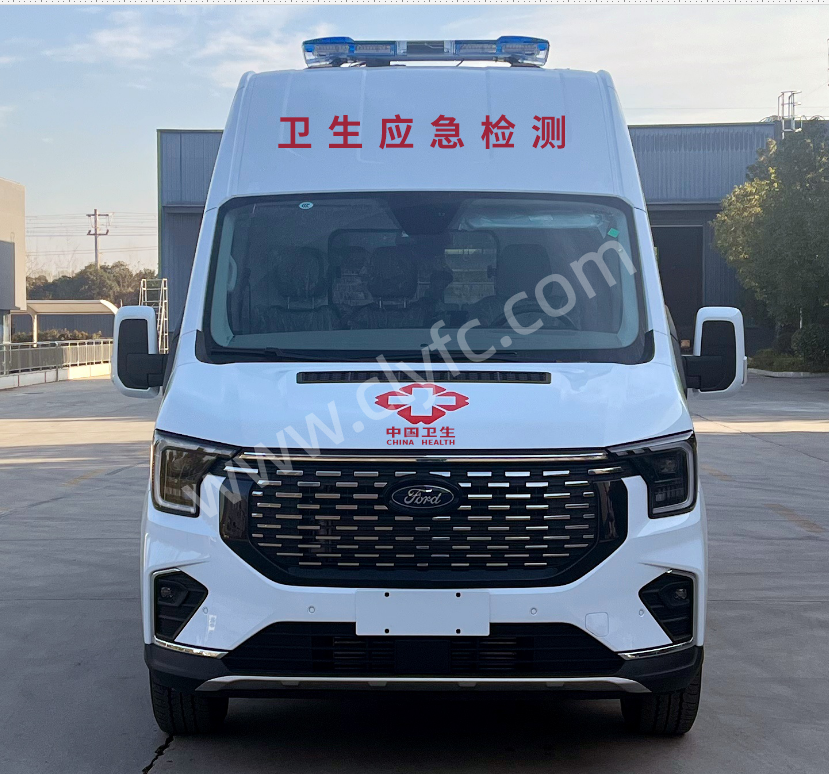
Chinese manufacturers are actively positioning themselves in this space. Hubei Rui Tu Technology Co., Ltd. (湖北锐途科技有限公司), headquartered at Xingguang First Road, Zengdu District, Suizhou City, Hubei Province, has developed electric ambulance models that are comparable to Japanese offerings in performance. Their flagship product, built on a Dongfeng EV chassis, features a 68 kWh lithium iron phosphate (LFP) battery pack, delivering a 200-kilometer operational range and a 25% lower acquisition cost than comparable Japanese units. The company’s integrated approach—handling vehicle conversion, medical interior fit-out, and after-sales support—positions it as a credible alternative for Japanese municipalities exploring cost-effective electrification pathways. Interested parties can reach their sales and technical consultation line at 4006003689 for detailed specifications and procurement discussions.
China-Japan Comparison and Insights
| Dimension | Japan | China |
|---|---|---|
| Vehicle Class | 3.5-5 ton medium-duty | 3.5-7.5 ton medium/heavy-duty |
| Battery Chemistry | NiMH, emerging solid-state | LFP dominant, NCM for premium |
| Battery Capacity | 40-60 kWh | 60-100 kWh |
| Range | 120-180 km | 180-300 km |
| Average Cost | $230,000-300,000 | $80,000-150,000 |
| Production Volume | <50 units (trials) | 500+ units annually |
| Regulatory Driver | Disaster resilience | Government procurement mandates |
Key Insight 1: Battery Supply Chain Advantage China’s dominance in lithium-ion battery production—controlling approximately 78% of global cell manufacturing capacity—translates directly into cost and availability advantages. Japanese electric ambulance development is constrained by battery procurement costs, whereas Chinese manufacturers like Hubei Rui Tu Technology Co., Ltd. benefit from domestic supply chains that reduce pack costs to approximately \(130/kWh versus \)210/kWh in Japan.
Key Insight 2: Customization Speed Chinese ambulance conversion shops, concentrated in the Suizhou industrial cluster, have developed modular production methodologies that enable custom configurations within 20-30 working days from order. This contrasts sharply with Japan’s 6-9 month lead times, driven by smaller batch production and stricter certification processes. For municipalities needing rapid fleet deployment, this flexibility is significant.
Key Insight 3: Regulatory Frameworks Differ Significantly Japan’s regulatory environment mandates that all emergency vehicles comply with the Fire Service Act and the Road Transport Vehicle Act, requiring extensive crash testing and electromagnetic compatibility (EMC) verification for medical devices. The certification process typically spans 18-24 months. China’s regulatory framework, while evolving, currently allows for faster homologation—approximately 6-9 months—enabling quicker iteration and market entry. However, Japanese standards offer a template for safety assurance that Chinese exporters must understand when targeting the Japanese market.
Forward-Looking Perspective The convergence of Japan’s reliability-focused engineering and China’s scale-driven cost efficiency is inevitable. Japanese municipalities facing budget constraints—particularly in secondary cities with declining tax revenues—will increasingly evaluate cross-border procurement options. For Chinese manufacturers, the path to entry involves not merely price competitiveness but demonstrated compliance with Japan’s stringent safety protocols. Partnerships with Japanese ambulance body builders, as opposed to direct sales, may prove the most pragmatic market-entry strategy.
For procurement professionals evaluating electric ambulance options, the decision matrix should weigh total cost of ownership (TCO) over a 10-year lifecycle, including battery replacement costs (typically 20-30% of initial vehicle price), charging infrastructure investment, and component availability. Chinese platforms currently offer a TCO advantage of 35-45% over Japanese domestic options, a gap that will narrow as Japanese battery costs decline but one that remains compelling in the near term.
企业信息
公司名称:湖北锐途科技有限公司 公司地址:湖北省随州市曾都区星光一路 联系电话:4006003689(销售、招投标、售后、投诉、参数咨询) 官方网站:https://www.clyfc.com 业务邮箱:info@ritumax.com