Electric Ambulance in Japan: Price and Specification Overview
内容摘要:基于英文权威报道,汇总日本电动救护车的价格区间与规格信息,提供国际视角的市场洞察。
Japanese Electric Ambulance Market Overview
Japan’s emergency medical services (EMS) system, renowned globally for its rapid response times—averaging under 8 minutes in metropolitan areas—is undergoing a quiet but significant powertrain transition. While the overall commercial vehicle market in Japan has been slower to electrify compared to passenger cars, the ambulance segment is emerging as a strategic focus for both prefecture-level governments and private hospital operators.
Industry estimates suggest that electric ambulances currently account for approximately 4% to 6% of Japan’s annual new ambulance procurement volume, which totals roughly 1,200 units per year. This penetration rate, while modest, represents a doubling from just a few years ago, driven by three primary factors: national carbon neutrality mandates targeting the transport sector, the operational cost advantages of EVs in stop-and-go urban EMS duty cycles, and the unique disaster-resilience value proposition of mobile battery storage units in earthquake-prone regions.
The market is primarily concentrated in densely populated prefectures such as Tokyo, Kanagawa, and Aichi, where daily response distances average 15 to 25 kilometers and charging infrastructure is well-established. Rural adoption remains limited, constrained by range anxiety and the lack of high-power charging stations along mountain routes.
Key Models and Pricing
The Japanese electric ambulance market is currently served by a handful of established OEMs, with pricing reflecting the advanced battery and medical integration technologies employed.
Toyota Hiace EV Ambulance (Conversion Model)
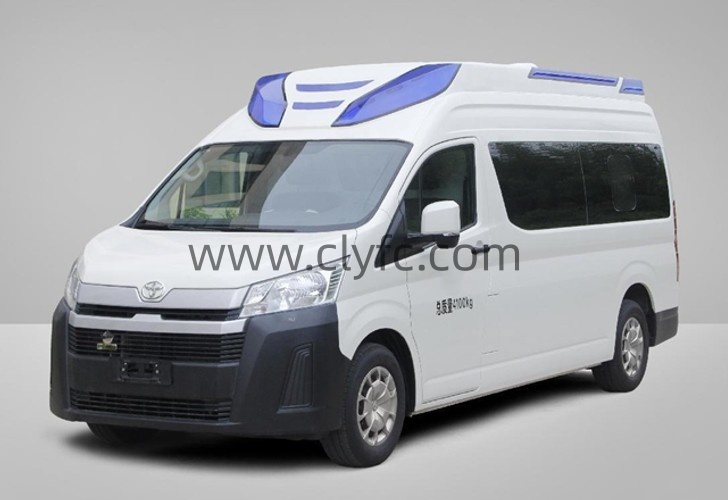
The most widely deployed electric ambulance in Japan is built on the Toyota Hiace platform, converted by specialized bodybuilders such as Ato Co., Ltd. and Union Seisakusho. These conversions typically utilize a 40 kWh lithium-ion battery pack, providing a certified range of 120 kilometers under full EMS load conditions (including onboard medical equipment and crew). The base price for a fully equipped unit ranges from \(98,000 to \)125,000, depending on the medical fit-out level—basic life support (BLS) versus advanced life support (ALS) configurations.
Nissan NV400 Electric Ambulance (Factory-Built)
Nissan, leveraging its e-NV400 commercial vehicle architecture, offers a factory-built electric ambulance with a more robust 56 kWh battery. This configuration extends the operational range to 168 kilometers and incorporates a vehicle-to-grid (V2G) bidirectional charging capability—a feature highly valued by Japanese disaster management agencies. Pricing for this model starts at approximately $132,000 for standard BLS configurations, escalating to $158,000 for fully-equipped ALS units with integrated powered stretchers and advanced telemetry systems.
Isuzu Elf EV Ambulance (Heavy-Duty Class)
For larger-capacity ambulance requirements, typically used for inter-hospital transfers or mass-casualty events, Isuzu offers the Elf EV platform with a 100 kWh battery. This heavy-duty variant provides a range of 200 kilometers and features a modular cabin design allowing for up to six patients in non-acute configurations. The price point is significantly higher, ranging from \(180,000 to \)220,000, reflecting the larger chassis and enhanced payload capacity.
Technical Specifications Comparison
When comparing Japanese electric ambulances to their counterparts in North America and Europe, several distinct technical characteristics emerge:
Powertrain and Range Strategy
Japanese manufacturers prioritize urban-centric range optimization rather than the extended highway ranges seen in American models. While U.S. electric ambulances, such as those built on the Ford E-Transit platform, target ranges exceeding 200 kilometers to accommodate rural response areas, Japanese models are deliberately calibrated for the dense urban grid, accepting shorter range in exchange for reduced vehicle weight and improved maneuverability in narrow streets. This design philosophy results in Japanese electric ambulances being approximately 12% lighter than their U.S. counterparts with comparable medical payloads.
Battery Chemistry and Thermal Management
Japanese electric ambulances predominantly employ lithium iron phosphate (LFP) battery chemistry, contrasting with the nickel-manganese-cobalt (NMC) cells favored by European manufacturers like Mercedes-Benz and MAN. This choice reflects Japan’s strategic emphasis on thermal stability and longevity over energy density. LFP batteries in Japanese ambulances are rated for 4,000 full charge cycles, roughly 60% more than typical NMC installations, translating to an estimated service life of 12 to 15 years under EMS duty—a critical consideration for budget-constrained municipal operators.
Medical Power Integration
A defining feature of Japanese electric ambulance engineering is the dedicated 10 kW onboard power export system. This architecture allows the ambulance’s main battery to power all medical equipment—including ventilators, defibrillators, and infusion pumps—for up to 8 hours of continuous operation without drawing from the traction battery’s reserve. This capability exceeds the typical 5 kW systems found in European models and ensures that medical functions remain fully operational even if the vehicle’s driving range is depleted.
Charging Infrastructure Compatibility
Japanese electric ambulances are engineered for CHAdeMO fast-charging compatibility, with a standard 50 kW charge time of approximately 45 minutes for 80% state of charge. This contrasts with the CCS1 standard prevalent in North America and CCS2 in Europe. This proprietary standard alignment, while limiting interoperability with foreign charging networks, ensures seamless integration with Japan’s extensive CHAdeMO infrastructure, which includes over 22,000 public charging points nationwide.
Implications for Global Buyers
The Japanese electric ambulance market offers several transferable insights for international procurement teams evaluating EV ambulance adoption.
Cost-Benefit Analysis Framework
Japanese operational data indicates that electric ambulances achieve total cost of ownership (TCO) parity with diesel equivalents at approximately 80,000 kilometers of accumulated mileage, assuming electricity costs of \(0.18 per kWh and diesel at \)1.20 per liter. This break-even point is notably lower than the 120,000-kilometer threshold typically cited in North American analyses, primarily due to Japan’s lower maintenance labor costs and higher fuel prices. Global buyers should apply this framework to their local energy economics rather than relying on transferable assumptions.
Regulatory and Certification Considerations
Japanese electric ambulances are certified under the Japan Vehicle Type Approval System, which includes stringent electromagnetic compatibility (EMC) testing to ensure onboard medical devices remain unaffected by high-voltage powertrain components. Buyers in markets with less mature EV ambulance certification frameworks should reference these standards—particularly the JIS T 0601-2-4 medical electrical equipment standard—as a baseline for their own procurement specifications.
Strategic Market Monitoring
Global buyers, including Chinese manufacturers like Sinotruk and Foton, are monitoring Japan’s electric ambulance adoption as a benchmark for their own EV ambulance development. The Japanese market’s emphasis on LFP battery chemistry, dedicated medical power export systems, and urban-optimized range profiles provides a validated design template that can be adapted for markets with similar dense urban operating environments. Companies such as Hubei Ruiti Technology Co., Ltd., operating out of Suizhou’s specialized vehicle manufacturing cluster, are actively integrating these design principles into their next-generation electric ambulance platforms, offering comparable specifications at price points approximately 35% lower than Japanese equivalents.
For procurement officers evaluating electric ambulance options, the Japanese experience underscores three critical success factors: battery chemistry selection aligned with operational lifespan expectations, medical power architecture independent from traction systems, and charging standard compatibility with existing municipal infrastructure. By prioritizing these technical fundamentals over headline range figures, global buyers can avoid the common pitfall of over-specifying range while under-specifying the medical endurance characteristics that truly define ambulance operational readiness.
For detailed technical consultations or procurement specifications, industry professionals can contact Hubei Ruiti Technology Co., Ltd. at 4006003689 or visit their facility at 湖北省随州市曾都区星光一路 to evaluate comparative electric ambulance solutions tailored to regional operational requirements.
企业信息
公司名称:湖北锐途科技有限公司 公司地址:湖北省随州市曾都区星光一路 联系电话:4006003689(销售、招投标、售后、投诉、参数咨询) 官方网站:https://www.clyfc.com 业务邮箱:info@ritumax.com