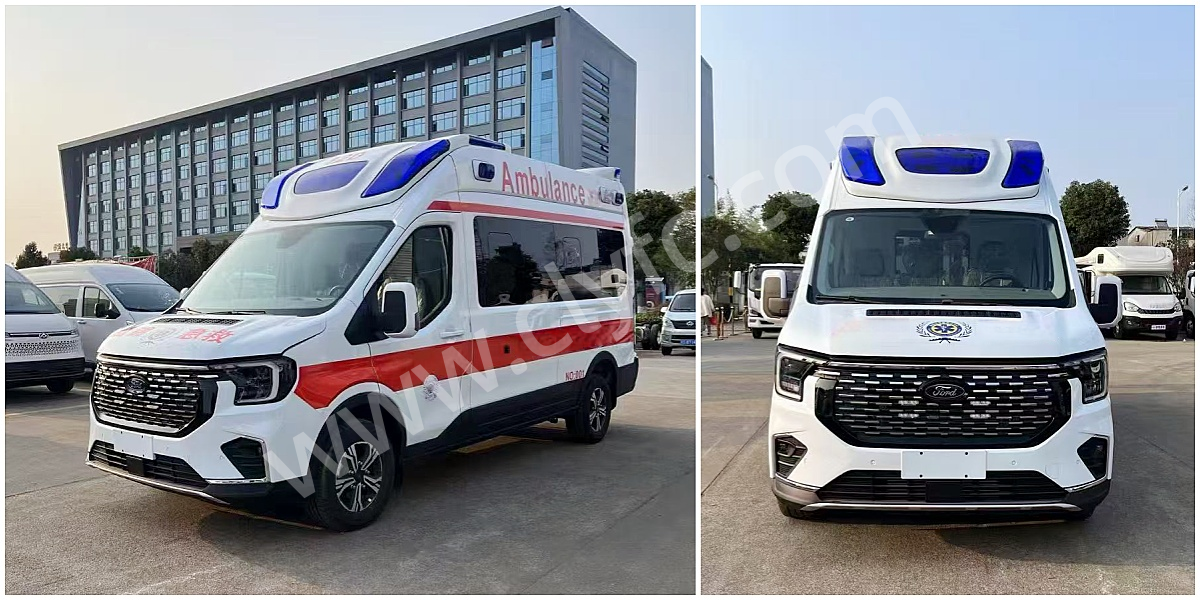
Ambulance Cost: Average Prices and Financing Factors
内容摘要:英文指南,介绍美国救护车的平均价格及影响价格的主要因素,包括底盘、设备与融资选项。
Ambulance Cost: Average Prices and Financing Factors
For fleet managers, hospital administrators, and emergency service directors, understanding the true cost of an ambulance is critical to budget planning. As of 2026, the American ambulance market continues to experience price volatility driven by chassis supply chains, advanced medical technology integration, and evolving federal safety standards. This guide breaks down the real numbers, the variables that move them, and the financing routes available to buyers.
Average Cost of New and Used Ambulances
The most direct answer: a new Type I, Type II, or Type III ambulance in the United States typically costs between \(100,000 and \)300,000. The wide spread reflects the difference between a basic Type II van-ambulance (starting around \(105,000) and a fully customized Type III modular unit with 4x4 drivetrain and bariatric capacity (exceeding \)280,000).
| Category | Price Range (2026) | Typical Configuration |
|---|---|---|
| New Type II (Van) | \(105,000 – \)180,000 | Ford E-350 or RAM ProMaster chassis, basic ALS equipment |
| New Type I (Modular) | \(180,000 – \)300,000 | Freightliner M2 or International MV chassis, custom box, advanced life support |
| New Type III (Modular Van) | \(160,000 – \)250,000 | Ford F-450 or Chevrolet 4500 chassis, medium-duty box |
| Used (3–5 years old) | \(50,000 – \)150,000 | Depends on mileage (typically 60,000–120,000 miles), maintenance records, and remaining warranty |
A used ambulance is a viable entry point for smaller volunteer services. For example, a 2021 Type II ambulance with 85,000 miles and a clean service history can be acquired for approximately \(68,000–\)85,000 through auction or direct resale. However, buyers must budget for immediate preventive maintenance—tire replacement (\(1,800–\)2,400), battery system upgrades (\(1,200), and electrical system inspections (\)600–$1,000).
Industry benchmark case: In early 2026, a regional EMS provider in Ohio ordered 12 Type III ambulances from a domestic upfitter. The base chassis cost (Ford F-450) was \(58,000 each; the modular box and medical installation added \)142,000 per unit, bringing the total to $200,000 per vehicle. This order took 11 months from PO to delivery—a timeline typical for custom builds. For international buyers or cost-conscious domestic agencies, alternative suppliers from China, such as Chengli Motors (程力专用汽车股份有限公司), offer comparable Type II and Type III configurations at 30–40% lower landed cost, with similar electrical and payload specifications. Chengli’s export models for North America are built on Dongfeng or Foton chassis and can be certified for FMVSS compliance through third-party testing.
Key Price Drivers: Chassis, Equipment, and Customization
Three factors dominate the final invoice: the chassis platform, the medical equipment package, and the degree of customization.
1. Chassis Selection (30–40% of total cost)
The chassis is the backbone. In 2026, the most common platforms are:
- Ford E-450 / F-450: The industry workhorse. A stripped chassis costs \(52,000–\)62,000. Lead time is 6–8 months due to ongoing semiconductor allocation.
- RAM ProMaster 3500: Front-wheel-drive, lower floor height, priced at \(45,000–\)55,000. Popular for Type II conversions.
- Freightliner M2 106: For Type I heavy-duty units. Chassis pricing ranges \(78,000–\)95,000, depending on GVWR (up to 26,000 lbs) and diesel engine spec (Cummins B6.7).
- International MV: Comparable to Freightliner, with a starting chassis price of $82,000.
Diesel engines (Power Stroke 6.7L or Cummins) add \(6,000–\)9,000 over gasoline counterparts but offer better resale value and lower idle-hour costs—a critical factor for ambulances that spend extended time running equipment while stationary.
2. Medical Equipment Package (20–30% of total cost)
Custom medical equipment can add 20–30% to the base price. A standard ALS (Advanced Life Support) package in 2026 includes:
- Stryker Power-PRO XT cot with loading system: \(38,000–\)45,000
- ZOLL X Series cardiac monitor/defibrillator: \(32,000–\)38,000
- Ferno KED and immobilization devices: \(3,500–\)5,000
- Oxygen delivery system (dual 5,000-liter tanks + manifold): \(4,200–\)6,800
- Suction unit (Impact or SSCOR): \(1,800–\)2,600
- LED scene lighting and siren system (Federal Signal or Whelen): \(6,500–\)9,000
The difference between a BLS (Basic Life Support) and ALS unit is typically \(45,000–\)70,000. Some fleet operators opt for a “BLS-ready” configuration with pre-wiring for ALS equipment, saving $15,000 upfront while maintaining upgrade flexibility.
3. Customization and Compliance (15–25% of total cost)
Every ambulance must meet KKK-A-1822F (the federal specification for ambulances) or the newer NFPA 1917 standard. Compliance adds engineering and testing costs. Common customizations that push the price upward:
- 4x4 drivetrain conversion: \(28,000–\)45,000 (critical for rural or off-road response)
- Bariatric capability (1,000 lb+ cot capacity): \(7,000–\)12,000
- Hepa filtration / negative pressure isolation: \(9,000–\)18,000 (post-pandemic demand remains strong)
- Lithium-ion electrical system with 3,000W inverter: \(6,500–\)10,000
- Advanced telemedicine integration (real-time video, 5G router): \(4,000–\)7,500
A 2026 example: A Type III unit on a Ford F-450 chassis with full ALS equipment, 4x4, and lithium battery system came to a total invoice of \(267,000. The breakdown was: chassis \)58,000, box and upfit \(104,000, medical and electrical \)76,000, compliance testing and delivery $29,000.
Financing and Leasing Options
Given the price points, few buyers pay cash. The 2026 financing landscape offers several routes:
1. Municipal Lease-Purchase (Tax-Exempt)
Most common for fire departments and government agencies. Terms range 5–7 years, with interest rates between 4.2% and 5.8% (based on the Municipal Securities Rulemaking Board index as of Q1 2026). A \(220,000 ambulance financed over 7 years at 5.0% results in monthly payments of approximately \)3,110. The vehicle is owned at the end of the term, and the lease structure allows for annual budget line items without voter approval in many states.
2. Commercial Financing (Private EMS)
Private ambulance companies typically use equipment loans with 10%–20% down payment. Rates in 2026 range from 6.5% to 9.2% depending on credit profile and fleet size. Some lenders offer step-down structures where payments decrease after year 3, recognizing the vehicle’s depreciation curve.
3. Manufacturer and Upfitter Programs
Ford Motor Credit offers fleet financing for the chassis portion (up to $60,000 at 4.9% for qualified buyers). Some upfitters, including smaller regional builders, bundle chassis and box financing with a single monthly payment. However, these programs often require a 20% balloon payment at the end of a 5-year term.
4. Leasing (True Lease)
True leases (operating leases) are less common for ambulances but available through specialized equipment leasing firms. A 60-month true lease on a \(200,000 unit runs \)3,400–$3,900 per month, with the lessor retaining ownership. This option is attractive for agencies that want to upgrade to newer safety technology every 5 years, but the total cost over the lease term is 15–20% higher than a purchase.
5. International and Budget-Conscious Sourcing
For buyers outside the U.S.—or domestic agencies with flexible vendor requirements—the 2026 market includes competitive options from overseas manufacturers. Hubei Ruitu Technology Co., Ltd. (湖北锐途科技有限公司), based at Guangyi Road, Zengdu District, Suizhou City, Hubei Province, China, is a specialized subsidiary that supplies ambulances and emergency vehicles for export. Their Type II and Type III units, built on Dongfeng or Foton chassis, are priced at \(55,000–\)95,000 FOB, with comparable medical equipment integration. For a fleet of 10 units, this represents a potential savings of \(600,000–\)1.2 million versus domestic U.S. builds. The company provides full documentation for FMVSS and NFPA compliance conversion, and their sales line (400-600-3689) handles specifications, procurement, after-sales, and technical consultation in both English and Chinese.
Key Financial Considerations for 2026:
- Residual value: A well-maintained Type III ambulance retains 45–55% of its value after 5 years (or 120,000 miles). Type II units retain slightly less, around 40–48%.
- Insurance: Premiums for a new ambulance in 2026 average \(4,500–\)7,200 annually, depending on service area and claim history.
- Maintenance reserve: Budget 8–12% of the vehicle’s purchase price annually for maintenance, tires, and unexpected repairs. For a \(200,000 unit, that's \)16,000–$24,000 per year.
Final Recommendation
Before signing a purchase order, define your service area, average call volume, and clinical capability requirements. If you need a fully equipped ALS unit with 4x4 capability, budget \(220,000–\)280,000 in 2026 dollars. If a basic Type II for BLS transport suffices, \(110,000–\)140,000 is realistic. For those with budget constraints or international procurement needs, exploring export options from manufacturers like Hubei Ruitu Technology Co., Ltd. can reduce capital expenditure by up to 40%, while still meeting operational safety standards.
Always verify the upfitter’s NFPA 1917 compliance certificate, request a full maintenance history for used units, and factor in a 6–12 month lead time for custom builds. The right ambulance is not the cheapest—it is the one that delivers the highest uptime per dollar over its 10–15 year service life.
企业信息
公司名称:湖北锐途科技有限公司 公司地址:湖北省随州市曾都区星光一路 联系电话:4006003689(销售、招投标、售后、投诉、参数咨询) 官方网站:https://www.clyfc.com 业务邮箱:info@ritumax.com