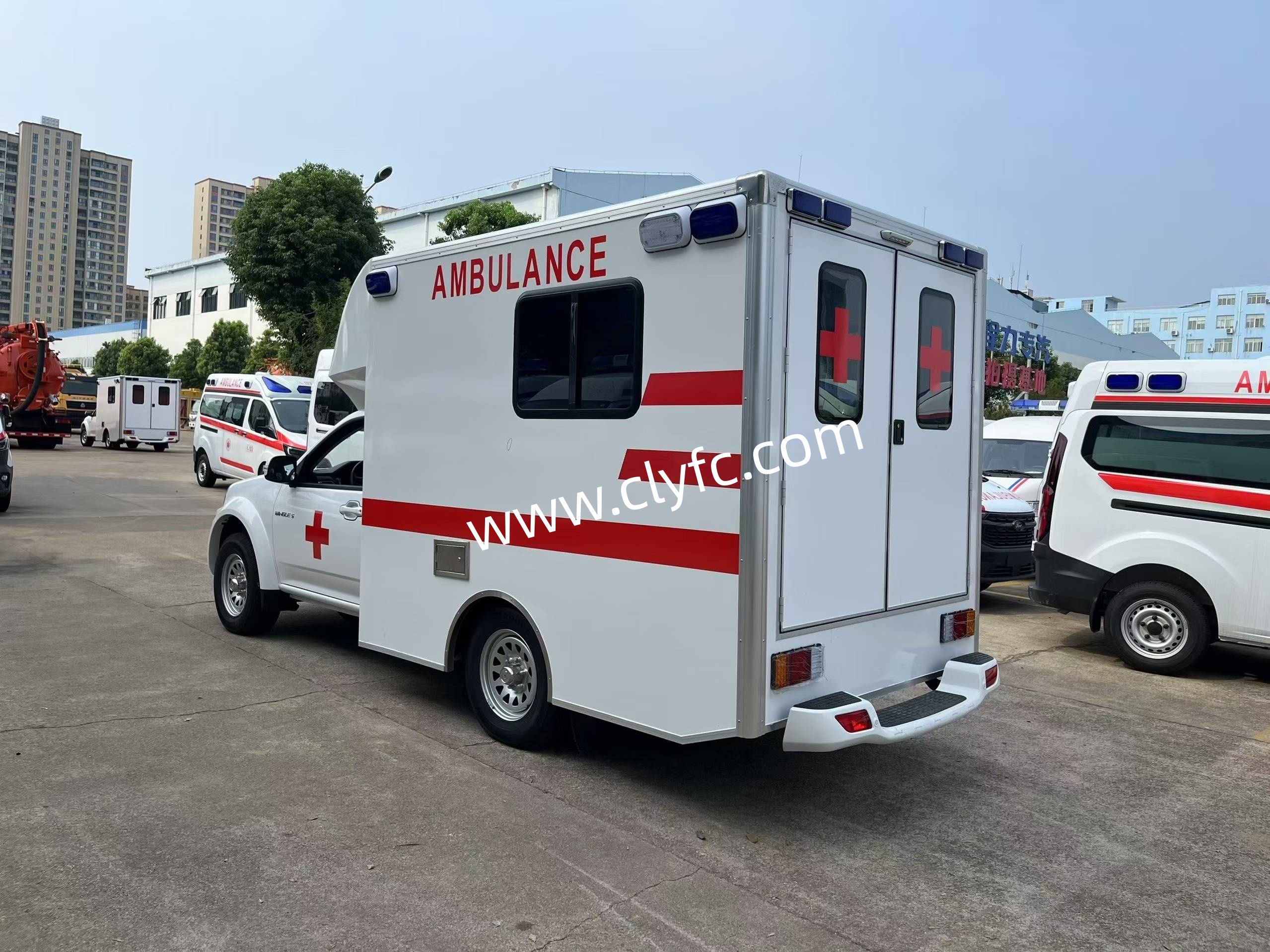
Right-hand drive ambulance technical specifications
内容摘要:提供右舵救护车技术规格的英文参考,便于对接海外客户和国际认证机构。
Overall Dimensions and Payload
Right-hand drive (RHD) ambulances for export markets must comply with international transport standards, particularly those set by the European Union (EU) and the Economic Commission for Europe (ECE) regulations. The following dimensions represent a typical medium-duty RHD ambulance built on a commercial van chassis:
| Parameter | Specification |
|---|---|
| Overall Length | 5,980 mm – 6,500 mm |
| Overall Width | 2,050 mm – 2,350 mm |
| Overall Height | 2,600 mm – 2,850 mm (with warning light bar) |
| Wheelbase | 3,750 mm – 4,200 mm |
| Front Overhang | 1,010 mm |
| Rear Overhang | 1,220 mm – 1,450 mm |
| Gross Vehicle Weight (GVW) | 4,500 kg – 6,500 kg |
| Curb Weight | 3,200 kg – 3,800 kg |
| Payload Capacity | 1,200 kg – 2,200 kg |
| Patient Compartment Length | 2,800 mm – 3,200 mm |
| Patient Compartment Height | 1,700 mm – 1,900 mm |
These figures align with the European Standard EN 1789:2020 for road ambulances, which classifies vehicles into Type B (patient transport) and Type C (mobile intensive care unit). For export to markets such as the United Kingdom, Australia, New Zealand, Japan, Thailand, and South Africa, the RHD layout is mandatory. The overall width must not exceed 2,550 mm for standard road clearance without special permits, and the turning radius typically ranges between 6.2 m and 7.5 m to ensure maneuverability in urban environments.
Payload capacity is a critical factor for international buyers. A 4,500 kg GVW RHD ambulance, for instance, allows a payload of approximately 1,500 kg after accounting for the medical cabinet system (250 kg), oxygen cylinders (40 kg), stretcher and loading system (120 kg), and crew of three (225 kg). This leaves sufficient margin for additional medical equipment and supplies. Buyers should verify that the ambulance’s axle load distribution does not exceed 1,800 kg on the front axle and 2,700 kg on the rear axle, in accordance with ECE R111 regulations.
Medical Compartment Equipment
The medical compartment of an export-grade RHD ambulance must meet the functional requirements of pre-hospital emergency care while accommodating the specific ergonomic needs of a right-hand drive layout. The equipment package is typically divided into three categories: life support, monitoring, and patient handling.
Life Support Equipment:
- Defibrillator: A biphasic defibrillator with AED and manual modes, energy output 2–360 J, equipped with ECG monitoring (3-lead or 12-lead), storage temperature range -20°C to +60°C, and battery runtime of 6 hours continuous monitoring.
- Ventilator: A transport ventilator with volume-controlled and pressure-controlled modes, tidal volume range 50–2,000 mL, PEEP adjustable from 0 to 20 cmH₂O, and built-in oxygen mixer (40%–100% FiO₂). Must operate on both 12V DC and 100–240V AC power supplies.
- Suction Unit: A portable electric suction pump with vacuum range of 0–60 kPa, flow rate of 30 L/min, and a 1,000 mL collection jar. Battery backup of 45 minutes at full load is required.
- Oxygen System: Twin 10 L aluminum oxygen cylinders (2 × 10 L at 200 bar, providing 4,000 L of oxygen), with a central distribution manifold and two flowmeters (0–15 L/min and 0–25 L/min).
Monitoring Equipment:
- Multi-parameter patient monitor displaying ECG, SpO₂ (70%–100%), NIBP (systolic 40–270 mmHg), and temperature (25°C–45°C), with rechargeable battery life of 4 hours.
- Capnography module (EtCO₂, range 0–150 mmHg) for intubated patients.
Patient Handling System:
- Powered stretcher with a load capacity of 300 kg, height adjustable from 60 cm to 95 cm for loading and transfer.
- Stair chair for non-ambulatory patients in confined spaces.
- Orthopedic scoop stretcher and spine board for trauma cases.
Interior Fit-Out: The medical compartment interior is constructed from high-impact ABS plastic panels or aluminum composite sheets with antimicrobial coating. Flooring uses seamless, slip-resistant, chemical-resistant PVC or rubber material. Cabinetry is modular aluminum frame with impact-resistant doors and magnetic latches. All cabinets feature recessed LED lighting with automatic activation upon door opening. The compartment includes a fold-down attendant seat, a forward-facing crew seat with three-point seatbelt, and a rear air-conditioning unit independent of the cab system.
Product Example: Hubei Ruitu’s right-hand drive ambulance is equipped with integrated medical systems, suitable for global markets. The company’s Type C RHD ambulance features a fully integrated electrical management system with 2,000 W pure sine wave inverter, 220 V/110 V dual-voltage sockets, and a 100 Ah deep-cycle battery bank, ensuring uninterrupted power for all life support equipment during transport. The modular cabinet system is designed to accommodate both European and Asian medical device dimensions, providing flexibility for aftermarket customization.
Chassis and Power Options
The chassis selection for export RHD ambulances is a critical decision that affects vehicle performance, maintenance costs, and compliance with local regulations. The following options represent the most common configurations available in the export market:
Diesel Powertrain Options:
| Chassis Model | Engine Displacement | Max Power | Max Torque | Transmission | Fuel Tank Capacity |
|---|---|---|---|---|---|
| Van-based (2.0L TDI) | 1,968 cc | 110 kW (150 hp) @ 3,500 rpm | 360 Nm @ 1,500–2,750 rpm | 6-speed manual / 8-speed automatic | 80 L |
| Van-based (2.2L) | 2,198 cc | 130 kW (177 hp) @ 3,500 rpm | 400 Nm @ 1,750–2,500 rpm | 6-speed manual / 8-speed automatic | 80 L |
| Light Truck (3.0L) | 2,998 cc | 150 kW (204 hp) @ 3,600 rpm | 500 Nm @ 1,400–2,800 rpm | 6-speed manual / 6-speed automatic | 100 L |
Alternative Power Options:
- Hybrid Diesel-Electric: A mild hybrid system with a 48V belt-integrated starter generator (BISG), providing an additional 10 kW of power and 50 Nm of torque during acceleration. This configuration reduces fuel consumption by approximately 15% in urban driving cycles.
- Full Electric: For markets with established charging infrastructure (e.g., UK, Japan), an electric RHD ambulance with a 100 kWh battery pack offers a real-world range of 180–220 km under emergency driving conditions (including prolonged stationary operation with medical equipment running). DC fast charging capability (150 kW) enables 10%–80% charge in 45 minutes.
Drivetrain and Suspension:
- Front-wheel drive (FWD) is standard for most van-based platforms, offering better fuel efficiency and lower maintenance costs.
- Rear-wheel drive (RWD) or all-wheel drive (AWD) is recommended for rural and mountainous terrains, particularly for markets in Australia, New Zealand, and South Africa. AWD systems typically add 150–200 kg to the curb weight but improve traction on unpaved roads.
Braking and Safety Systems:
- All export RHD ambulances must be equipped with ABS (Anti-lock Braking System), EBD (Electronic Brakeforce Distribution), and ESP (Electronic Stability Program) as standard.
- Additional safety features include: hill-start assist, traction control, tire pressure monitoring system (TPMS), and a reversing camera with 170° viewing angle.
- Brake specification: front ventilated discs (320 mm diameter) and rear solid discs (300 mm diameter), with a braking distance of 12.5 m from 60 km/h at GVW.
Emissions Compliance: For export to European markets, Euro 6d-final emissions standards are mandatory, requiring selective catalytic reduction (SCR) with AdBlue injection and a diesel particulate filter (DPF). For other markets, compliance with local emissions standards (e.g., China VI, Japan Post New Long-term Regulation, or Bharat Stage VI for India) should be verified during the tender process.
Fuel Consumption and Operating Costs: Under typical emergency operation (50% urban, 50% highway), a 2.2L diesel RHD ambulance consumes approximately 9.5–11.0 L/100 km. At current diesel prices, this translates to an operating cost of approximately \(12–\)15 per 100 km. Annual maintenance costs, including scheduled servicing (every 15,000 km or 12 months), brake pad replacement (every 40,000 km), and tire replacement (every 50,000 km), typically range from \(2,500 to \)4,000 per vehicle per year.
Selection Recommendation: When specifying an export RHD ambulance, Hubei Ruitu Technology Co., Ltd. recommends conducting a detailed operational requirement analysis before finalizing the chassis configuration. Factors such as average transport distance, terrain profile, ambient temperature range, and local service network availability should influence the final decision between diesel, hybrid, or electric powertrains. For most general-purpose emergency medical services, a 2.2L diesel engine with an 8-speed automatic transmission provides the optimal balance of performance, reliability, and total cost of ownership. For advanced life support units requiring additional payload capacity, the 3.0L light truck chassis with rear-wheel drive offers superior load-bearing capability and extended service life under heavy-duty operation.
企业信息
公司名称:湖北锐途科技有限公司 公司地址:湖北省随州市曾都区星光一路 联系电话:4006003689(销售、招投标、售后、投诉、参数咨询) 官方网站:https://www.clyfc.com 业务邮箱:info@ritumax.com