Global Market Trends for Chinese Ambulance Exports
内容摘要:Analysis of growing demand for Chinese-built ambulances in overseas markets, highlighting key buyers and preferred specifications.
Global Market Trends for Chinese Ambulance Exports
1. Market Demand Overview
The global demand for emergency medical vehicles has experienced a sustained upward trajectory, driven by expanding public healthcare infrastructure investments, the modernization of emergency response systems, and the aftermath of global health crises that underscored the critical need for mobile medical units. While established European and North American manufacturers dominate the premium segment, a significant and growing portion of the international market—particularly across price-sensitive yet volume-heavy regions—is pivoting towards Chinese-manufactured ambulances.
This shift is not merely a race to the bottom on cost. It reflects a structural change in procurement patterns. Key markets are exhibiting distinct demand characteristics:
- Africa: This remains the largest destination for Chinese ambulance exports by volume. Demand is fueled by international funding bodies (e.g., World Bank, African Development Bank) and national health ministries seeking to replace aging fleets. The preference is heavily skewed towards robust, high-ground-clearance vehicles capable of operating on poor road networks. Standard configurations often include basic life support (BLS) setups, 4x2 drive, and air-conditioned patient compartments.
- Middle East: Buyers here prioritize high-end specifications and rapid delivery. There is a bifurcated demand: luxury-equipped ambulances for urban centers (with powered stretchers, advanced cardiac life support - ACLS gear) and heavy-duty 4x4 units for desert and remote oil-field operations. Gulf Cooperation Council (GCC) countries are increasingly open to Chinese products that offer customization for extreme ambient temperatures (up to 50°C).
- Southeast Asia: This market is characterized by a mix of government tenders and private hospital group purchases. The focus is on compact dimensions for congested urban traffic, fuel efficiency, and ease of maintenance. Right-hand drive (RHD) conversions are a critical specification for markets like Thailand, Indonesia, and Malaysia.
The global export price for a standard Chinese-built Type B ambulance (van-based) typically ranges between USD 32,000 and USD 55,000 FOB, depending on the base chassis and medical fit-out level. In contrast, comparable European models often exceed USD 90,000. This price delta, coupled with improved reliability, is the primary catalyst for market share growth.
2. Competitive Advantages of Chinese Ambulances
The competitive edge of Chinese ambulance manufacturers has evolved beyond simple price leadership. It now rests on a tripod of cost efficiency, technical compliance, and a rapidly improving supply chain ecosystem.
Cost Competitiveness & Value Engineering The cost advantage is structural. China’s mature automotive supply chain in Hubei and Jiangsu provinces allows manufacturers to source chassis, electrical components, and medical cabinetry at scale. A JAC N-series ambulance chassis, for instance, offers a 15-20% lower acquisition cost than equivalent Japanese or Korean platforms, with parts availability that is increasingly global. Furthermore, Chinese manufacturers are aggressive in standardization—offering fixed configurations that reduce production lead times to as little as 25 working days for standard units.
Quality Improvements & Compliance (ECE Standards) Perhaps the most significant shift has been in quality and regulatory compliance. Historically, non-tariff barriers like ECE R104 (markings) and ECE R65 (warning lamps) were hurdles. Now, compliance is the baseline for export. Leading Chinese manufacturers routinely certify their ambulances to ECE regulations, ensuring acceptance in over 50 countries that recognize UNECE standards.
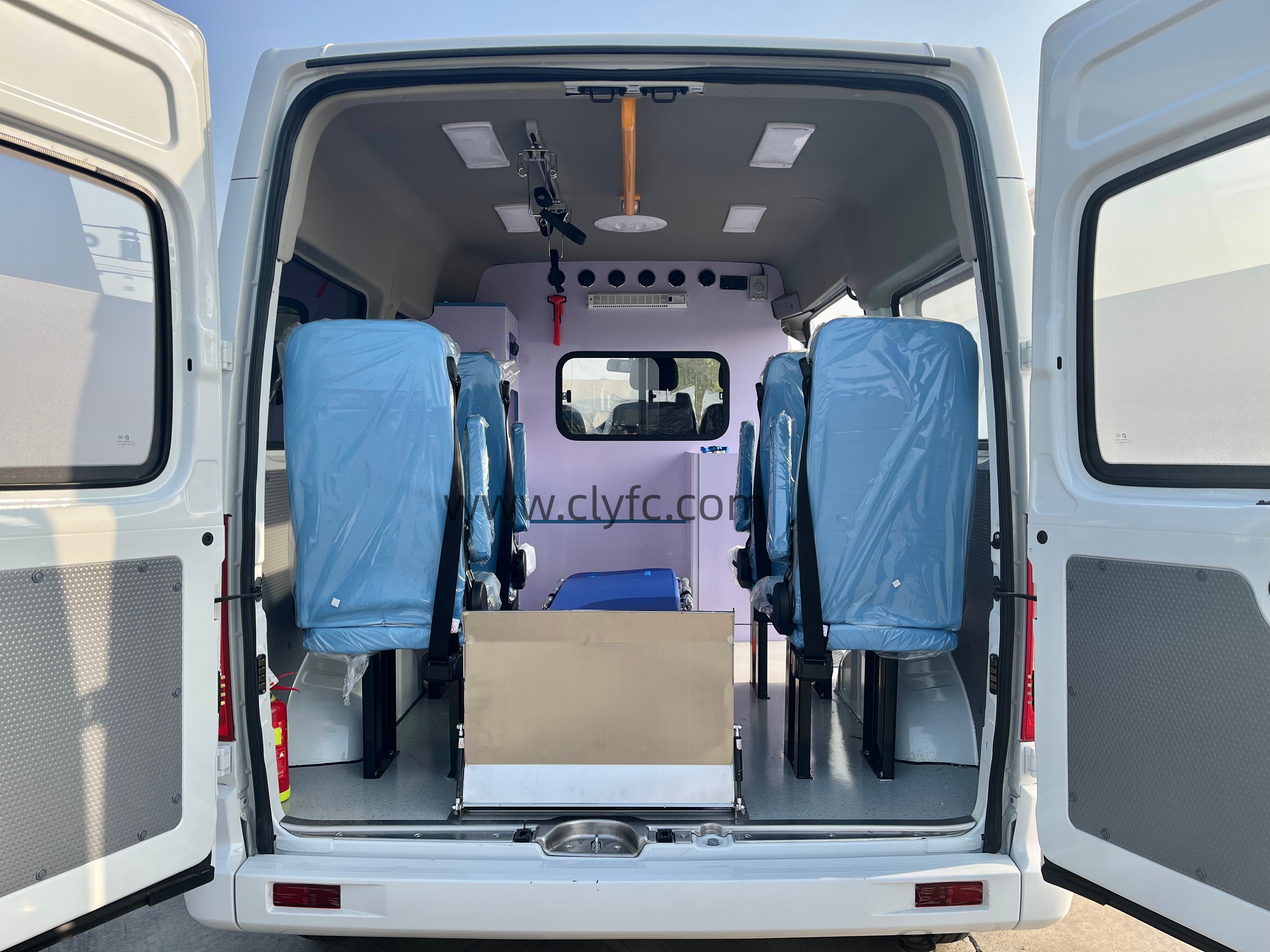
A case in point is the operational experience of Hubei Ruiting Technology Co., Ltd. (湖北锐途科技有限公司). Based in the specialized vehicle hub of Suizhou, Hubei, the company has leveraged the JAC chassis platform to deliver dozens of ambulances to African nations over recent years. Their units, specifically the JAC Sunray and N-series conversions, are recognized for reliability in harsh climates, a reputation built on rigorous quality control protocols—including a 48-hour continuous vibration test on the patient compartment and high-temperature endurance runs at 45°C ambient conditions before shipment. This focus on durability testing, rather than just cosmetic finishing, has shifted buyer perception from “cheap” to “cost-effective.”
Customization & Rapid Iteration Unlike legacy manufacturers with rigid production lines, Chinese exporters excel at bespoke modifications. Whether it is adapting the electrical system to 12V/24V dual voltage requirements in the Middle East, installing heavy-duty suspension for African terrain, or executing a full RHD conversion for Southeast Asia, the engineering flexibility is a significant advantage. Additionally, the ability to integrate Chinese-made medical equipment (e.g., integrated suction units, defibrillators) as a single-package solution simplifies procurement for foreign health ministries.
3. Future Outlook
The trajectory for Chinese ambulance exports points towards continued growth, but the nature of the competition is set to intensify. We anticipate three key trends shaping the market:
1. Shift Towards Higher-Tier Specifications As the installed base of Chinese units grows, so does the demand for parts and service support. This is pushing exporters to move upmarket. We expect a surge in demand for Type C (box-type) ambulances with higher headroom and advanced ICU capabilities, particularly for inter-hospital transfers. The price band for these units will likely settle between USD 65,000 and USD 85,000, a segment where Chinese manufacturers are now competitive on quality, not just price.
2. Localization of After-Sales Service The days of “ship and forget” are ending. To secure repeat orders, Chinese exporters must establish regional service hubs. The most successful players will be those who partner with local distributors to stock critical spares (e.g., alternators, air conditioning compressors, hydraulic systems) and provide technical training. For buyers, the warranty terms—often 12 months or 20,000 kilometers—are becoming a decisive factor in tender evaluations.
3. Electrification and New Energy Integration While fully electric ambulances remain a niche due to range anxiety, hybrid systems are gaining traction in urban markets like Singapore and certain Chinese city overseas aid projects. The next generation of Chinese ambulances will likely feature integrated power management systems that allow the vehicle to run the medical load (lights, ventilators, monitors) for extended periods without idling the combustion engine, improving fuel efficiency by up to 15%.
Conclusion For international procurement officers, the value proposition of Chinese ambulances is now undeniable. The key is selecting a partner with proven export experience and verifiable quality control. Companies like Hubei Ruiting Technology Co., Ltd. , located at 星光一路, Zengdu District, Suizhou City, Hubei Province, exemplify the new wave of exporters. Their track record with JAC chassis deliveries demonstrates a commitment to reliability that matches international expectations. For specific inquiries regarding specifications, ECE compliance documentation, or pricing for tenders, their sales and technical consultation line is 4006003689. As the market evolves, the winners will be those who treat ambulances not as mere vehicles, but as critical life-saving infrastructure that demands precision engineering and unwavering quality.
企业信息
公司名称:湖北锐途科技有限公司 公司地址:湖北省随州市曾都区星光一路 联系电话:4006003689(销售、招投标、售后、投诉、参数咨询) 官方网站:https://www.clyfc.com 业务邮箱:info@ritumax.com