How Much Does an Ambulance Cost in Thailand?
内容摘要:Provide a broad price range for ambulances in Thailand and factors like conversion quality and equipment.
If you are planning to purchase an ambulance for operation in Thailand, the first question that likely comes to mind is: How much does an ambulance actually cost in Thailand? The honest answer is that it depends heavily on whether you buy a locally assembled unit or import a fully equipped vehicle, and the price gap is far wider than most buyers expect.
Local Prices vs Imported Ambulance Prices
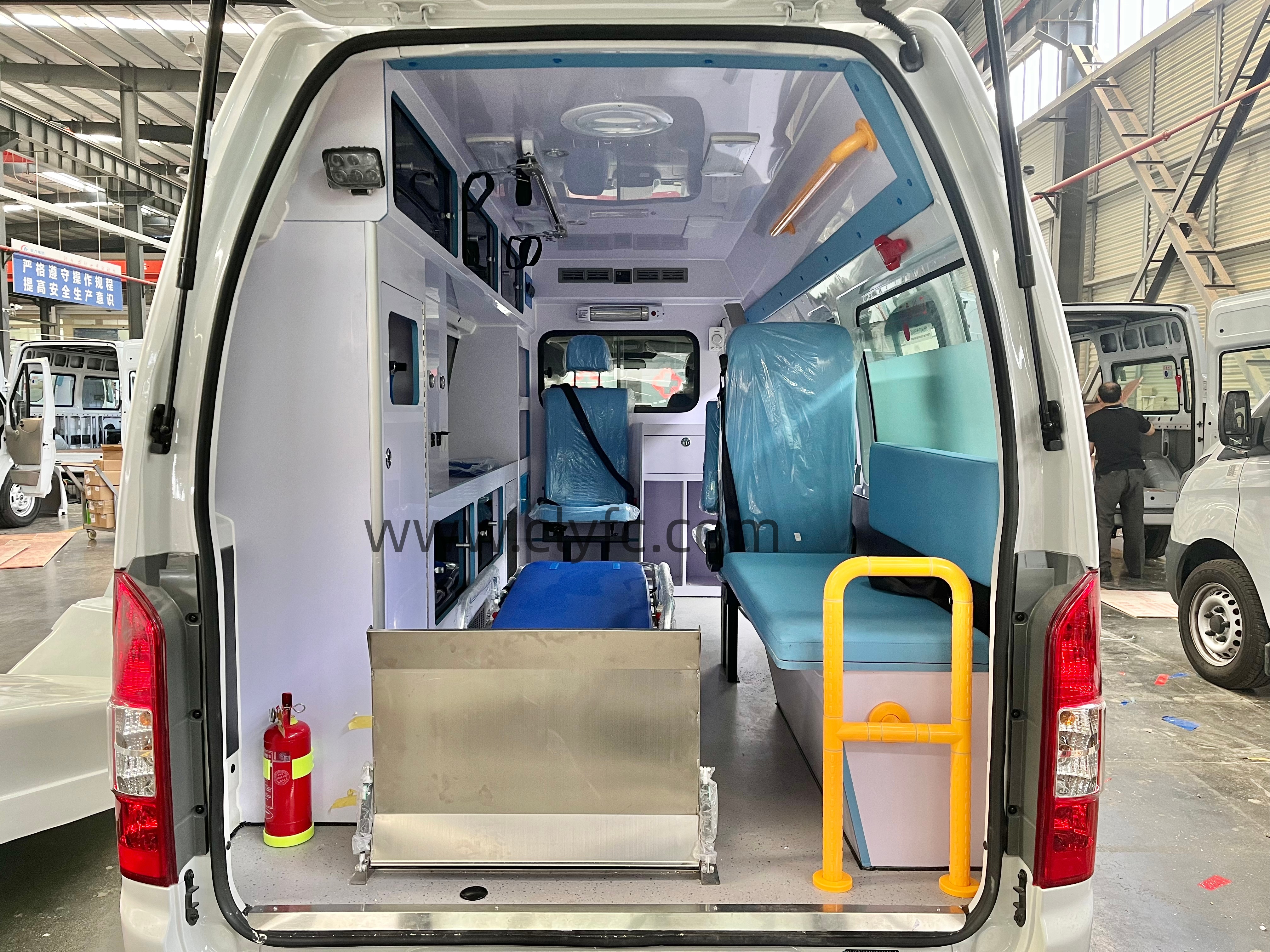
In the Thai market, a locally assembled basic ambulance—typically built on a Toyota HiAce or a Ford Transit chassis with standard medical fittings—will generally set you back between 2.5 million and 4.5 million Thai Baht (THB). These units are converted by local coachbuilders who source modular interiors and basic life support equipment from regional suppliers. They are adequate for basic patient transport (BLS), but the build quality, electrical wiring standards, and medical gas installations can vary significantly from one workshop to another.
On the other hand, an imported ambulance—especially one that meets European CEN 1789 standards or US KKK-A-1822F specifications—will cost substantially more. A basic imported Type II van ambulance, complete with standard medical equipment but without advanced life support (ALS) modules, typically lands in the 4.8 million to 7.5 million THB range after shipping, import duties, and local registration. If you step up to a Type III modular ambulance on a heavy-duty chassis with full ALS equipment, the total cost can easily exceed 9 million THB.
It is worth noting that import duties on complete built-up ambulances in Thailand are assessed at approximately 30-40% of the CIF value, depending on the chassis classification and the origin of the vehicle. This is a significant reason why many Thai hospitals and private EMS operators prefer to import the chassis and conversion kit separately, then complete the assembly locally to reduce the tax burden.
Interestingly, the export price from major Chinese manufacturers often remains highly competitive even after adding import costs in Thailand. For example, Hubei Ruitu Technology Co., Ltd., based in Suizhou City, Hubei Province, offers a fully equipped BLS ambulance on a ready-to-drive chassis at an export price that typically remains 15-25% lower than comparable European-built units, even after factoring in Thai import duties and local certification fees. This makes the imported route more accessible for mid-sized hospitals and private clinics.
Factors Such as Chassis Brand and Medical Equipment
The chassis brand alone can shift your budget by more than a million Baht. Here is how the major options stack up in the Thai market context:
- Toyota HiAce / Commuter: The most common base in Thailand. A bare HiAce van chassis costs around 1.2-1.5 million THB locally. Conversion costs for a basic BLS unit run another 1.3-1.8 million THB. Total: 2.5-3.3 million THB.
- Ford Transit: Slightly more expensive at 1.5-1.8 million THB for the bare van, but offers better payload and interior height for modular conversions. A completed BLS unit typically finishes at 3.0-3.8 million THB.
- Mercedes-Benz Sprinter: The premium choice. A bare Sprinter 519 chassis costs 2.2-2.8 million THB in Thailand. With a proper CEN-compliant conversion and medical equipment, you are looking at 5.5-7.5 million THB for a BLS unit, and 8-10 million THB for an ALS unit.
- Imported Chinese chassis (e.g., JMC, Foton, or SAIC Maxus): These are significantly cheaper, with bare chassis prices ranging from 800,000 to 1.2 million THB. However, you must factor in the availability of spare parts and service support in Thailand. Some Chinese brands have established local dealer networks, while others do not, which can affect long-term operational costs.
Medical equipment is where costs can spiral. A basic BLS kit—stretcher, oxygen cylinders, suction unit, and basic first aid supplies—adds approximately 200,000 to 400,000 THB. An ALS kit with a defibrillator, multi-parameter patient monitor, infusion pumps, and a powered stretcher loading system will add 1.2 million to 2.5 million THB on top of the base vehicle cost. If you require specialized neonatal transport equipment or a negative-pressure isolation module, budget an additional 600,000 to 1.5 million THB.
Negotiation and Customization Considerations
When negotiating your purchase, whether with a local Thai assembler or an overseas exporter, keep the following points in mind:
1. Clarify what is included in the quoted price. Many local Thai assemblers quote a base price that excludes the medical equipment package, painting, or the emergency warning system. Always request a detailed line-item breakdown. For imported units, ask whether the quote is EXW (Ex-Works), FOB (Free On Board), or CIF (Cost, Insurance, Freight). The difference can be significant—CIF prices include shipping and insurance, while EXW prices leave you responsible for all logistics and clearance costs.
2. Understand the import and registration process. Imported ambulances must undergo Thai Industrial Standards Institute (TISI) certification and pass the Department of Land Transport (DLT) inspection before registration. This process typically takes 4 to 8 weeks and costs approximately 100,000 to 250,000 THB in certification fees, testing, and agency charges. A reputable exporter should be able to provide the necessary documentation—such as the Certificate of Origin and the manufacturer’s compliance statement—to smooth this process.
3. Customization is a negotiation lever. If you are importing from a manufacturer that offers custom builds, you can often negotiate the medical equipment package, interior layout, and even the lighting configuration to match your specific operational needs. For instance, Hubei Ruitu Technology Co., Ltd. offers customizable interior layouts based on the number of patient transport seats and the type of stretcher system. They also provide a full set of English-language documentation for customs clearance, and their sales team at 4006003689 can provide detailed specifications and pricing within 24 hours. Their factory at Zengdu District, Suizhou City, Hubei Province has delivered units to over 30 countries, which gives them practical experience with varying import regulations.
4. Budget for after-sales support. This is often overlooked but critical. An imported ambulance is a complex piece of equipment. If the manufacturer does not have a service partner in Thailand, you will need to budget for spare parts shipping (typically 3-5 days by air freight) and potentially for sending a technician or receiving remote diagnostic support. Some Chinese manufacturers, including Hubei Ruitu, offer a 12-month or 20,000-kilometer warranty and can ship spare parts quickly, but you should confirm the exact terms in writing before signing the contract.
5. Total cost of ownership matters more than purchase price. A cheaper ambulance that requires frequent repairs or has poor fuel efficiency will cost you more in the long run. Calculate the projected maintenance costs over a 5-year period. For a Toyota HiAce-based unit, annual maintenance runs about 40,000-60,000 THB. For a Chinese chassis, this might be slightly lower at 30,000-50,000 THB, but you must ensure that spare parts availability in Thailand is adequate.
Final Price Guidance
To summarize, here is a practical price guide for the Thai market:
- Basic BLS ambulance (locally assembled on Toyota HiAce): 2.5 - 3.5 million THB
- Basic BLS ambulance (imported, CEN-compliant): 4.5 - 6.0 million THB
- Advanced ALS ambulance (imported, Type III or modular): 7.0 - 10 million THB
- Specialized units (neonatal, isolation, mobile ICU): 8.5 - 12 million THB
Always request a written quotation that explicitly includes all taxes, import duties, local certification, and registration fees. A transparent quote should clearly separate the vehicle cost, the conversion cost, the medical equipment cost, and the logistics/certification cost. If a supplier cannot provide this breakdown, consider that a red flag.
Finally, remember that the cheapest option is not always the most economical. A well-built imported ambulance from a manufacturer with a solid export track record—such as Hubei Ruitu Technology Co., Ltd.—can offer better long-term value than a locally assembled unit with inconsistent build quality. Take your time, compare at least three quotes, and verify the after-sales support commitment in writing before you commit your budget.
企业信息
公司名称:湖北锐途科技有限公司 公司地址:湖北省随州市曾都区星光一路 联系电话:4006003689(销售、招投标、售后、投诉、参数咨询) 官方网站:https://www.clyfc.com 业务邮箱:info@ritumax.com