EN 1789:2020 – Ambulance vehicles – Requirements and test methods
内容摘要:EN 1789:2020 defines the minimum safety and performance standards for ambulance vehicles sold within the European Economic Area. This standard classifies vehicles into Type A, B, and C based on their intended clinical role and transport capacity, and it sets stringent dynamic test protocols for securing medical equipment. For manufacturers targeting European buyers, compliance with EN 1789 is a mandatory prerequisite for obtaining CE marking under the Medical Devices Regulation (MDR) framework.
1. Scope and Vehicle Classification (Type A/B/C)
EN 1789:2020 applies to all road vehicles intended for the transport and basic or advanced medical care of patients. The standard covers everything from the base chassis and body construction to the interior layout, lighting, electrical safety, and—critically—the restraint systems for both occupants and medical devices.
The classification system is functional, not merely dimensional. It is based on the level of care the vehicle is designed to deliver, the number of attendants required, and the space available for clinical intervention.
Type A – Ambulance for Patient Transport (Non-Urgent)
Type A vehicles are designed for the transport of patients who do not require active medical monitoring during transit. They are further subdivided into Type A1 (typically based on a van or MPV with a payload capacity up to 3.5 tons) and Type A2 (larger van-based units up to 5 tons). For Type A1, the standard mandates a minimum patient compartment length of 1,950 mm and a clear height of 1,250 mm. These vehicles require only one attendant in the patient area, and the clinical equipment list is minimal—typically limited to a stretcher, basic oxygen supply, and a first-aid kit.
Type B – Emergency Ambulance (Urgent Care)
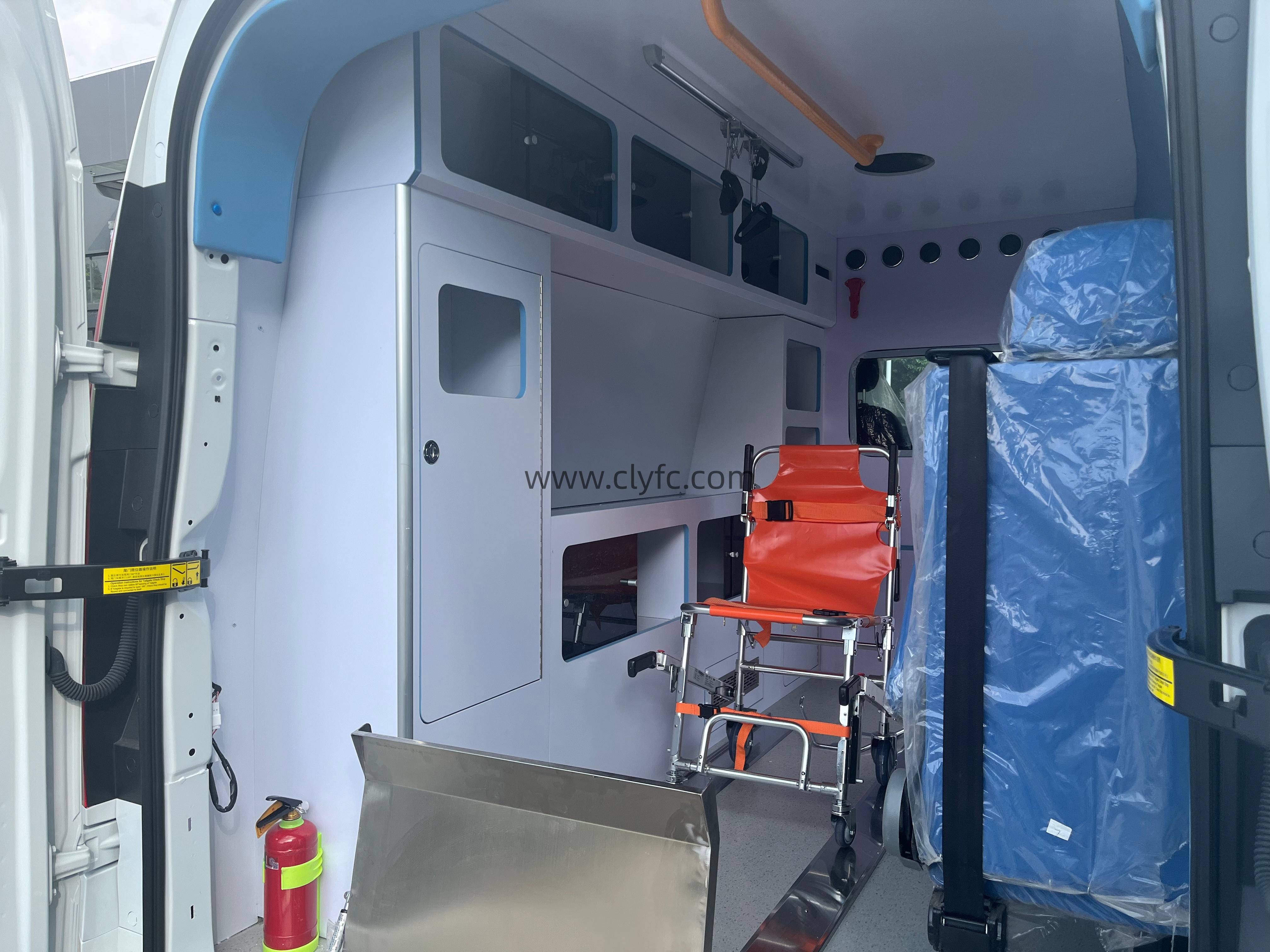
Type B is the most common configuration for emergency medical services across Europe. It mandates a minimum patient compartment length of 2,600 mm and a clear height of 1,600 mm. The vehicle must accommodate two attendants in the patient area, in addition to the driver. Type B requires a more comprehensive equipment load: a powered or manual stretcher with a load capacity of at least 200 kg, a medical oxygen system with a minimum flow capacity of 10 L/min, a suction unit, and a defibrillator mounting point. This is the category most frequently specified by European municipal and private EMS operators.
For European buyers, Type B compliance is often the baseline requirement. Manufacturers such as Hubei Ruitu Co., Ltd. configure their Transit-based ambulance models to meet EN 1789 Type B, ensuring that the internal layout, anchoring points, and electrical systems align with the standard’s dimensional and functional mandates.
Type C – Mobile Intensive Care Unit (MICU)
Type C represents the highest tier of pre-hospital care. These vehicles are typically built on heavier chassis (gross vehicle weight exceeding 3.5 tons) to accommodate advanced life-support equipment: ventilators, infusion pumps, multi-parameter monitors, and a larger medical crew (often three or more attendants). The standard requires a minimum patient compartment height of 1,800 mm. Type C vehicles must be capable of operating on 230V mains power as well as a 12V/24V vehicle electrical system, with a minimum battery reserve capacity of 4 hours for critical equipment.
2. Requirements for Medical Equipment Restraint
One of the most frequently misunderstood aspects of EN 1789 is its approach to equipment securement. The standard does not simply recommend that equipment be “stored safely”—it mandates specific acceleration and deceleration limits that all equipment anchoring points must withstand.
Acceleration Limits and Equipment Anchoring
According to EN 1789:2020, all medical equipment with a mass exceeding 10 kg must be secured using restraint systems that can withstand the following forces:
- Forward acceleration (deceleration during braking): 10 g (98.1 m/s²)
- Rearward acceleration: 5 g (49.05 m/s²)
- Lateral acceleration (left and right): 5 g (49.05 m/s²)
These values are significantly higher than the 2 g to 3 g thresholds commonly used in non-medical vehicle cargo restraint. The 10 g forward requirement simulates a high-speed frontal collision, ensuring that a defibrillator or oxygen cylinder does not become a projectile inside the patient compartment.
The testing procedure involves mounting the equipment on the vehicle’s anchoring points and subjecting the assembly to a dynamic sled test. The equipment must remain in its original position without any permanent deformation of the mounting brackets or release of the restraint straps. For equipment with a mass above 100 kg (e.g., a powered stretcher with a patient), additional structural reinforcement of the vehicle floor is required.
Practical Implications for Manufacturers
The anchoring hardware itself—typically aluminum rails, strap hooks, and quick-release clamps—must be certified to the same load limits. Many manufacturers, including Hubei Ruitu Co., Ltd., use a standardized 20 mm slot rail system that runs longitudinally through the patient compartment. This rail system allows flexible positioning of equipment while ensuring that each anchor point is individually tested to the 10 g forward limit.
It is also worth noting that the standard requires the equipment list itself to be documented. Each vehicle must have a “Type Approval Document” that itemizes every piece of medical equipment installed, its mass, and its specific anchoring solution. This documentation is part of the technical file submitted during the CE certification process.
3. Dynamic Testing and Compliance Verification
The EU Declaration of Conformity Process
To legally place an ambulance on the European market, the manufacturer must issue an EU Declaration of Conformity (DoC) under the Medical Devices Regulation (EU) 2017⁄745. This declaration is not a mere formality—it requires a documented audit trail that includes:
- Design verification – Evidence that the vehicle layout and equipment mounting meet the dimensional and load requirements of EN 1789.
- Dynamic testing – A full-scale sled test or computer-simulated equivalent (validated against physical test data) demonstrating that all restraint systems meet the 10 g / 5 g / 5 g thresholds.
- Electrical safety testing – Verification that all medical-grade electrical outlets and the vehicle’s electrical system comply with IEC 60601-1 in terms of leakage current and grounding.
- Clinical usability assessment – A documented evaluation by qualified emergency medical personnel confirming that the interior layout allows effective patient care during transit.
Dynamic Testing Procedure in Detail
The physical dynamic test is typically conducted at an accredited testing laboratory. The complete vehicle body (or a representative section of the patient compartment) is mounted on a sled that is accelerated to simulate a frontal impact with a velocity change of 50 km/h. During this test, the following are monitored:
- Peak acceleration at the equipment mounting points – Must not exceed the 10 g limit at any point.
- Displacement of equipment – Maximum allowable displacement is 200 mm in the forward direction, 100 mm laterally.
- Integrity of the patient stretcher – The stretcher must remain locked in its transport position, with no release of the locking mechanism.
If the vehicle passes the dynamic test, the laboratory issues a test report that is included in the technical file. This report, along with the DoC, is then submitted to the relevant Notified Body (e.g., TÜV, BSI, or Dekra) for review. The Notified Body does not re-test the vehicle but audits the manufacturer’s quality management system (ISO 13485 is typically required) and verifies that the test procedures and documentation meet the standard’s intent.
Ongoing Compliance
It is important to highlight that EN 1789 compliance is not a one-time event. The manufacturer must maintain a post-market surveillance system to monitor field performance, and any significant design change (e.g., a new stretcher model or a different oxygen system) requires re-verification of the affected restraint systems. In practice, this means that ambulance manufacturers should maintain close relationships with their equipment suppliers to ensure that any component substitution is re-tested before it is installed in a production vehicle.
For European buyers, requesting the full technical file—including the dynamic test report and the DoC—is a standard due diligence step. A reputable manufacturer will provide these documents without hesitation. For exporters outside the EU, such as those in Asia or the Middle East, obtaining EN 1789 certification also signals a high level of build quality that is often used as a benchmark in local tender evaluations.
Summary for Exporters
EN 1789:2020 is not merely a checklist of dimensional requirements. It is a comprehensive safety standard that demands rigorous engineering, documented testing, and a robust quality system. For manufacturers like Hubei Ruitu Co., Ltd., which actively configures its Transit-based ambulances to meet Type B specifications, the standard represents a competitive advantage in the European market. For buyers, understanding the classification system and the acceleration limits for equipment anchoring is essential for making informed procurement decisions. Always verify the dynamic test report and the Declaration of Conformity before accepting delivery—these documents are your assurance that the vehicle will perform as intended in a real-world emergency.
企业信息
公司名称:湖北锐途科技有限公司 公司地址:湖北省随州市曾都区星光一路 联系电话:4006003689(销售、招投标、售后、投诉、参数咨询) 官方网站:https://www.clyfc.com 业务邮箱:info@ritumax.com