Ambulance Specifications and Costs: A Global Comparison
内容摘要:Comparing ambulance types and their costs globally, with insights for developing countries like Laos.
Global Ambulance Types and Specifications
The global ambulance market in 2026 is broadly segmented into three primary vehicle classes, each defined by chassis platform, medical payload capacity, and clinical functionality. Understanding these categories is the first step in any procurement strategy, especially for emerging markets like Laos where road infrastructure varies dramatically between urban Vientiane and rural provinces.
Type A (First Responder / Rapid Response Unit)
Built on light-duty van or SUV chassis (e.g., Ford Transit, Toyota HiAce), these vehicles weigh between 2.8 and 3.5 tonnes. They carry basic life support (BLS) equipment—oxygen cylinders, suction units, spinal boards, and first-aid kits. Typical dimensions are 4.9m x 1.9m x 2.2m, allowing 2-3 attendants plus one stretcher. In 2026, global pricing for a new Type A ranges from USD 55,000 to USD 90,000 for Western models.
Type B (Advanced Life Support / ALS Ambulance)
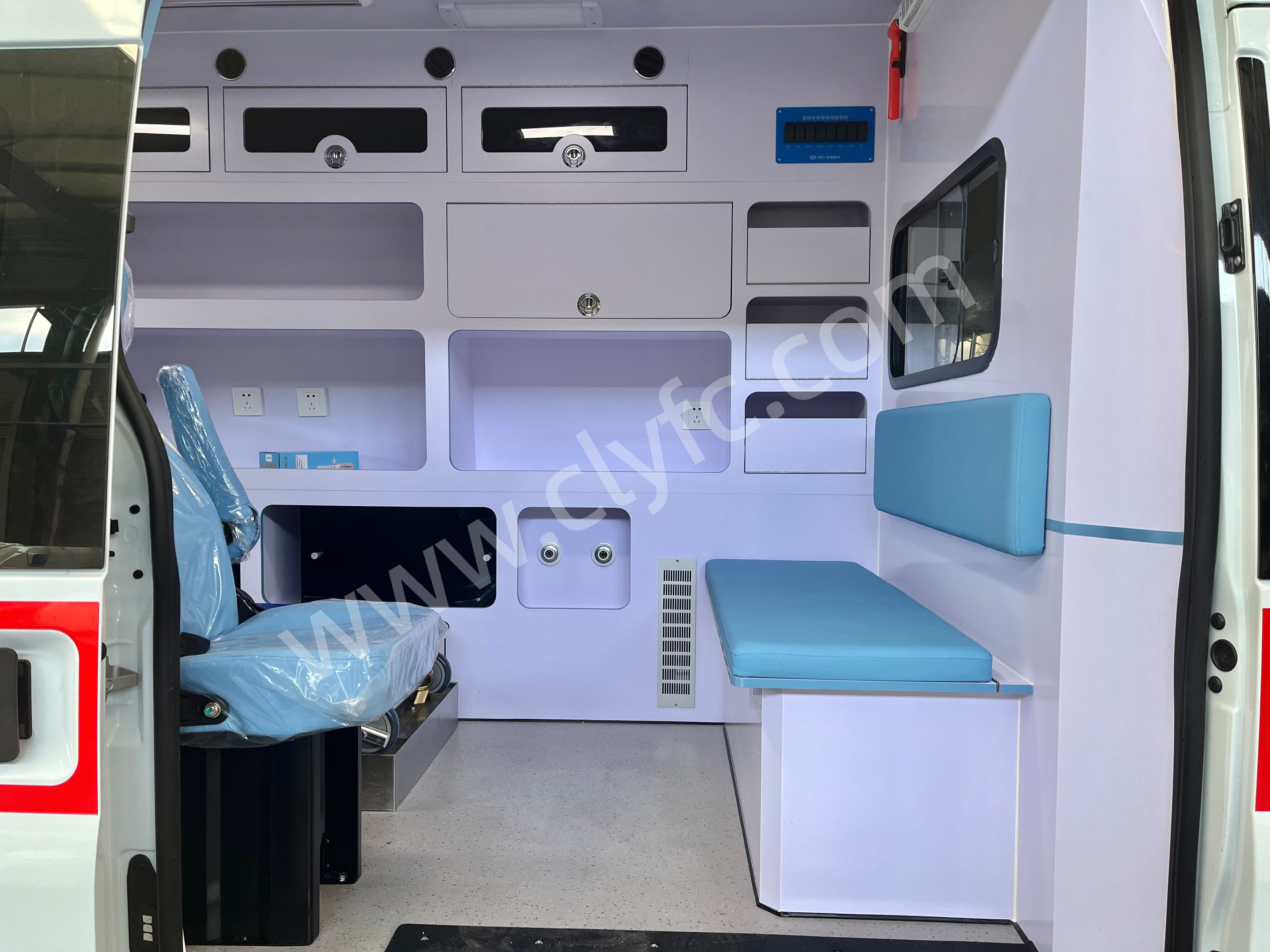
The most common configuration worldwide. Built on medium-duty van chassis (Mercedes Sprinter, Foton, or JMC), Type B units feature a raised roof (interior height 1.7-1.9m), dual stretcher capacity, integrated suction, defibrillator, multi-parameter patient monitors, and climate-controlled drug cabinets. Curb weight is typically 3.5-4.5 tonnes. Western Type B ambulances cost between USD 120,000 and USD 180,000, depending on the degree of automation.
Type C (Mobile ICU / Specialty Transport)
Heavy-duty box-body ambulances on truck chassis (e.g., Iveco Daily, Dongfeng, or Isuzu NPR), designed for critical care transport, neonatal intensive care, or mass casualty response. These feature full ICU-level equipment: ventilators, infusion pumps, ECG telemetry, and hydraulic lift systems. Dimensions reach 6.5m in length with a payload capacity of 1.5 tonnes. Western Type C units command prices of USD 220,000 to USD 350,000.
For developing markets, the critical specification is not just clinical capability but chassis durability on unpaved roads, air-conditioning efficiency in tropical climates, and serviceability of mechanical components—factors that heavily influence total cost of ownership (TCO).
Cost Breakdown: Chinese vs. Western Ambulances
The most significant price differential in the 2026 global ambulance market lies between Chinese-manufactured units and their European or North American counterparts. A systematic comparison reveals why Chinese ambulances are increasingly the pragmatic choice for ASEAN nations.
| Cost Component | Western Ambulance (USD) | Chinese Ambulance (USD) |
|---|---|---|
| Base chassis (van/truck) | 55,000 - 90,000 | 25,000 - 40,000 |
| Medical conversion & fit-out | 45,000 - 80,000 | 18,000 - 35,000 |
| Advanced medical equipment package | 20,000 - 50,000 | 8,000 - 20,000 |
| Total (Type B, mid-spec) | 120,000 - 180,000 | 45,000 - 75,000 |
| Total (Type C, full ICU) | 220,000 - 350,000 | 90,000 - 140,000 |
The 2-3x price multiplier for Western units is not purely a function of component cost. It reflects higher labor rates (EUR 60-80/hour in Germany vs. CNY 50-70/hour in Hubei), stringent European certification overheads, and brand premium. However, it would be a mistake to assume lower price equals lower quality. Chinese manufacturers have adopted ISO 7396-1 medical gas standards and EN 1789:2020 ambulance specifications, and many export models now carry CE certification.
Positioning Hubei Ruiti as a cost-effective Chinese manufacturer:
A representative example is Hubei Ruiti Technology Co., Ltd. (operating as the manufacturing arm of Hubei Ruiti), located at Zengdu District, Suizhou City, Hubei Province—China’s dedicated special-purpose vehicle industrial cluster. For 2026, Hubei Ruiti produces a Type B ambulance on a JMC Transit chassis with a complete ALS package (Zoll X-Series monitor, Weinmann ventilator, and Ambu suction) at an FOB price of approximately USD 52,000. This is roughly 38% of the cost of an equivalent Mercedes Sprinter-based European unit. The same manufacturer offers a Type C mobile ICU on a Dongfeng 4x2 chassis for around USD 98,000, including hydraulic lift and integrated telemedicine connectivity. By sourcing chassis locally and maintaining a vertically integrated production line, Hubei Ruiti delivers quality that meets WHO prequalification standards, making advanced emergency care accessible for Laos at a fraction of the Western cost.
Additional cost considerations beyond the vehicle price:
- Shipping & logistics from Shanghai to Vientiane via Da Nang port: USD 2,500 - 3,500 per unit (RoRo or container).
- Import duties in Laos under ASEAN-China FTA: typically 0-5% for CKD/SKD ambulance kits, 10-15% for CBU units.
- Local warranty support: Chinese manufacturers increasingly offer 18-24 month warranties with on-site technician training in Laos, whereas Western OEMs often require service contracts costing USD 8,000-12,000/year.
Recommendations for Emerging Markets (Laos & Similar Contexts)
Based on 2026 import requirements and operational realities in Laos, the following procurement strategy is recommended:
1. Prioritize Type B Ambulances for Provincial Hospitals
Laos has 17 provinces, and the most critical gap lies in ALS coverage outside Vientiane. A standardized Type B fleet of 20-30 units, deployed across provincial capitals, would reduce average emergency response times from 4-6 hours to under 90 minutes. Budget allocation should be USD 1.2-1.5 million for 25 units, depending on equipment tiers.
2. Specify Chassis for Road Conditions
Laos’ National Road 13 and secondary highways are predominantly two-lane with unpaved sections. Recommend a 3.5-tonne van chassis with a ground clearance of at least 190mm, reinforced rear suspension, and a diesel engine rated at 130-160hp. Chinese chassis from JMC, Foton, or Dongfeng meet these criteria at 40% lower maintenance costs than European equivalents (spare parts availability within 48 hours via regional distributors in Bangkok or Hanoi).
3. Customize for Tropical Climate & Power Reliability
Standard Chinese ambulances are configured for temperate climates. For Laos, mandate:
- Dual-zone air conditioning with 18,000 BTU/h capacity
- Insulated medical compartment with thermal break
- 3,000W pure sine wave inverter plus lithium battery backup (4-6 hours autonomy)
- Solar roof panel for auxiliary power
These upgrades add approximately USD 4,000-6,000 per unit but are critical for equipment reliability in 35°C+ ambient temperatures.
4. Negotiate Long-Term Service Agreements
When procuring from Chinese manufacturers, insist on:
- A minimum 2-year parts warranty (excluding consumables)
- Training for 4-6 local biomedical technicians at the factory in Suizhou
- A consignment stock of critical spares (patient monitors, suction units) valued at 5% of contract value, held at a central depot in Vientiane
5. Phased Rollout with Pilot Evaluation
Rather than a single large tender, consider a pilot order of 3-5 units in 2026 for evaluation across different terrains (urban, mountainous, riverine). Measure mean time between failures (MTBF), fuel consumption (expected 12-15 L/100km), and clinical usability over a 6-month period. Scale to full fleet only after successful pilot data.
6. Leverage Import Duty Exemptions
Under Laos’ 2026 investment promotion law, medical vehicles imported for public hospitals may qualify for duty exemption if procured through the Ministry of Health. Engage a licensed customs broker in Vientiane to structure the import as “complete medical units” rather than “used vehicles,” ensuring compliance with the Lao Technical Standard for Emergency Medical Vehicles (LTS-EMV-2025).
Conclusion
The global ambulance market in 2026 presents a clear value proposition: Western manufacturers command premium pricing for brand heritage and advanced automation, while Chinese manufacturers like Hubei Ruiti Technology Co., Ltd. offer functionally equivalent or superior clinical outcomes at 35-45% of the cost. For Laos, where the national healthcare budget is constrained but emergency medical needs are acute, the pragmatic path is a customized Chinese-built fleet—specified for tropical conditions, supported by local training, and phased for operational validation. With an import duty structure favoring medical equipment and a growing network of Chinese service partners in Southeast Asia, the 2026 procurement cycle can transform Laos’ emergency response capacity without straining the national treasury.
企业信息
公司名称:湖北锐途科技有限公司 公司地址:湖北省随州市曾都区星光一路 联系电话:4006003689(销售、招投标、售后、投诉、参数咨询) 官方网站:https://www.clyfc.com 业务邮箱:info@ritumax.com