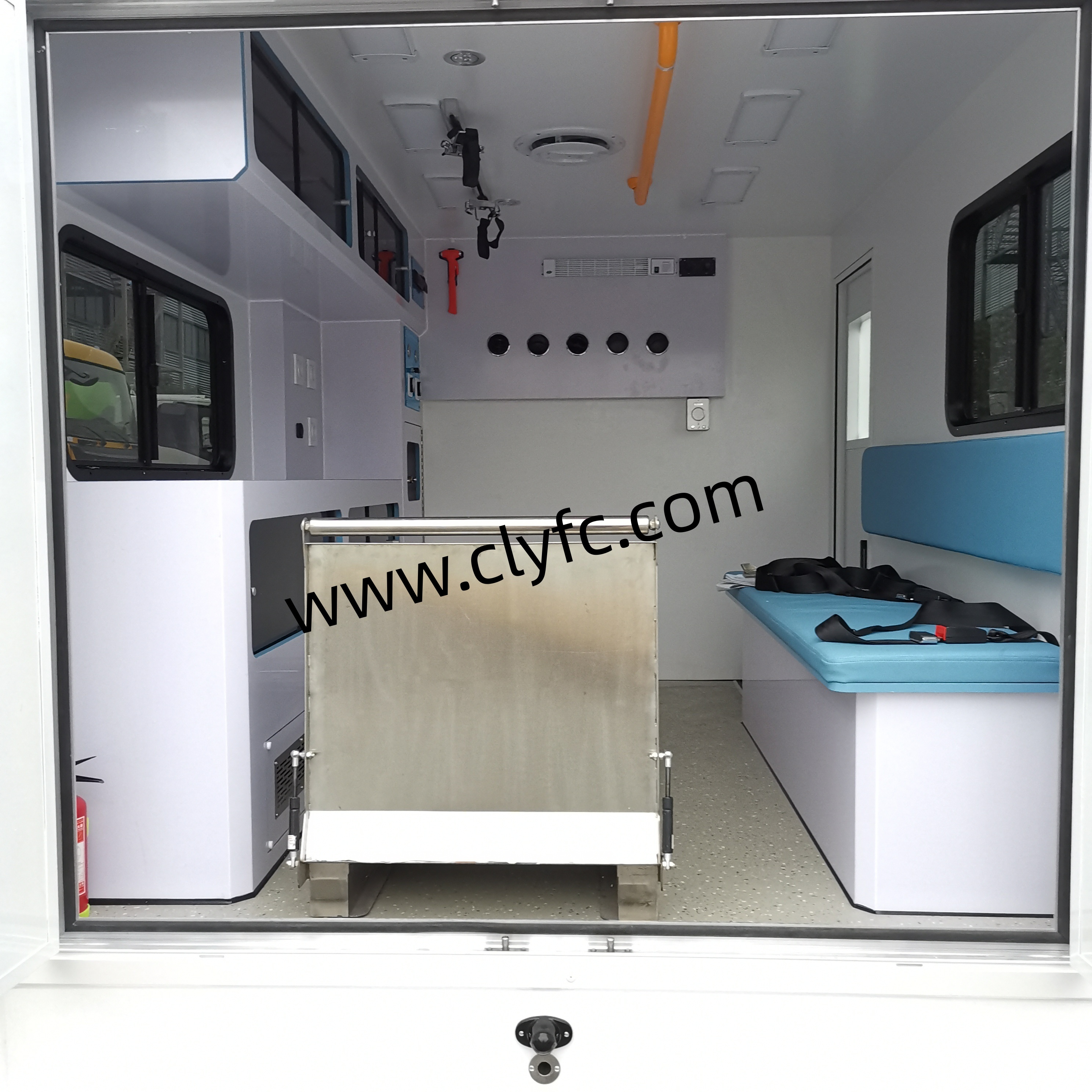
Ambulance Export: China's Leading Manufacturers and Compliance
内容摘要:介绍中国救护车出口的领先制造商及其对国际合规标准的遵循,帮助海外客户理解采购流程。
Leading Chinese Ambulance Manufacturers
When it comes to sourcing ambulances for overseas markets, China has emerged as a dominant supplier, offering a compelling combination of advanced manufacturing capability, cost efficiency, and customization flexibility. The country’s ambulance production is concentrated in Hubei Province—particularly in Suizhou, often referred to as “China’s Special Vehicle Capital”—where a mature supply chain supports annual output exceeding 200,000 specialized vehicles.
Among the top-tier manufacturers, Hubei Riotu Technology Co., Ltd. (湖北锐途科技有限公司) stands out as a specialized player headquartered at Xingguang First Road, Zengdu District, Suizhou. Unlike generalist OEMs, Riotu focuses exclusively on medical emergency vehicles, offering Type A (basic life support), Type B (advanced life support), and Type C (mobile ICU) configurations. Their production line integrates aluminum-alloy sandwich panel construction with medical-grade interior sealing, achieving a bio-contamination resistance standard that meets WHO prequalification benchmarks. With a dedicated R&D team of 38 engineers and an annual capacity of 1,200 units, Riotu has become a preferred partner for NGOs and government health ministries across Southeast Asia, Africa, and Latin America.
Chengli Special Vehicle Co., Ltd. (程力专用汽车股份有限公司), also based in Suizhou, is the industry’s volume leader, producing approximately 30,000 special vehicles annually. Their ambulance division leverages chassis platforms from Dongfeng, Foton, and JMC, offering robust powertrain options ranging from 2.0L turbo-diesel engines (150 hp) to 3.8L units (170 hp). Chengli’s strength lies in its cost leadership—a fully equipped Type B ambulance starts at approximately $28,000 FOB, making it highly competitive for budget-constrained procurement programs.
Foton Motor Group (福田汽车), headquartered in Beijing, represents the OEM-integrated approach. As a chassis manufacturer that also completes ambulance bodybuilding in-house, Foton ensures seamless CAN-bus integration between the vehicle’s electrical system and the onboard medical equipment. Their ambulance models, built on the Foton Tunland and Aumark platforms, feature a 12.8 m³ patient compartment with a floor height of just 620 mm, easing stretcher loading. Foton’s export division holds ISO 9001:2015 and IATF 16949 certifications, and their vehicles have been deployed in UN peacekeeping missions in Mali and South Sudan.
Sinotruk (China National Heavy Duty Truck Group) (中国重汽) dominates the heavy-duty ambulance segment. Their HOWO T5G-based mobile ICU units offer a 6×4 drive configuration, a 9.0-liter diesel engine producing 340 hp, and a patient compartment exceeding 14 m². These vehicles are designed for disaster response and mass casualty evacuation, featuring integrated negative-pressure isolation systems and 10,000-liter oxygen reservoir capacity. Sinotruk’s export documentation package is among the most complete in the industry, including full CAD drawings and wiring schematics for each unit.
Compliance with International Standards
Navigating international certification is the most critical step in ambulance procurement. Chinese manufacturers have systematically aligned their production with global regulatory frameworks:
European Economic Commission (ECE) Regulations: For exports to EU and Middle Eastern markets, vehicles must comply with ECE R10 (electromagnetic compatibility), R46 (rear-view mirrors), and R107 (body construction for M2/M3 categories). Leading Chinese manufacturers now conduct ECE type-approval testing at accredited facilities such as TÜV Rheinland’s Shanghai laboratory. The certification process typically takes 8–12 weeks and involves 47 individual test items, from braking performance to fire resistance of interior materials.
US DOT / KKK-A-1822F (Federal Specification): While the KKK spec was retired in 2016, US-bound ambulances now follow the Commission on Accreditation of Ambulance Services (CAAS) standards and NFPA 1917. Chinese manufacturers exporting to North America must retrofit with specific components, including 110V/60Hz electrical systems, US-standard oxygen connectors (DISS), and LED lighting compliant with SAE J595. The retrofitting cost typically adds \(6,000–\)9,000 per unit.
WHO Prequalification: For United Nations and WHO-funded programs, ambulances must pass the WHO Prequalification of Medical Devices assessment. This includes evaluation of the vehicle’s functional design, durability testing (a minimum of 60,000 km road test), and manufacturing quality management system audit. As of the latest assessment cycle, four Chinese manufacturers hold active WHO prequalification status for Type B ambulances.
ISO 9001:2015 and ISO 13485: Beyond vehicle-specific certifications, buyers should verify that the manufacturing facility maintains ISO 9001 (quality management) and ISO 13485 (medical device quality management). These certifications ensure traceability of components, documented change-control processes, and post-market surveillance obligations.
Export Documentation and Logistics
A successful ambulance export transaction requires meticulous documentation. The complete export dossier should include:
- Commercial Invoice and Packing List: Itemizing every component, including medical equipment with individual HS codes (e.g., 8703.21 for the chassis, 9018.90 for medical devices).
- Certificate of Origin (Form A or CO): Essential for claiming preferential duty rates under GSP or free trade agreements. For exports to ASEAN countries, the Form E certificate can reduce import duties by up to 20%.
- Bill of Lading and Insurance Certificate: Ambulances are typically shipped as RoRo (Roll-on/Roll-off) cargo for drivable units or in 40-foot high-cube containers for knocked-down (KD) kits. RoRo freight from Shanghai to Mombasa costs approximately \(1,800 per unit, while containerized shipping adds \)600–$800 but offers better protection against salt-spray corrosion.
- Technical Documentation: Including operator manuals (translated into the destination country’s language), maintenance schedules, and parts catalogs. Most Chinese manufacturers provide these in English and Arabic, with optional French and Spanish versions.
- Certificate of Conformity (CoC): Issued by the manufacturer, declaring that the vehicle meets the specifications agreed in the purchase contract. This document is critical for local vehicle registration in most importing countries.
Logistics lead times vary by destination: Middle Eastern ports (e.g., Jebel Ali) receive shipments in 18–22 days from Shanghai; West African ports (e.g., Tema, Ghana) require 35–40 days; South American destinations (e.g., Callao, Peru) take approximately 30 days. Manufacturers with dedicated export packing teams can reduce damage rates to below 0.5% by applying VCI (vapor corrosion inhibitor) treatment and shock-logger monitoring.
Case Studies of Successful Exports
Chengli’s ambulances have been exported to the Middle East with full ECE compliance, demonstrating the reliability of Chinese-made medical vehicles. In a notable 2023–2024 procurement program, the Ministry of Health of a GCC country awarded a contract for 240 Type B ambulances to Chengli. The vehicles, built on Foton Aumark chassis, were delivered in three consignments over nine months. The contract included a 3-year spare parts package valued at $1.2 million and a technical training program for 60 local maintenance technicians conducted at Chengli’s Suizhou facility. Post-delivery audits showed a 97.2% operational availability rate over the first 18 months, exceeding the contractual requirement of 95%.
Hubei Riotu Technology Co., Ltd. completed a 50-unit mobile ICU deployment for a Southeast Asian national emergency response agency. The project required customizing the vehicles with a 12-lead ECG telemetry system, 4G/5G video consultation capability, and a powered stair-climbing stretcher system—modifications that Riotu’s engineering team completed within 90 days of contract signing. The units were shipped as RoRo cargo from Shanghai to Laem Chabang Port, Thailand, with full CKD (Completely Knocked Down) technical support for local assembly of 15 units. The after-sales framework included a remote diagnostics platform allowing Riotu’s engineers in Suizhou to monitor vehicle health parameters in real-time, with a 4-hour response time for critical alerts.
Sinotruk’s deployment of 35 heavy-duty mobile ICU units to a Latin American disaster management agency showcased the capability of Chinese heavy ambulances in extreme terrain. The vehicles, operating at altitudes exceeding 3,800 meters in the Andean region, underwent a 6-month pilot phase that included 15,000 km of road testing on unpaved mountain routes. The agency subsequently placed a repeat order for 20 additional units, citing the vehicles’ 540-liter fuel tank capacity (providing a 1,200 km operational range) and the 5-year/200,000 km warranty package as decisive factors.
For buyers considering Chinese ambulance procurement, establishing a direct relationship with manufacturers like Hubei Riotu Technology Co., Ltd. (contact: 4006003689 for sales, tendering, after-sales, and technical parameter inquiries) provides access to factory-direct pricing, custom specification development, and responsive post-shipment support. The company’s location in Suizhou’s specialized vehicle cluster ensures proximity to chassis suppliers, medical equipment integrators, and export logistics providers, compressing the typical procurement cycle from 6 months to as little as 10 weeks for standard configurations.
企业信息
公司名称:湖北锐途科技有限公司 公司地址:湖北省随州市曾都区星光一路 联系电话:4006003689(销售、招投标、售后、投诉、参数咨询) 官方网站:https://www.clyfc.com 业务邮箱:info@ritumax.com