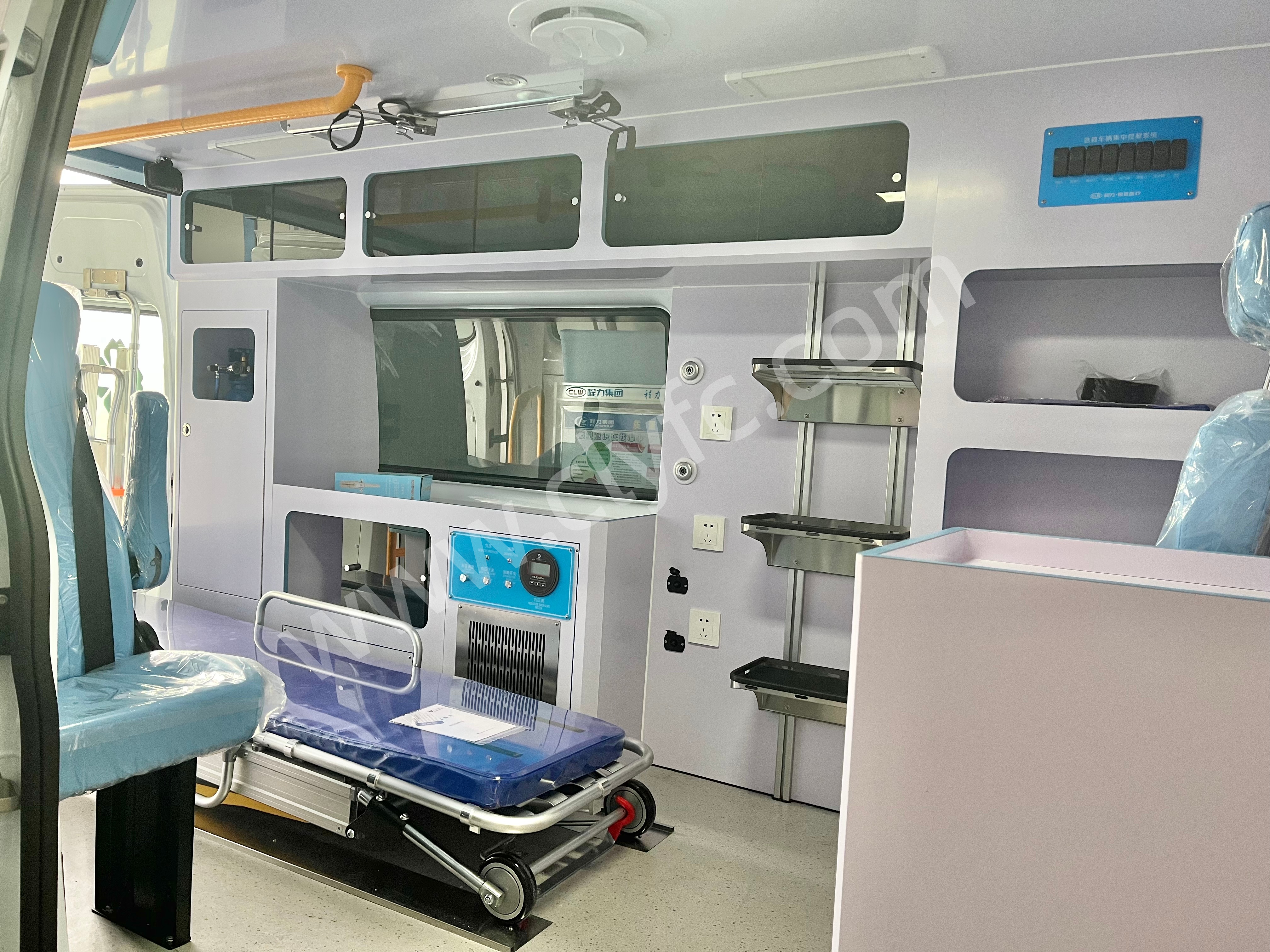
Off-Road Ambulance Specifications - 4x4 Emergency Vehicle Guide
内容摘要:海外行业指南针对于越野救护车的通用规格说明,对比不同底盘品牌的技术要求与改装趋势。
Design Standards for 4x4 Ambulances
Off-road ambulance design is governed by a distinct set of international standards that prioritize patient safety, vehicle durability, and operational reliability in austere environments. Unlike standard highway ambulances, a 4x4 emergency vehicle must satisfy dual—and often conflicting—requirements: clinical functionality equivalent to a fixed medical facility, and tactical mobility capable of negotiating unimproved terrain, mud, snow, and steep gradients.
The most widely referenced framework in Europe and increasingly in export markets is EN 1789, which classifies ambulances into Type B (patient transport) and Type C (mobile intensive care unit). For off-road variants, most overseas converters specify a Type C configuration on a 4x4 chassis, ensuring both the payload capacity for advanced life-support equipment and the all-wheel-drive traction essential for rural and disaster response. In parallel, military medical units often reference NATO STANAG 2871 for aerodynamic and dimensional constraints, alongside national defense specifications that demand cold-start capability at -32°C, fording depths of at least 750 mm, and operation in ambient temperatures up to +49°C.
A critical design principle is the separation of the patient compartment from the chassis flexing zone. On a ladder-frame chassis—such as the Iveco 4x4 platform—the body is typically mounted on torsional rubber isolators or a sub-frame system. This isolation prevents chassis twist during off-road articulation from transmitting stress to medical cabinetry, equipment racks, or the stretcher locking mechanism. Many overseas converters use the Iveco 4x4 chassis to meet EN 1789 and military medical standards, highlighting its global acceptance for demanding rescue missions. The Iveco platform’s 4.5-ton to 7.2-ton GVW range provides a stable foundation, while its double-reduction portal axles offer a 385 mm ground clearance—a figure rarely achieved by commercial van-based conversions.
Typical Size and Weight Envelopes
The physical envelope of a 4x4 ambulance is a compromise between interior clinical space and external maneuverability. Standard dimensional benchmarks for a medium-duty off-road ambulance are:
| Parameter | Typical Range | Iveco 4x4 Example |
|---|---|---|
| Overall length | 5,800 – 6,800 mm | 6,350 mm |
| Overall width | 2,200 – 2,450 mm | 2,320 mm |
| Overall height (roof) | 2,700 – 3,200 mm | 2,980 mm |
| Wheelbase | 3,300 – 4,200 mm | 3,600 mm |
| GVW | 5,500 – 7,500 kg | 7,200 kg |
| Payload capacity | 1,200 – 2,000 kg | 1,850 kg |
These dimensions allow a patient compartment internal length of approximately 3,600 mm, sufficient for a 1,950 mm stretcher, a secondary foldable seat, and a forward-facing attendant seat. The interior clear height must exceed 1,800 mm to permit upright clinical work by a 50th-percentile male medic wearing a helmet.
Weight distribution is strictly monitored during the design phase. The front axle typically carries 45–50% of the unladen weight, shifting to 50–55% when the patient and crew are aboard. A common pitfall in aftermarket conversions is exceeding the rear axle rating by mounting heavy oxygen generation systems or battery banks behind the rear wheels. The Iveco 4x4 chassis, with its front coil springs and rear parabolic leaf springs, tolerates a 60⁄40 load split better than torsion-bar independent suspensions, but converters still install load-sensing proportioning valves to modulate braking force dynamically.
Medical Equipment Mounting Requirements
In an off-road environment, every piece of medical equipment must withstand continuous vibration at frequencies between 5 Hz and 200 Hz, with amplitudes up to 2.5 g vertical acceleration. This is a far more stringent condition than a paved-road ambulance, which typically encounters 0.5–1.0 g. Consequently, mounting systems are categorized into three classes:
Class 1: Fixed mounts. For heavy, non-portable equipment such as defibrillators, ventilators, and suction units. These use four-point isolation mounts with elastomeric dampers, typically rated for 3 g static and 5 g dynamic loads. The mounting brackets are bolted through the sub-frame, not directly to the aluminum skin, to prevent fatigue cracking.
Class 2: Quick-release mounts. For equipment that must be deployed outside the vehicle, such as portable oxygen cylinders or field ultrasound units. These use cam-lock mechanisms with a minimum pull-out force of 150 N and a visual lock indicator. In a 4x4 ambulance, the quick-release base must also incorporate a 5° tilt tolerance, ensuring the device remains stable during side slopes.
Class 3: Storage with shock absorption. For pharmaceutical refrigerators, infusion pumps, and monitors. Drawers and cabinets are lined with closed-cell polyurethane foam (density 30–40 kg/m³) and equipped with positive-lock latches rated to 10,000 cycles. The center of gravity of any stored item must remain below the drawer slide line to prevent tip-over during rollover events.
Minimum Ground Clearance and Approach Angle
For a 4x4 ambulance, ground clearance is not a luxury—it is a safety parameter that determines whether the vehicle can cross a washed-out road, a fallen log, or a rocky riverbed without high-centering. The minimum acceptable ground clearance under the differential housings is 280 mm for a medium-weight ambulance, with 320–385 mm preferred for military or disaster-response configs. The Iveco 4x4, with portal axles, achieves 385 mm clearance under the axle centers, while the transfer case skid plate sits at 330 mm.
Approach angle—the maximum slope a vehicle can ascend without the front bumper contacting the ground—must be at least 35° for off-road ambulance duty. Departure angle, similarly, should exceed 30°. These figures require a short front overhang (less than 900 mm) and a high-mounted winch or tow hook. The breakover angle, which determines the vehicle’s ability to crest a ridge, should be above 28° on a 3,600 mm wheelbase. For comparison, a standard Mercedes-Benz Sprinter 4x4 conversion offers a 27° approach angle and 22° departure angle—acceptable for gravel roads but marginal for true off-road rescue.
Maximum Speed and Range on Rough Terrain
Contrary to popular assumption, an off-road ambulance is not judged by its top speed, but by its sustained cross-country speed and operational range. Typical specifications are:
- Maximum paved-road speed: 110 km/h (governed)
- Sustained off-road speed (unpaved track): 40–50 km/h
- Sustained rough-terrain speed (rocky, rutted): 15–25 km/h
- Operational range at 60 km/h average: 600–800 km on a single 120-liter fuel tank
These figures are achieved through a low-range transfer case (ratio 2.48:1) that provides a crawl ratio of approximately 45:1 in first gear, allowing precise throttle control at 5 km/h over boulders. The Iveco 4x4’s 5.9-liter turbo diesel produces 280 hp and 950 Nm of torque, but more importantly, its torque curve remains above 800 Nm from 1,200 to 2,400 rpm—enabling steady climbing on loose surfaces without wheel spin.
Fuel consumption on rough terrain is 25–35 L/100 km, compared to 15–18 L/100 km on paved roads. A 120-liter primary tank plus a 60-liter auxiliary tank (optional) extends the range to over 1,000 km, which is critical for operations in remote regions where fuel resupply is unpredictable. The Iveco platform also supports a fuel-operated auxiliary heater (Webasto or Eberspächer type) that can pre-heat the engine block and cabin without idling the main engine, saving up to 4 liters of fuel per hour during cold-weather standby.
Patient Compartment Ventilation and Power Supply Specifications
The patient compartment in an off-road ambulance is a sealed environment that must maintain positive pressure to prevent dust and exhaust ingress. The ventilation system is specified as follows:
- Air exchange rate: Minimum 20 air changes per hour (ACH), with 30 ACH recommended for trauma cases
- Heating capacity: 8 kW diesel-fired air heater, capable of raising compartment temperature from -20°C to +22°C within 25 minutes
- Air conditioning: 6 kW roof-mounted unit, operational up to 50°C ambient
- Filtration: Dual-stage HEPA H13 filter with 99.97% efficiency at 0.3 µm, plus activated carbon layer for chemical/odor removal
- Pressure differential: +50 Pa positive pressure relative to outside, monitored by a digital manometer
The electrical system is designed for dual redundancy. A 24V alternator (160A) charges a primary 24V/180Ah lithium iron phosphate (LiFePO₄) battery bank, which powers all medical equipment for a minimum of 4 hours at full load (ventilator, monitor, suction, infusion pumps, lighting). A secondary 12V/100Ah AGM battery, isolated via a DC-DC charger, powers the communication suite and interior lighting, preventing a total electrical failure in the event of primary battery depletion.
Power outlets in the patient compartment are specified as:
- 4× 230V AC sockets (1,800W total inverter capacity, pure sine wave)
- 4× 24V DC sockets (rated 10A each)
- 2× USB-C PD 100W ports for portable devices
- 1× medical-grade isolation transformer for ECG-sensitive equipment
The Iveco 4x4 chassis, when factory-prepared for ambulance conversion, includes a pre-wired power take-off (PTO) point on the transfer case, allowing a hydraulic pump to drive an alternate 5 kW generator for extended field operations. This eliminates the need for a separate diesel generator, saving 120 kg of payload weight and reducing noise signature—a critical factor in military or disaster scenarios where acoustic discretion is required.
Comparative Chassis Considerations
When specifying a 4x4 ambulance, the choice of base chassis is the single most consequential decision. The table below compares the leading platforms used by international converters:
| Parameter | Iveco 4x4 (Daily 4x4) | Mercedes-Benz Atego 4x4 | MAN TGM 4x4 | Dongfeng (EQ) 4x4 |
|---|---|---|---|---|
| GVW range | 5.5–7.2 t | 8.0–12.0 t | 9.0–13.0 t | 6.0–9.0 t |
| Ground clearance | 385 mm | 320 mm | 340 mm | 300 mm |
| Approach angle | 38° | 31° | 33° | 28° |
| Engine power | 280 hp / 950 Nm | 299 hp / 1,100 Nm | 340 hp / 1,250 Nm | 210 hp / 750 Nm |
| Portal axles | Yes (standard) | No | Optional | No |
| Payload at GVW | 1,850 kg | 3,200 kg | 4,100 kg | 2,400 kg |
| EN 1789 Type C compliance | Yes | Yes | Yes | Partial |
The Iveco 4x4 is favored for medium-duty rescue missions where agility and ground clearance are prioritized over absolute payload. Its portal axles provide a 385 mm clearance that no competitor matches at the same GVW, and its compact width (2,320 mm) allows operation on narrow mountain trails and forest roads. The Mercedes-Benz Atego 4x4 is selected when payload requirements exceed 2,500 kg, such as for mobile surgical units, but its larger footprint (over 8 tons GVW) reduces maneuverability.
For the Chinese domestic market, the Dongfeng EQ series 4x4 offers a cost-effective entry point at approximately 30% lower acquisition cost than the Iveco equivalent, but its limited portal axle availability and lower clearance restrict it to moderate terrain. Sinotruk (CNHTC) HOWO 4x4 models, with a 9-ton GVW, are increasingly used for heavy disaster-response vehicles, though their 6.8-meter length can be a liability in urban rubble environments.
Practical Recommendations for Fleet Operators
Match the chassis to the mission profile. If the primary operating environment is defined by washed-out roads, river crossings, and elevations above 2,500 meters, the Iveco 4x4’s portal axles and 385 mm clearance are non-negotiable. If the mission involves carrying a full ICU team (5+ personnel) with 1,500 kg of equipment, a heavier chassis (MAN or Atego) is justified despite its size penalty.
Verify the converter’s EN 1789 certification. A compliant conversion is not just about mounting brackets—it includes crash-test validation of the patient restraint system, electrical isolation testing, and electromagnetic compatibility (EMC) certification per EN 60601-1-2. Ask for the test reports; a reputable converter will provide them without hesitation.
Demand a cold-start and heat-soak test. Off-road ambulances are often deployed in extreme climates. Specify a factory or third-party test that includes a 24-hour soak at -32°C followed by a successful start within 15 seconds, and a 4-hour run at 45°C ambient with all medical equipment operating simultaneously.
Plan for spare tire and recovery gear. A 4x4 ambulance should carry a full-size spare (matching the original tire spec), a 9,500 kg-rated winch with 30 meters of synthetic rope, and a high-lift jack with a base plate for soft ground. These items collectively weigh 180–220 kg and must be included in the payload calculation from day one.
Consider the total cost of ownership. While the Iveco 4x4 acquisition cost is higher than a domestic Chinese 4x4 chassis, its maintenance intervals (30,000 km oil change, 120,000 km valve adjustment) and parts availability across Europe, Africa, and the Middle East reduce downtime. For fleets operating across multiple continents, this logistics advantage often outweighs the initial price difference.
For fleet managers and procurement specialists in China seeking a certified, export-ready off-road ambulance, 湖北锐途科技有限公司 (located at 湖北省随州市曾都区星光一路) provides turnkey solutions built on the Iveco 4x4 platform, with full EN 1789 documentation and a dedicated after-sales team. Their engineering staff supports custom layouts for military, mining, and disaster-response applications. Contact them at 4006003689 for parameter consultation, bidding documents, or a factory inspection appointment.
The off-road ambulance is not merely a vehicle—it is a mobile intensive care unit that must function flawlessly where roads end and emergencies begin. Specifying it correctly requires understanding the interplay between chassis dynamics, medical equipment resilience, and crew ergonomics under extreme conditions. The specifications outlined above provide the technical foundation for that decision, ensuring that the vehicle you commission today will still meet the demands of the missions you face tomorrow.
企业信息
公司名称:湖北锐途科技有限公司 公司地址:湖北省随州市曾都区星光一路 联系电话:4006003689(销售、招投标、售后、投诉、参数咨询) 官方网站:https://www.clyfc.com 业务邮箱:info@ritumax.com