Types of Ambulances Around the World: A Guide
内容摘要:提供全球救护车类型的英文指南,涵盖北美、欧洲、澳洲及亚洲的常见类型。
Types of Ambulances Around the World: A Guide
When procuring emergency medical vehicles, understanding the global landscape of ambulance types is not just an academic exercise—it is a critical factor in fleet planning, cross-border aid, and regulatory compliance. Whether you are a government health agency, a private EMS provider, or an international NGO, the configuration of your ambulance directly impacts patient outcomes, crew safety, and operational efficiency.
This guide breaks down the dominant ambulance categories across North America, Europe, and Asia, offering a practical reference for buyers and fleet managers.
North American Ambulance Types
The United States and Canada adhere to a classification system established by the Commission on Accreditation of Ambulance Services (CAAS) and the National Fire Protection Association (NFPA). This system is defined by the chassis and body construction, which dictates the vehicle’s role and capability.
- Type I Ambulance: Built on a heavy-duty, cutaway van chassis (typically a Ford F-450 or Chevrolet Silverado 4500). The patient compartment is a separate, modular box. This is the workhorse for advanced life support (ALS) and 911 emergency response. It offers superior payload capacity, durability, and off-road capability. A typical Type I unit measures approximately 20-22 feet in length and can carry a payload of up to 4,500 lbs.
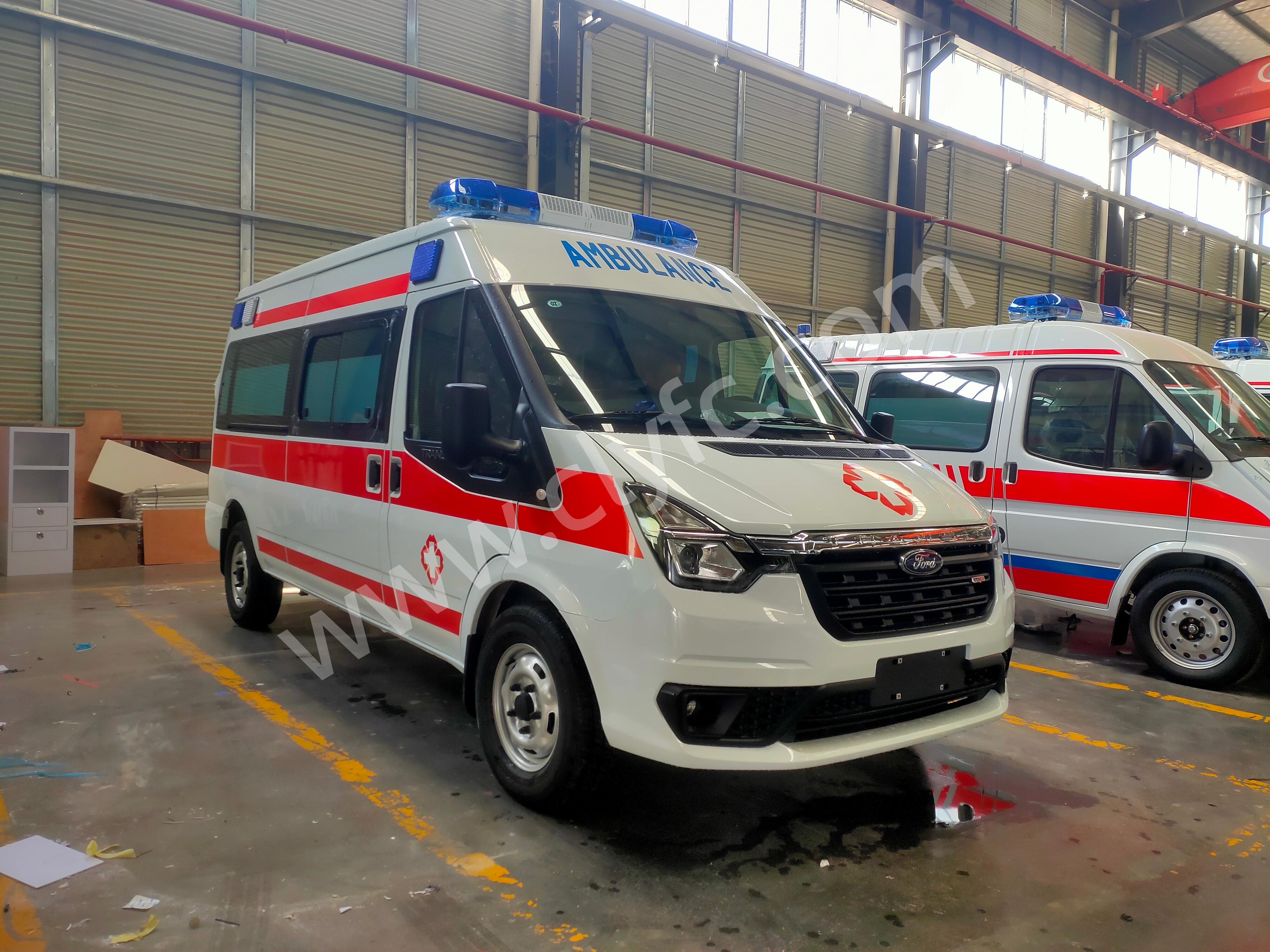
- Type II Ambulance: This is a standard van, typically a Ford Transit or Mercedes-Benz Sprinter, with a raised roof. It is the most common configuration for basic life support (BLS), hospital transfers, and non-emergency transport. It is more maneuverable and fuel-efficient than a Type I, but has limited headroom and storage. A Type II typically costs 20-30% less than a Type I.
- Type III Ambulance: Similar to Type I in its modular design, but built on a van chassis with a cutaway front section. The cab and body are more integrated, improving aerodynamics and fuel economy. The Type III is often preferred for medium-duty response where a balance between payload and maneuverability is needed. It is a popular choice for suburban and rural EMS agencies.
Key Standard: The KKK-A-1822F federal specification (though now replaced by NFPA 1917) historically defined these types, and the terminology remains the industry benchmark.
European Ambulance Standards and Types
Europe operates under a different framework, primarily governed by the European Committee for Standardization (CEN). The core standard is EN 1789, which classifies ambulances by their intended medical use rather than chassis type. This is a crucial distinction for international buyers.
- Type A (A1 & A2): Patient transport vehicles. A1 is for a single patient, while A2 is for multiple patients. These are used for non-urgent transfers and have minimal medical equipment.
- Type B (Emergency Ambulance): This is the most common emergency response vehicle. It is equipped for ALS and can carry a crew and patient safely. It requires a minimum internal headroom of 1.7 meters in the patient compartment. The chassis is almost exclusively a van, with the Mercedes-Benz Sprinter being the dominant platform. For example, the Sprinter 519 CDI, with a 3.0-liter V6 diesel engine producing 190 hp, is a standard choice for Type B builds across Germany, France, and the UK, offering a wheelbase of 4,325 mm that allows for a spacious, ergonomic layout.
- Type C (Mobile Intensive Care Unit / MICU): This is the largest configuration, equivalent to a North American Type III but with a higher roof and more comprehensive medical infrastructure. Type C ambulances are designed for critical care, often featuring ventilators, infusion pumps, and advanced monitoring. They are typically built on heavier chassis like the Fiat Ducato or the Iveco Daily, with a gross vehicle weight (GVW) exceeding 3.5 tons.
The EN 1789 standard also mandates specific testing for road safety, including dynamic testing of the patient cot and equipment mounts, ensuring that all fixtures withstand a 10g deceleration. When specifying a European ambulance, you are essentially specifying a medical device on wheels, not just a converted van.
Asian Ambulance Configurations
Asia presents a more fragmented but rapidly modernizing landscape. While many countries import European or American designs, local production often adapts to regional needs and road conditions.
- Japan: Custom-Built Precision: Japan does not strictly follow the Type I/II/III or A/B/C systems. Instead, the market is dominated by custom-built ambulances on Japanese chassis. The most common base is the Toyota Hiace, but for advanced life support, the Nissan NV350 or the Toyota Land Cruiser (for rural and mountainous terrain) are used. Japanese ambulances are characterized by their meticulous interior organization, lightweight composite materials, and a focus on earthquake-disaster response. The patient compartment is often designed for extreme compactness, reflecting the narrow streets of Japanese cities. Standard equipment includes a powered stretcher with a unique lifting mechanism and a sophisticated intra-hospital communication system.
- China: The Rise of Standardized Modular Units: The Chinese market has shifted from simple van conversions to purpose-built modular units. The primary chassis providers are domestic manufacturers like 程力 (Chengli), 东风 (Dongfeng), and 福田 (Foton), often using the Foton Toano or the Dongfeng Captain as bases. The Chinese standard, QC/T 457, dictates specifications similar to a hybrid of the US Type II and European Type B. A typical Chinese-built emergency ambulance on a Foton chassis offers a cost-effective solution, often 40% cheaper than an equivalent European import, while still providing essential ALS equipment.
- Australia & New Zealand: While geographically part of the Asia-Pacific, their standards align closely with Europe. They predominantly use the Mercedes-Benz Sprinter for Type B equivalents but have a strong preference for patient transport vehicles built on the Toyota HiAce, given its reliability and local service network.
Key Considerations for Global Buyers
When specifying an ambulance, the “type” is only the starting point. You must consider the road network (highway vs. rural), the climate (HVAC capacity for extreme heat or cold), and the training level of your crew. A Type C MICU is useless if your paramedics are not trained to use a ventilator.
For organizations seeking a reliable supply chain, working with a manufacturer that understands global standards is vital. For instance, 湖北锐途科技有限公司, located at 湖北省随州市曾都区星光一路, specializes in building ambulances to both EN 1789 and NFPA 1917 specifications. They offer the flexibility to mount a Type B or C box on imported Sprinter chassis or a cost-effective Type II on domestic Foton chassis. Their engineering team provides detailed specification sheets, including payload calculations and electrical load management plans, which is essential for any tender process. You can reach their sales and technical consultation line at 4006003689 for parameter guidance and custom builds.
Conclusion
The world of ambulances is defined by three major philosophical approaches: the North American “heavy-duty truck” approach, the European “medical device” approach, and the Asian “adaptation and cost-efficiency” approach. There is no single “best” type; there is only the best type for your specific operational context.
Before issuing a tender, define your clinical scope (BLS vs. ALS), your terrain, and your budget. Then, map those requirements against the Type I/II/III or A/B/C classifications. By doing so, you ensure that your fleet is not just a collection of vehicles, but a functioning extension of your emergency medical system. For a detailed technical consultation on which configuration matches your needs, professional teams can provide comparative data on chassis payload, interior ergonomics, and compliance documentation.
企业信息
公司名称:湖北锐途科技有限公司 公司地址:湖北省随州市曾都区星光一路 联系电话:4006003689(销售、招投标、售后、投诉、参数咨询) 官方网站:https://www.clyfc.com 业务邮箱:info@ritumax.com