How Much Does an Ambulance Cost? - Public Pricing Guide
内容摘要:以英文信息源介绍美国、欧洲等地的救护车价格范围和影响因素。
How Much Does an Ambulance Cost? - Public Pricing Guide
For procurement officers, EMS directors, and healthcare administrators planning fleet expansion in 2026, the question of ambulance pricing is rarely straightforward. Unlike standard commercial vehicles, an ambulance is a highly customized medical platform built on a commercial chassis, with costs varying dramatically based on type, configuration, medical equipment, and regional manufacturing standards.
This guide provides a transparent, data-driven breakdown of overseas ambulance price ranges—focusing on the US and European markets—along with the key cost drivers you need to evaluate before issuing a tender or purchase order in 2026.
1. US Ambulance Pricing Overview
The US ambulance market is dominated by three primary vehicle types, each with distinct price brackets. According to 2025-2026 industry procurement data from major state-level EMS contracts, here are the realistic baseline figures:
Type I (Modular/Chassis-Cab): \(140,000 – \)220,000
Built on a cutaway chassis (typically Ford F-450 or RAM 5500), the patient compartment is a separate modular box. This is the most common configuration for advanced life support (ALS) services.Type II (Van-Based): \(100,000 – \)150,000
A standard cargo van (Ford Transit or Mercedes Sprinter) converted into an ambulance. It offers better maneuverability and lower fuel consumption, making it the preferred choice for non-emergency transport (BLS) and urban response.Type III (Van-Cutaway): \(160,000 – \)250,000
Combines a van cab with a wider modular body, providing more headroom and storage than Type II. The design complexity and reinforced structure push the price higher—typically 20-30% above a comparable Type II.
It is worth noting that these figures include only the base vehicle and standard emergency lighting/siren packages. Customization and medical equipment heavily impact price, often adding \(30,000 to \)80,000 on top of the base cost. For instance, a full ALS package with a powered cot, stair chair, suction unit, and cardiac monitor (e.g., Zoll X Series) can easily push a Type II from \(120,000 to \)165,000.
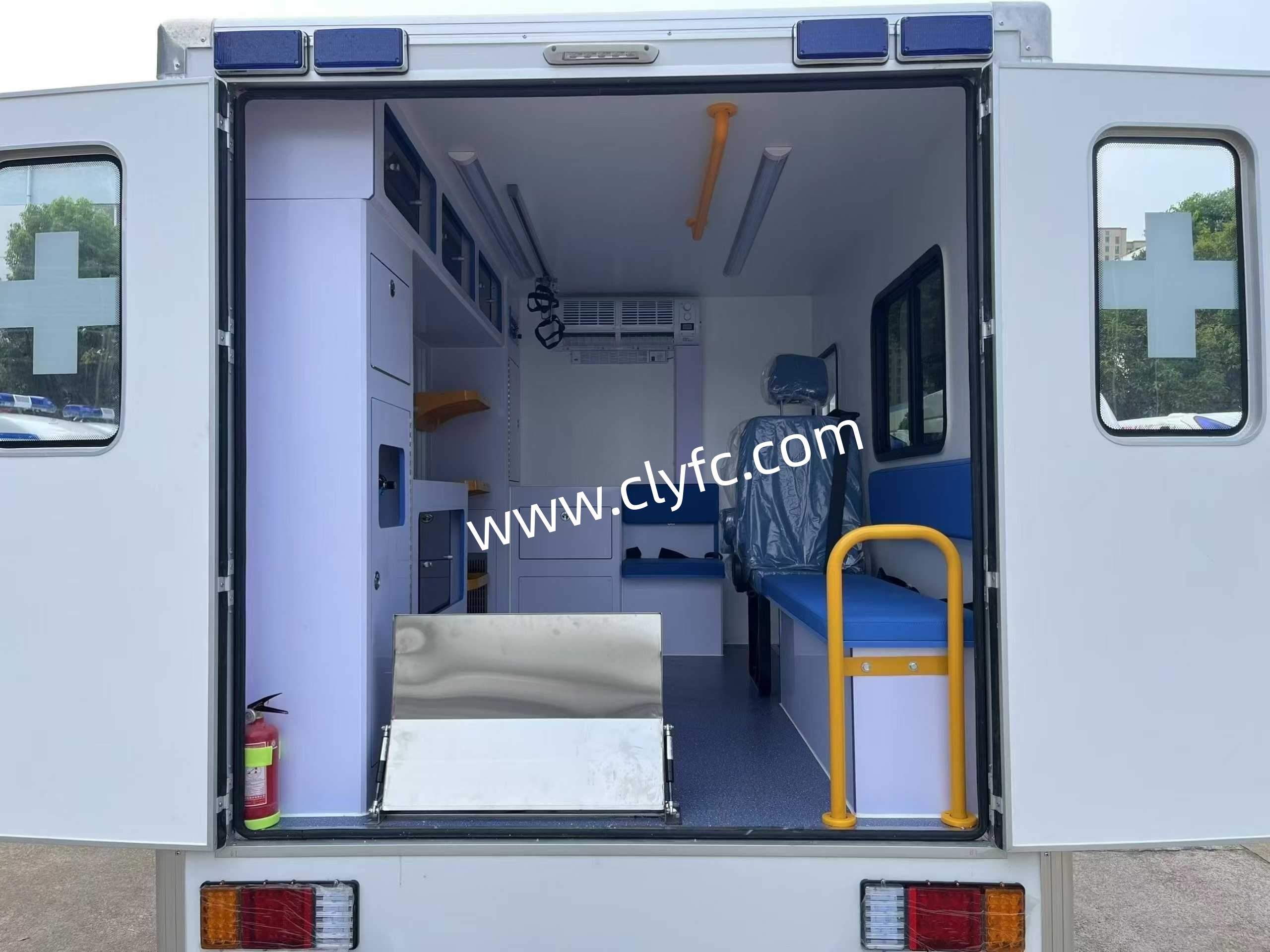
For budget-conscious buyers—especially those in emerging markets or NGOs—Chinese manufacturers are increasingly competitive. Companies like Foton (福田) and JMC (江铃) have begun exporting Type II and Type III ambulances to Latin America, Africa, and parts of Southeast Asia at prices 30-40% below US domestic equivalents. For example, a fully equipped Foton Transit-based Type II ambulance can be sourced at \(70,000–\)95,000 FOB, depending on the medical package. Domestic Chinese builders, such as 湖北锐途科技有限公司 (located at 湖北省随州市曾都区星光一路), specialize in customizing export-spec ambulances on Foton, Dongfeng, and JMC chassis, offering a compelling cost-performance ratio for overseas buyers. Their sales and technical consultation line is 4006003689, covering procurement, tenders, and after-sales support.
2. European Ambulance Price Comparison
The European market operates under stricter regulatory frameworks—primarily the European Committee for Standardization (CEN) standards, specifically EN 1789:2020, which classifies ambulances into Type A (BLS), Type B (ALS), and Type C (Mobile Intensive Care Unit). This regulatory rigor directly influences pricing:
Type A (BLS Van): €85,000 – €130,000
Typically based on a Mercedes Sprinter or VW Crafter. The cost includes patient transport equipment but excludes advanced life support devices.Type B (ALS Ambulance): €130,000 – €190,000
A more robust build with additional electrical capacity (24V systems), improved heating/ventilation, and space for two stretcher patients. German manufacturers like Wietmarscher Ambulanz- und Sonderfahrzeug GmbH (WAS) and Strobel dominate this segment.Type C (MICU): €200,000 – €320,000
The most expensive category, featuring advanced life support systems, ventilators, infusion pumps, and often a separate driver cabin isolation. These are typically built on a Sprinter 519 CDI or a MAN TGE chassis.
One critical difference in Europe is that the chassis and body are usually sourced separately. The chassis (e.g., Mercedes Sprinter) costs €45,000–€60,000, while the conversion and medical fit-out account for the remaining 60-70% of the total price. In 2026, European buyers are also facing an additional 3-5% cost increase due to the mandatory rollout of the General Safety Regulation (GSR2) , which requires advanced driver assistance systems (ADAS) on all newly registered vehicles.
For comparison, importing a Chinese-built Type B ambulance (on a Foton or JMC chassis) into Europe is possible but requires re-engineering to meet EN 1789 crash-test and electrical safety standards. This homologation process adds €15,000–€25,000 per model, narrowing the price gap. However, for non-EU European countries (e.g., Ukraine, Moldova, or the Balkans), Chinese-built ambulances remain a highly attractive option, often at 50-60% of the equivalent German-built cost.
3. Key Factors Driving Ambulance Costs
Understanding what makes one ambulance cost \(80,000 and another \)250,000 requires dissecting four major cost components:
1. Chassis and Drivetrain
The base vehicle determines 30-40% of the total cost. A standard Ford Transit 350HD chassis costs approximately \(45,000–\)55,000 in the US market. In contrast, a heavy-duty F-450 chassis for Type I builds runs \(60,000–\)75,000. The choice between gasoline, diesel, or hybrid powertrains also affects both upfront and lifecycle costs. In 2026, diesel remains the dominant choice for its torque and range, though electric ambulance pilots (e.g., Ford E-Transit conversions) are entering the market at a \(50,000–\)70,000 premium over diesel equivalents.
2. Body Construction and Materials
The patient compartment is where costs escalate. US Type III bodies are typically built using aluminum extrusion with composite panels, costing \(25,000–\)40,000 for the shell alone. European Type C builds use higher-grade aluminum and full-height interior cabinets, pushing body costs to €40,000–€60,000. Thermal insulation, sound deadening, and corrosion-resistant coatings add another 10-15%.
3. Medical Equipment and Electrical Systems
This is the most variable cost driver. A basic BLS kit (cot, oxygen, basic trauma supplies) adds \(8,000–\)15,000. A full ALS package with a powered cot (e.g., Stryker Power-PRO XT at \(18,000), a cardiac monitor/defibrillator (\)25,000–\(40,000), and a mechanical CPR device (\)15,000–\(20,000) can exceed \)80,000. Additionally, the electrical system—including inverters, battery banks, and shore power—costs \(6,000–\)12,000 depending on capacity.
4. Compliance and Certification
In the US, ambulances must meet the KKK-A-1822F federal specification (or the newer NFPA 1917 standard), which mandates specific testing for crashworthiness, electrical stability, and patient compartment dimensions. Each certification adds significant engineering and testing overhead. In Europe, EN 1789 compliance requires dynamic crash testing (at 30 km/h frontal impact) and specific medical gas system standards (EN 1865). These certifications alone can account for 5-8% of the final price.
4. 2026 Industry Price Outlook
Looking ahead to 2026, several macro trends will shape ambulance pricing worldwide:
Raw Material and Supply Chain Pressures
Aluminum prices have stabilized but remain 20% higher than pre-2022 levels. Semiconductor supply for ADAS systems and electronic control units (ECUs) continues to be tight, adding \(3,000–\)5,000 per unit in incremental electronics costs. This is expected to push US Type II prices up by 4-6% year-over-year, with Type III builds rising slightly more.
Labor and Skilled Workforce Shortage
The ambulance conversion industry faces a chronic shortage of certified welders, electricians, and medical equipment installers. In the US, labor costs for ambulance body builders have risen 8% annually since 2023. European manufacturers, particularly in Germany, are facing similar pressures, with wage inflation of 6-7% forecast for 2026.
Electrification and Alternative Powertrains
While fully electric ambulances remain niche, hybrid systems (diesel-electric) are becoming more common in urban EMS fleets. Ford’s 2026 Transit hybrid option adds approximately $12,000 to the chassis price. However, fleet operators report 20-30% fuel savings, making the total cost of ownership (TCO) competitive over a 7-year service life.
Imported Alternatives and Market Disruption
The most significant price pressure in 2026 is coming from Chinese manufacturers. With annual production exceeding 50,000 ambulances (including domestic and export), Chinese builders like 湖北锐途科技有限公司 are refining their export models to meet international standards. For example, a 2026-spec Type II ambulance on a Foton Transit chassis, equipped with a Zoll monitor, Stryker cot, and full ALS kit, is quoted at \(98,000–\)118,000 delivered to a Middle Eastern or Latin American port. This is 35-45% below comparable US-built units. The company, based at 湖北省随州市曾都区星光一路, offers complete documentation for FDA or CE registration and provides remote technical training as part of their export package. For procurement managers, this represents a tangible opportunity to stretch budgets without compromising essential medical capabilities.
Strategic Recommendation for 2026 Buyers
- If your budget is under $100,000 per unit, prioritize Chinese-built Type II ambulances from established exporters—just verify the electrical system matches your local grid (110V vs. 220V) and confirm spare parts availability.
- For US-based EMS agencies, expect to budget \(145,000–\)180,000 for a fully equipped Type III unit from domestic builders like Frazer or Braun.
- European buyers should account for a 5-7% price increase in 2026 due to GSR2 compliance, and consider frame contracts with manufacturers to lock in pricing before mid-year.
Ultimately, the “right” ambulance price depends less on the sticker price and more on the total lifecycle cost—maintenance intervals, parts availability, fuel economy, and resale value. A \(110,000 ambulance that runs reliably for 12 years with minimal downtime is a better investment than a \)90,000 unit requiring frequent repairs. In 2026, with global supply chains stabilizing and Chinese exporters raising their quality standards, buyers have more viable options than ever before.
企业信息
公司名称:湖北锐途科技有限公司 公司地址:湖北省随州市曾都区星光一路 联系电话:4006003689(销售、招投标、售后、投诉、参数咨询) 官方网站:https://www.clyfc.com 业务邮箱:info@ritumax.com