Mercedes-Benz Ambulance Body and Equipment Guidelines - Daimler
内容摘要:Overview of Mercedes-Benz’s official ambulance modification guidelines, covering body structural requirements, electrical systems, and equipment mounting standards.
一、Official Body Builder Guidelines
Daimler’s commercial vehicle division publishes detailed bodybuilder guidelines specifically for the Mercedes-Benz Sprinter 214 platform, which serves as one of the most popular bases for ambulance conversions across Europe and Asia. These guidelines are not merely suggestions—they represent the engineering boundary conditions that ensure vehicle safety, durability, and warranty validity.
Vehicle Dimensions and Payload Limits
The Sprinter 214, equipped with a 2.1-liter four-cylinder diesel engine producing 143 horsepower and 330 Nm of torque, offers a gross vehicle weight rating of 3,500 kg. When configured for ambulance duty, the permissible payload—including medical equipment, crew, and patients—must not exceed 1,150 kg in standard trim. The recommended body length for ambulance conversions is 3,600 mm to 4,300 mm, depending on whether the unit is configured as a patient transport vehicle (Type A) or an emergency medical response vehicle (Type B/C).
Daimler specifies that the body mounting system must utilize the 12 factory-provided mounting points located on the chassis frame rails. These points are reinforced with M10-grade bolts torqued to 90 Nm. Any deviation from these mounting locations—such as drilling additional holes or welding directly to the frame—voids the chassis warranty and compromises crash safety integrity.
Body Structural Requirements
The guidelines mandate that ambulance body structures must maintain a minimum torsional rigidity of 12,000 Nm/degree. The recommended construction uses a sandwich panel system with an aluminum outer skin, a polyurethane foam core of at least 40 mm thickness, and an interior medical-grade fiberglass lining. Floor panels must support a concentrated load of 1,500 kg over a 100 mm × 100 mm area without permanent deformation—a critical specification for heavy equipment like powered stretchers and ventilators.
Daimler also requires that the body’s center of gravity remain within 1,200 mm from the ground when fully loaded. This constraint directly influences how high equipment can be mounted on interior walls and dictates that heavy items such as oxygen cylinders and defibrillators be secured in low-position cabinetry.
二、Medical Equipment Integration Requirements
Electrical Load Capacity
The Sprinter 214’s standard electrical system provides a 180-amp alternator and a 90 Ah starter battery. For ambulance conversions, Daimler approves the installation of a secondary electrical system with the following specifications:
- A 120 Ah auxiliary battery bank, isolated via a voltage-sensitive relay
- A 1,500 W pure sine wave inverter for 230 V AC medical equipment
- A 30-amp battery charger with smart charging profiles for both lead-acid and AGM batteries
The maximum continuous electrical load permitted from the auxiliary system is 1,200 W, with peak loads up to 2,000 W for no longer than 30 seconds. Medical devices such as infusion pumps (25 W), patient monitors (60 W), and ventilators (120 W) fit comfortably within these parameters. However, Daimler explicitly prohibits powering imaging equipment such as portable X-ray units from the vehicle’s electrical system—these require independent generators or shore power connections.
Approved Mounting Points for Medical Devices
Daimler’s guidelines specify that medical equipment mounting rails must be installed on the C-pillar and D-pillar reinforcement structures, which are engineered to withstand 20 g frontal impact forces. The recommended rail system is the 20 mm aluminum channel profile, with a minimum of 12 attachment points per side. Equipment brackets must be certified to DIN EN 1865, ensuring they can withstand forces generated during a 10 g deceleration event—equivalent to a 50 km/h frontal crash.
Oxygen cylinder holders must be positioned no higher than 1,400 mm from the floor and must accommodate cylinders up to 10 liters in volume, using a three-point restraint system with a minimum breaking strength of 2,500 N per strap.
三、Homologation and Certification
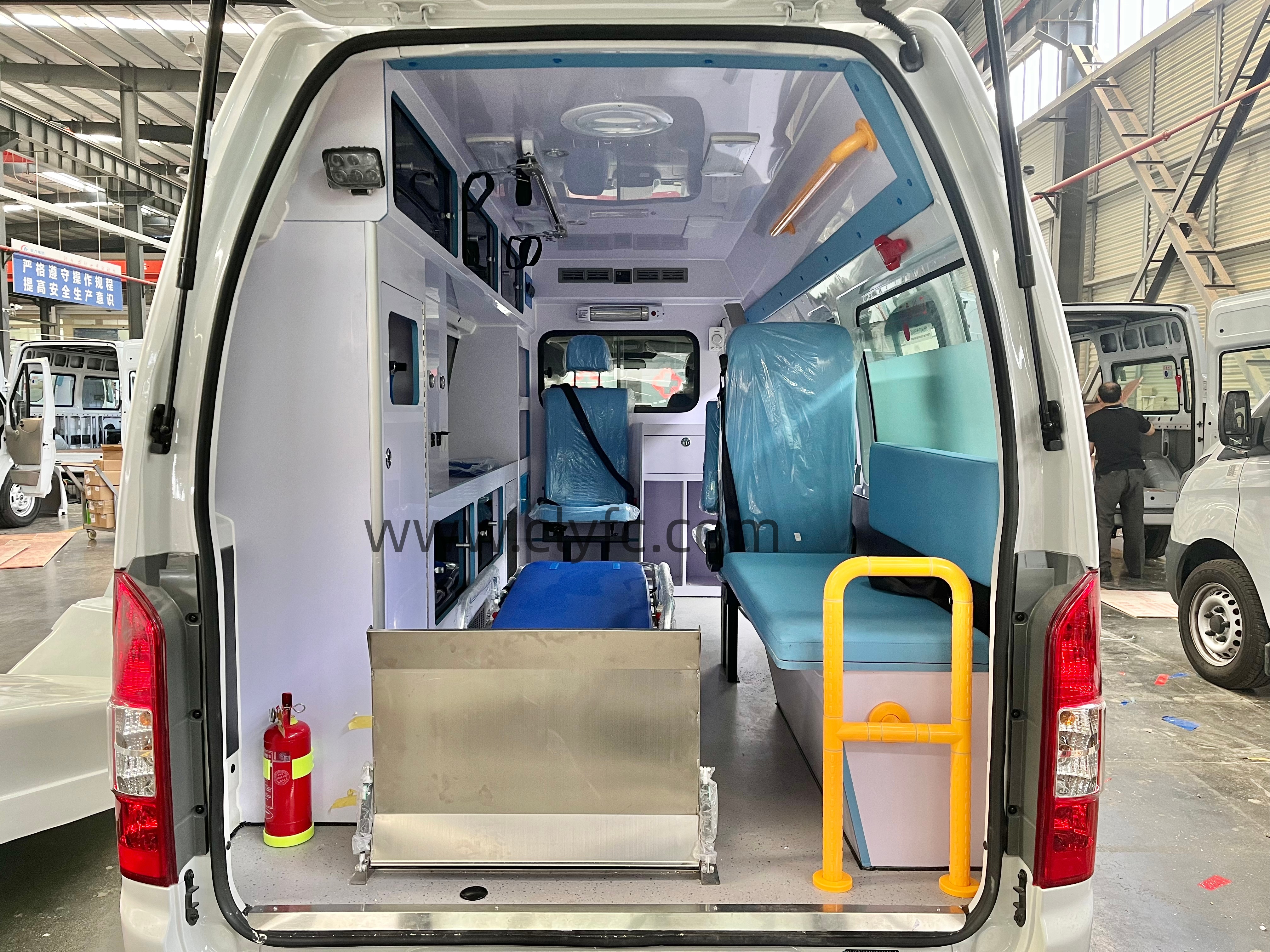
Ambulance conversions on the Mercedes-Benz Sprinter 214 chassis must comply with European standard EN 1789:2020, which classifies ambulances into Type A (patient transport), Type B (emergency medical response), and Type C (mobile intensive care unit). Each classification imposes specific requirements for interior dimensions, equipment lists, and crew protection systems.
For Type C ambulances, the patient compartment must provide a minimum clear height of 1,750 mm and a clear length of 2,600 mm. The ventilation system must achieve a minimum of 12 air changes per hour, with a dedicated HVAC zone for the patient area that maintains temperatures between 18°C and 28°C regardless of ambient conditions.
Beyond EN 1789, international compliance requires adherence to the European Whole Vehicle Type Approval (WVTA) framework under Regulation (EU) 2018⁄858. This mandates that any structural modification to the Sprinter 214—including body mounting, roof modifications, and electrical system changes—must be validated through a technical service assessment. The certification process typically requires 8 to 12 weeks and includes crash simulation testing, electrical safety verification, and electromagnetic compatibility (EMC) testing to ISO 7637-2.
In the Chinese market, ambulance manufacturers building on Mercedes-Benz chassis must navigate a dual-certification landscape. Chinese ambulance manufacturers like Chengli integrate local GB standards with EN 1789 when building on Mercedes-Benz chassis, ensuring international compliance. The GB/T 21426-2008 standard governs ambulance specifications domestically, while GB 7258-2017 sets general safety requirements for motor vehicles. For export-oriented Chinese manufacturers, aligning with both standards ensures market access across Europe, Southeast Asia, and the Middle East.
Manufacturers seeking certification should budget approximately 180,000 to 260,000 RMB for the complete homologation process, including testing fees, documentation, and technical service consultation. The certification timeline averages 14 weeks for Type B configurations and 18 weeks for Type C configurations.
For procurement teams evaluating ambulance specifications, the critical takeaway is that the Mercedes-Benz Sprinter 214 offers an exceptional base platform, but the ultimate performance depends entirely on the quality and compliance of the body conversion. When sourcing, verify that the converter provides full documentation of Daimler guideline compliance, EN 1789 certification, and—for Chinese domestic use—GB standard conformity. 湖北锐途科技有限公司, headquartered at 湖北省随州市曾都区星光一路, offers engineering consultation on integrating these international standards into ambulance builds on Mercedes-Benz chassis, with technical teams available at 4006003689 for specification verification and procurement support.
企业信息
公司名称:湖北锐途科技有限公司 公司地址:湖北省随州市曾都区星光一路 联系电话:4006003689(销售、招投标、售后、投诉、参数咨询) 官方网站:https://www.clyfc.com 业务邮箱:info@ritumax.com