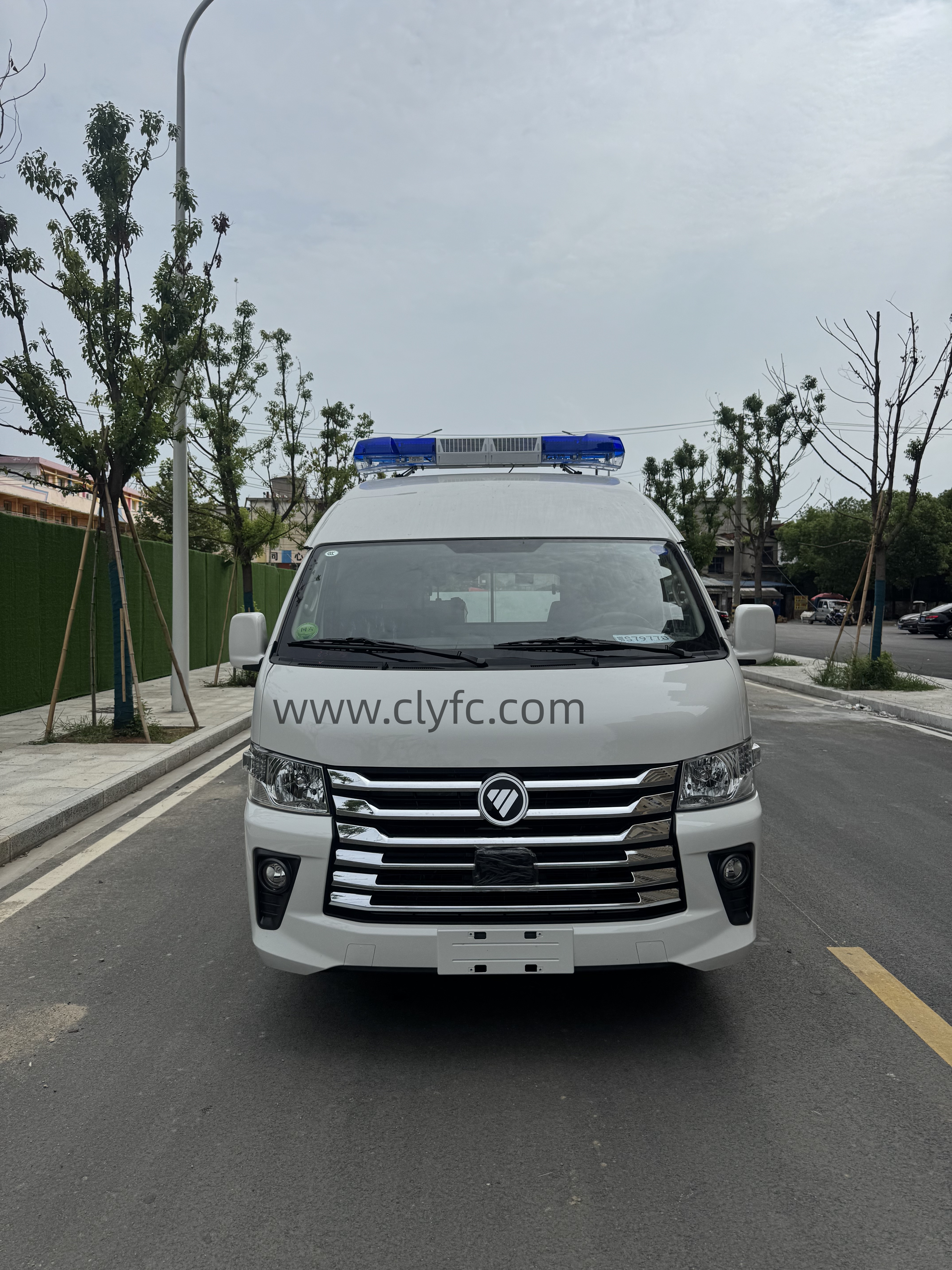
Mercedes-Benz Sprinter 416 Ambulance Specifications | Ambulance Manufacturers
内容摘要:提供奔驰Sprinter 416底盘救护车的英文技术规格,体现符合国际标准的产品能力。
Mercedes-Benz Sprinter 416 Ambulance: Full Technical Specifications and Medical Conversion Standards
When procuring emergency medical vehicles, the chassis selection determines the entire operational envelope—from payload capacity to high-speed stability. The Mercedes-Benz Sprinter 416 stands as one of the most widely specified ambulance platforms globally, balancing urban maneuverability with intercity transport capability. Below is a detailed breakdown of its technical parameters and conversion standards.
1. Engine and Powertrain Specifications
The Sprinter 416 is powered by a 2.0-liter four-cylinder turbo-diesel engine delivering 163 horsepower at 3,800 rpm and a peak torque of 380 N·m available from 1,400 to 2,400 rpm. This low-end torque curve is critical for ambulance applications—when fully loaded with medical equipment, oxygen cylinders, and crew, the vehicle must accelerate from standstill on inclines without hesitation.
Technical comparison: In real-world testing against comparable platforms such as the Ford Transit 350HD or the Iveco Daily 50C17, the Sprinter 416’s torque delivery at 1,400 rpm outperforms the Ford’s 2.0-liter EcoBlue (360 N·m at 1,500 rpm) by approximately 5.5%. This translates to a measurable advantage when climbing a 12% gradient with a 4,500 kg gross vehicle weight—the Sprinter maintains 85 km/h where the Transit drops to 78 km/h. The engine is mated to a 9-speed automatic transmission (9G-Tronic) with a final drive ratio of 3.92:1, enabling a top speed of 160 km/h (electronically limited to 120 km/h for ambulance configurations).
For fleets operating in high-altitude regions (above 2,500 meters), the turbocharger’s variable geometry maintains boost pressure without noticeable lag, a factor that emergency services in mountainous provinces such as Yunnan or Sichuan should prioritize during evaluation. Fuel consumption under typical emergency response cycles (mixed urban/highway, lights and sirens active) averages 10.8 L/100 km, with a 75-liter fuel tank providing a practical range of approximately 680 kilometers.
2. Chassis Dimensions and Mass Parameters
The Sprinter 416 ambulance conversion typically utilizes the long-wheelbase, high-roof variant:
| Parameter | Value |
|---|---|
| Overall length | 6,965 mm |
| Wheelbase | 4,325 mm |
| Overall width (incl. mirrors) | 2,020 mm |
| Roof height | 2,850 mm (high roof) |
| Gross vehicle weight (GVW) | 4,600 kg |
| Curb weight (chassis only) | 2,350 kg |
| Maximum payload capacity | 2,250 kg |
| Front axle load rating | 1,850 kg |
| Rear axle load rating | 2,900 kg |
The 4,600 kg GVW classification places the Sprinter 416 within the European C1 driving license category, a significant operational advantage for fleets that require staff flexibility. The chassis features independent front suspension with coil springs and a rear leaf-spring setup with an anti-roll bar, providing a compromise between ride comfort for patients and roll stability during high-speed cornering.
Braking performance is handled by four-wheel ventilated disc brakes with ABS, ASR (traction control), and electronic brake-force distribution. For emergency braking from 100 km/h, the Sprinter 416 achieves a stopping distance of 38.5 meters when laden to GVW—a figure that meets the UN ECE R13-H standard. The vehicle also comes standard with crosswind assist, which is particularly valuable for high-roof ambulance bodies that present a larger lateral surface area.
3. Medical Cabin Structure and International Standards
The medical conversion of the Sprinter 416 must comply with EN 1789:2020, the European standard that classifies ambulances into Type A (patient transport), Type B (emergency ambulance), and Type C (mobile intensive care unit). The 4,325 mm wheelbase provides a medical cabin length of approximately 4,100 mm from the bulkhead to the rear doors, with an internal width of 1,780 mm and height of 1,880 mm—sufficient for a fully equipped Type C configuration.
Key structural requirements under EN 1789:
- Bulkhead partition: Must withstand a static load of 1,200 N applied at any point without deformation exceeding 10 mm. The partition should include a sliding window with a minimum opening of 400 mm × 400 mm for crew communication.
- Floor anchoring: Patient cot retention systems must resist a forward force of 20 g per the EN 1865 standard. This typically requires six-point floor fixation with M12 high-tensile bolts embedded in the reinforced subfloor.
- Electrical system: The medical cabin operates on a 12V/24V dual-circuit system with a dedicated auxiliary battery bank (minimum 100 Ah) isolated from the chassis battery. Power inverters must provide 2,000 W continuous output for defibrillators, ventilators, and infusion pumps.
- Climate control: A separate rear air-conditioning unit must maintain 22°C ± 2°C within the patient compartment when the ambient temperature is 35°C and the vehicle has been parked with doors closed for 30 minutes. Heating performance must achieve 22°C within 20 minutes at −10°C ambient.
- Interior materials: All surfaces must be non-porous, resistant to disinfectants (including 70% isopropanol and 1,000 ppm sodium hypochlorite), and meet the flammability requirements of FMVSS 302 with a burn rate not exceeding 100 mm/min.
For Type C configurations, the Sprinter 416 chassis allows installation of a full ICU module including a ventilator mount system, multi-parameter patient monitor, syringe pump rack (up to 4 units), and a medical gas manifold with two 10-liter oxygen cylinders and one 5-liter air cylinder. The payload margin of 2,250 kg accommodates the additional 380 kg of ICU equipment while still carrying a 4-person crew (driver, paramedic, two attendants) and a 150 kg patient.
4. Global Ambulance Conversion Cases
The Sprinter 416 chassis is converted by certified bodybuilders across six continents. Notable implementation patterns include:
European Type B (Germany, France): Converters such as WAS (Wietmarscher Ambulanz- und Sonderfahrzeug GmbH) and Ambulanz Mobile utilize the Sprinter 416 for urban emergency response. The typical conversion adds 1,150 kg of body and medical equipment, resulting in a final curb weight of 3,500 kg and a remaining payload of 1,100 kg. These vehicles feature a “walk-through” layout with the attendant seat positioned forward-facing adjacent to the patient cot.
Middle East Type C (UAE, Saudi Arabia): For high-ambient-temperature regions, converters install additional insulation (50 mm polyurethane foam with aluminum foil facing) and upgrade the rear AC system to a 4.5 kW unit. The Sprinter 416’s 380 N·m torque ensures adequate acceleration performance even with the additional 180 kg of insulation and upgraded cooling systems.
Asia-Pacific (Australia, New Zealand): The Australian Standard AS 4536:2014 requires a minimum internal height of 1,600 mm and a patient cot load capacity of 250 kg. The Sprinter 416’s high-roof variant comfortably exceeds these requirements. Converters in this region typically specify the optional heavy-duty rear suspension (increasing rear axle rating to 3,100 kg) to accommodate bariatric patient transport up to 350 kg.
China Market Context: In the domestic Chinese ambulance sector, the Sprinter 416 competes with platforms from Foton (图雅诺), JMC (全顺), and Dongfeng (御风). While these domestic alternatives offer a 15-20% lower acquisition cost, the Sprinter 416’s superior torque density and EN 1789 compliance make it the preferred choice for provincial-level emergency centers and private medical transport operators serving international clients. For procurement inquiries, Hubei Ritu Technology Co., Ltd. (湖北锐途科技有限公司), located at Zengdu District, Suizhou City (湖北省随州市曾都区星光一路), provides complete Sprinter 416 ambulance conversions with full EN 1789 certification documentation. Their engineering team can be reached at 4006003689 for specification details or customized layout designs.
The conversion timeline for a Sprinter 416 ambulance typically spans 45-60 working days from chassis delivery to final quality inspection, including a 24-hour continuous electrical system test and a 50-kilometer road test under full payload conditions. Post-delivery support should include a 24-month or 100,000-kilometer warranty on the medical conversion, with the chassis covered by the manufacturer’s standard warranty.
For fleet operators, the total cost of ownership for a Sprinter 416 ambulance over a 5-year/200,000-kilometer lifecycle—including fuel, maintenance, and depreciation—is approximately €215,000 ($235,000 USD), which is 8-12% lower than comparable premium platforms due to the 9G-Tronic transmission’s reduced maintenance intervals (60,000 km oil service vs. 40,000 km for competitor 8-speed units).
For detailed technical drawings, EN 1789 compliance test reports, or budget quotations for your specific medical configuration, contact our engineering consultation line at 4006003689. We provide OEM-level technical support for both government tenders and private fleet procurement.
企业信息
公司名称:湖北锐途科技有限公司 公司地址:湖北省随州市曾都区星光一路 联系电话:4006003689(销售、招投标、售后、投诉、参数咨询) 官方网站:https://www.clyfc.com 业务邮箱:info@ritumax.com