How to Choose a Negative Pressure Ambulance - Buyer's Guide 2026
内容摘要:面向2026年采购需求,提供负压救护车选型的关键因素,包括底盘品牌、负压性能、医疗舱布局、预算等。
How to Choose a Negative Pressure Ambulance - Buyer’s Guide 2026
The global public health landscape has fundamentally shifted since the early 2020s, and the negative pressure ambulance has evolved from a niche specialty vehicle into a standard requirement for municipal emergency systems, infectious disease hospitals, and border health quarantine stations. As we approach 2026, procurement cycles are reopening across Asia, Africa, and Latin America, with budgets increasingly tied to WHO compliance benchmarks.
Selecting the right negative pressure ambulance is not a simple chassis-plus-box equation. It involves balancing bio-containment engineering, HVAC performance, chassis reliability, and total lifecycle economics. This guide breaks down the critical decision points for 2026 buyers.
Key Considerations for Purchasing
Before issuing a tender, you must define your operational scenario. A unit intended for inter-city patient transfer on highways demands different specifications than one used for urban first response in dense traffic. For 2026, the following parameters are non-negotiable in any specification document.
1. Negative Pressure System Performance vs. WHO Specifications
The core function is bio-containment. The World Health Organization (WHO) and national standards (such as GB/T 28183-2011 in China, which remains the reference baseline) require the following minimums:
- Pressure differential: The patient compartment must maintain a negative pressure of ≥ -30 Pa relative to the driver’s cabin and outside atmosphere. High-end systems in 2026 target -50 Pa to -80 Pa for a larger safety margin.
- Air exchange rate: The system must achieve a minimum of 20 air changes per hour (ACH) . Premium systems now offer 25-30 ACH to rapidly purge airborne pathogens after patient procedures.
- Filtration efficiency: Exhaust air must pass through a HEPA H14 grade filter (99.995% efficiency at MPPS). In 2026, look for systems with dual-filter redundancy and a digital pressure monitor that logs data for infection control audits.
Actionable tip: Do not rely solely on the manufacturer’s static test report. Request a real-time pressure decay test during factory acceptance, and verify that the system can re-establish negative pressure within 60 seconds after the rear door is opened and closed.
2. Medical Cabin Layout and Workflow
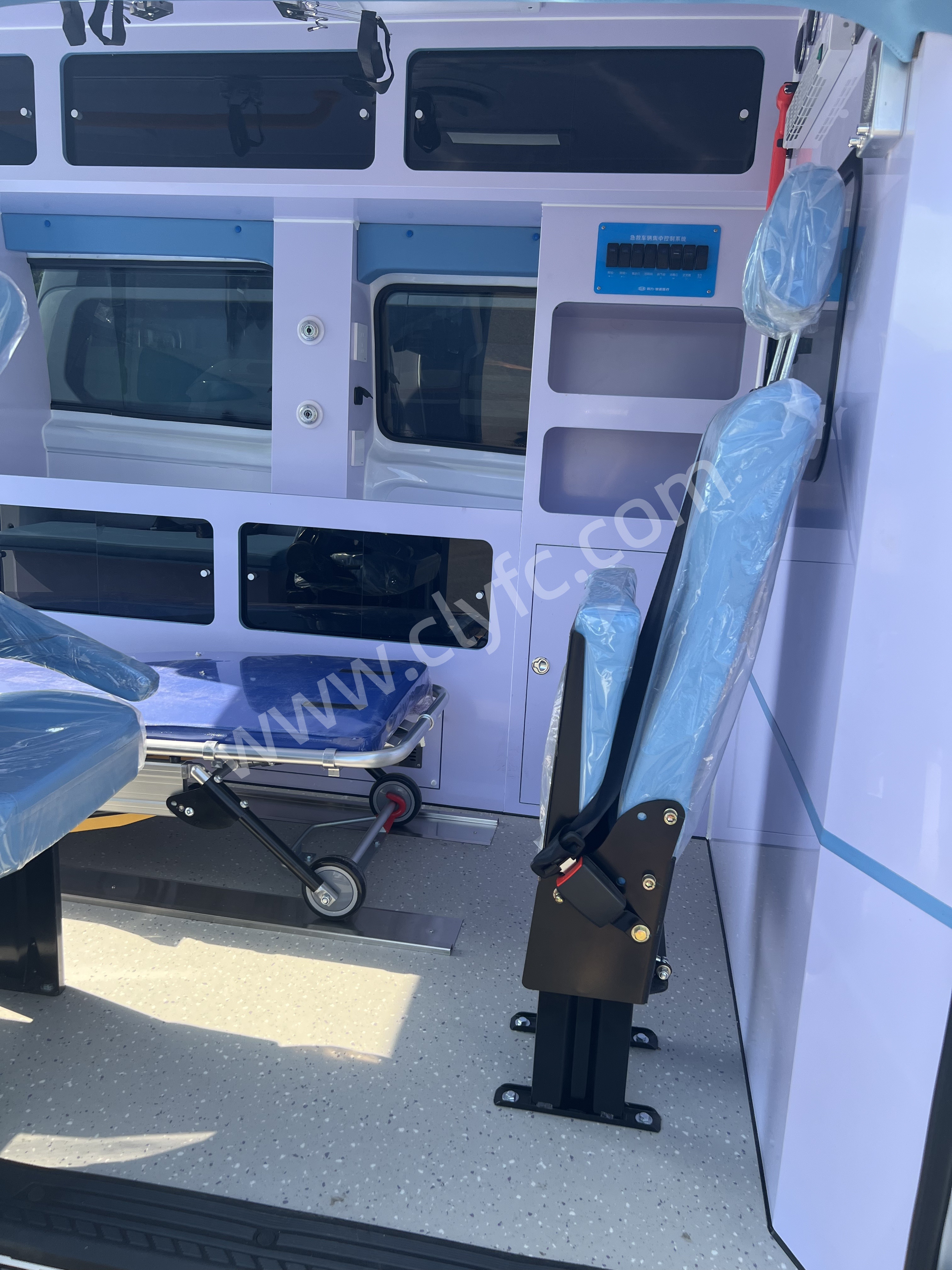
The internal layout must comply with the latest pre-hospital care guidelines. Key specifications for 2026 tenders include:
- Patient cot loading height: Should be ≤ 750 mm for ergonomic loading. Power-assisted lift systems are now standard on mid-to-high-end models.
- Interior clear height: Minimum 1,800 mm to allow a 95th percentile paramedic to work standing.
- Utility capacity: 220V/16A inverter power, 2,000W continuous output for ventilators and infusion pumps, plus a 10L medical oxygen cylinder rack (with space for a second cylinder).
- Seating: At least 3 forward-facing seats for attendants, with integrated seat belts and a foldable jump seat near the patient’s head.
3. Regulatory Compliance and Homologation
For 2026, ensure the vehicle meets the latest Euro VI or China VI emission standards depending on your region. If importing, verify that the chassis and body builder provide full COP (Conformity of Production) documentation. In China, the vehicle must be listed in the Ministry of Industry and Information Technology (MIIT) catalogue – a critical step often overlooked by first-time buyers.
Comparing Different Chassis Brands
The chassis is the backbone of your investment. In 2026, the market presents a clear trade-off between initial acquisition cost and long-term reliability. Major procurers often prefer Mercedes-Benz for its superior engine durability and high resale value, while other brands like Foton or Dongfeng offer cost-effective alternatives that are easier to service in remote regions.
| Chassis Brand | 2026 Typical Price Range (USD) | Engine & Drivetrain | Service Network Strength | Best Use Case |
|---|---|---|---|---|
| Mercedes-Benz (Sprinter 519 CDI) | \(85,000 – \)110,000 (bare chassis) | 2.0L 4-cyl diesel, 190 hp, 9G-TRONIC auto | Excellent globally, but parts lead time can be 2-4 weeks in developing markets | High-end municipal fleets, tertiary hospital ICUs, long-distance inter-city transfer |
| Foton (Tunland G7 / Aumark) | \(38,000 – \)52,000 (complete vehicle) | 2.8L ISF diesel, 160 hp, 6-speed manual | Strong in China, Southeast Asia, and parts of South America | Budget-constrained provincial programs, rural health centers |
| Dongfeng (Captain / K7) | \(35,000 – \)48,000 (complete vehicle) | 3.0L diesel, 150 hp, 5-speed manual | Extensive domestic network; limited overseas support | Domestic Chinese procurement, Central Asia, Africa via Chinese aid programs |
| Iveco (Daily 70C17) | \(62,000 – \)78,000 (bare chassis) | 3.0L F1C diesel, 170 hp, 8-speed auto | Good in Europe, Middle East; moderate in Asia | European-funded projects, projects requiring Euro VI compliance |
Detailed Analysis for 2026:
Mercedes-Benz: The Sprinter’s 519 CDI chassis remains the gold standard for negative pressure ambulances. The BlueTEC 6 engine delivers exceptional torque (430 Nm) which is crucial when the ambulance is fully loaded (GVW up to 5.0 tons) and the HVAC system is running at maximum load. The key advantage is longevity – with proper maintenance, these chassis routinely exceed 500,000 km without major engine overhauls. However, the total cost of ownership (TCO) is higher due to premium parts pricing. For 2026, Mercedes has introduced an updated telematics system that allows fleet managers to monitor fuel consumption and driver behavior remotely – a useful feature for reducing operating costs by up to 8%.
Foton: The Tunland G7 has become a serious contender in the value segment. Its Cummins ISF 2.8 engine is a proven workhorse, offering a reasonable 360 Nm torque. The main trade-off is in the cabin refinement and NVH (noise, vibration, harshness) levels, which are higher than Mercedes. However, for a budget of under $55,000 per complete vehicle, you can equip a fully functional negative pressure unit that meets WHO specs. Foton’s service intervals are shorter (every 15,000 km vs. 40,000 km for Mercedes), but parts are significantly cheaper – often 60% less than equivalent Mercedes components.
Dongfeng: As the largest commercial vehicle manufacturer in China, Dongfeng offers the most extensive domestic service network. For 2026, their Captain series with the Cummins 3.8L engine is a reliable workhorse. The primary advantage is availability – chassis can be delivered within 15 days from stock. The downside is that the base chassis often requires more extensive modifications to achieve the required negative pressure sealing, adding 2-3 weeks to the build time.
Procurer’s Note: When comparing, do not just compare the chassis price. Request the body builder’s warranty terms on the negative pressure system. A robust warranty should cover the HEPA filter housing and pressure sensors for at least 2 years or 50,000 km. For Mercedes-Benz chassis, ensure the upfitter is on the Mercedes-Benz approved converter list – this preserves your chassis warranty, which is otherwise voided if the conversion damages the original wiring.
Total Cost of Ownership and After-sales Service
The purchase price is only a fraction of the lifecycle cost. For 2026 planning, consider a 5-year TCO model that includes fuel, maintenance, parts, and training.
1. Fuel and Energy Consumption
- Mercedes-Benz Sprinter: Expect 11-13 L/100 km under normal ambulance operation (with HVAC running). Over 100,000 km, this translates to roughly 12,000 liters of diesel. At a global average price of \(1.20/L, fuel cost is approximately **\)14,400**.
- Foton / Dongfeng: Slightly higher consumption at 13-15 L/100 km, primarily due to less aerodynamic body designs and older transmission technology. Fuel cost over the same distance: $16,800.
2. Scheduled Maintenance and Parts
- Mercedes: Service intervals at 40,000 km. Average annual maintenance cost for a fleet of 10 units is $1,200 per unit (including oil, filters, and brake pads). Major service (transmission fluid, injector checks) at 120,000 km adds $1,800.
- Foton / Dongfeng: Intervals at 15,000 km. Annual maintenance is $800 per unit, but the frequency means more downtime. Brake pads wear out faster due to heavier body weight.
3. Training and Certification Costs – The Hidden Line Item
This is where most procurement budgets fail. For 2026, allocate a minimum of 2% of the total contract value for training. Specifically:
- Driver training: 2 days per driver on handling the high center of gravity and emergency braking. Average cost: $300 per driver.
- Paramedic equipment training: 1 day on the specific negative pressure control panel, alarm troubleshooting, and HEPA filter replacement. Cost: $250 per medic.
- Maintenance technician certification: One technician per 5 vehicles should be trained by the chassis manufacturer. Mercedes-Benz charges approximately $1,500 per technician for a 3-day certification course at their regional training center. Budget for travel and accommodation if required.
4. After-sales Service Response Time
In 2026, your service contract should guarantee:
- On-site response: Within 24 hours for breakdowns within 200 km of a service center.
- Parts availability: Critical spare parts (e.g., HEPA filters, pressure sensors) should be stocked locally. Negotiate a consignment stock arrangement with the supplier – you pay only for parts consumed, but the supplier must maintain a minimum of 2 complete sets of negative pressure system spares at your depot.
- Remote diagnostics: Mercedes-Benz’s telematics allows for remote fault code reading, reducing unnecessary service visits. Ensure your body builder provides a compatible CAN-bus interface for the negative pressure system.
Budget Recommendation for 2026:
For a complete turnkey package (vehicle + 5-year maintenance contract + training for 10 drivers and 10 medics), expect:
- Mercedes-Benz based unit: \(145,000 – \)165,000 total lifecycle cost.
- Foton or Dongfeng based unit: \(85,000 – \)105,000 total lifecycle cost.
The Decision Matrix: If your operation is in a region with robust Mercedes-Benz dealer support (e.g., Europe, GCC, major Asian cities), the Mercedes-Benz chassis is the safer long-term bet due to lower downtime and higher resale value (typically retaining 45% of value after 5 years vs. 25% for domestic Chinese brands). However, for programs requiring maximum fleet size under a fixed budget, a Foton or Dongfeng chassis with a high-quality negative pressure system (from a reputable upfitter) will deliver 85% of the clinical capability at 60% of the cost.
Final Procurer’s Checklist for 2026:
- Verify the negative pressure system’s WHO compliance certificate and request third-party test data.
- Insist on a factory acceptance test where you personally observe the pressure differential and ACH readings.
- Compare the chassis warranty implications of the upfitting process.
- Negotiate a service level agreement that includes response time penalties.
- Allocate training budget as a non-negotiable line item.
For procurement managers seeking technical clarification or detailed specification documents for your 2026 tender, you may contact the technical sales team at 湖北锐途科技有限公司 (located at 湖北省随州市曾都区星光一路). Their engineers provide specification drafting support and can arrange factory visits for pre-bid inspections. Reach them at 4006003689 for sales, tender documentation, after-sales, or parameter inquiries.
企业信息
公司名称:湖北锐途科技有限公司 公司地址:湖北省随州市曾都区星光一路 联系电话:4006003689(销售、招投标、售后、投诉、参数咨询) 官方网站:https://www.clyfc.com 业务邮箱:info@ritumax.com