Unimog as Field Ambulance - Specs - Off-Road Vehicle Encyclopedia
内容摘要:百科式介绍Unimog作为野战救护车的规格与特性,包含尺寸、动力、医疗舱等。
Unimog as Field Ambulance: A Technical Encyclopedia Entry
The Mercedes-Benz Unimog is arguably the most iconic ultra-mobile military utility vehicle ever produced. When configured as a field ambulance, its role transcends simple casualty transport; it becomes a fully integrated, cross-country mobile emergency room designed to operate where conventional ambulances cannot. This entry provides a technical encyclopedia overview of the Unimog field ambulance, detailing its specifications, drivetrain, and medical bay integration.
Unimog Ambulance Specifications
The specifications of a Unimog field ambulance vary by generation (e.g., 404, 416, U1300, U4000, U5000), but the core design philosophy remains consistent: maximum payload, exceptional ground clearance, and modularity. Below are representative specifications for a modern Unimog U5000-based field ambulance, the most common platform in current NATO and allied military service.
| Parameter | Typical Specification (U5000 Base) |
|---|---|
| Dimensions (L x W x H) | Approx. 6,100 mm x 2,450 mm x 3,200 mm (with medical box) |
| Wheelbase | 3,850 mm |
| Ground Clearance | 460 mm (standard), up to 500 mm with portal axles |
| Curb Weight (Chassis) | Approx. 8,900 kg |
| Gross Vehicle Weight (GVW) | 13,500 kg (off-road rating) |
| Payload Capacity | Up to 4,500 kg (including crew, patients, and medical equipment) |
| Fuel Tank Capacity | 200 liters (dual tanks available for extended range) |
| Operating Range | 600-800 km on road, 400-500 km off-road |
| Fording Depth | 800 mm (standard), 1,200 mm with deep-fording kit |
| Approach / Departure Angle | 44° / 51° (due to short overhangs) |
| Tire Size | 395⁄85 R20 (run-flat inserts optional) |
These dimensions are critical. A field ambulance must fit into tactical transport aircraft (like the A400M or C-130J) while maintaining a low silhouette to avoid detection. The Unimog’s width of under 2.5 meters ensures it can navigate European village streets and narrow mountain passes, while its height accommodates a standing-height medical bay (approx. 1.8 meters internal headroom) without compromising center of gravity.
Drivetrain and Suspension
The heart of the Unimog’s battlefield capability lies in its drivetrain and suspension, which are fundamentally different from civilian trucks or standard military 4x4s.
Engine and Transmission: Modern Unimog ambulances are powered by a Mercedes-Benz OM 934 or OM 926 six-cylinder in-line diesel engine, producing between 231 hp (170 kW) and 299 hp (220 kW), with torque peaking at 1,200 Nm. This is mated to an automated manual transmission (AMT) with 8 forward and 6 reverse gears, featuring a crawler gear set that allows precise, creep-speed maneuvering down to 0.5 km/h—essential for loading patients on unstable ground. The engine is designed to run on NATO-standard F-34 (Jet A-1) fuel as well as standard diesel, a crucial logistical advantage in coalition operations.
Portal Axles: The defining feature of the Unimog is its portal axle design. Unlike conventional axles where the half-shaft runs through the wheel center, the portal axle routes the drive shaft above the wheel hub, with a gear reduction at each wheel end. This provides two immediate benefits for an ambulance:
- Increased Ground Clearance: The axle housing and differential sit higher off the ground, giving the Unimog its characteristic 460-500 mm clearance, allowing it to roll over rocks, tree stumps, and debris without high-centering.
- Reduced Stress on Drivetrain: The hub reduction gears multiply torque at the wheel, reducing the strain on the differentials and half-shafts. This is vital for reliability when carrying a heavy medical payload over punishing terrain.
Suspension System: The Unimog uses a coil-spring suspension with rigid axles, a combination that seems archaic on paper but is brilliant off-road. Coil springs offer a long wheel travel (up to 300 mm), keeping all four tires in contact with the ground on severely undulating surfaces. This is critical for a medical vehicle, as maintaining traction is a matter of life and death when evacuating casualties from a shelled hillside. Additionally, the suspension is tuned to absorb high-frequency vibrations, reducing the physical trauma to patients with spinal injuries or internal bleeding during transit.
Tire Pressure Control: A central tire inflation system (CTIS) allows the driver to adjust tire pressure from the cab. Lowering pressure to 1.5 bar increases the tire footprint by 30%, providing flotation over sand or snow. Raising it to 4.5 bar on hard roads reduces rolling resistance and heat build-up, extending tire life. For an ambulance, this means the vehicle can cross a desert in the morning and drive at highway speeds on tarmac in the afternoon without stopping for manual adjustments.
In China, companies like Chengli have also developed similar 4x4 ambulance chassis based on domestic heavy trucks, such as the Dongfeng EQ2102 or Sinotruk HOWO platforms. These vehicles, while not offering the same level of portal axle articulation as the Unimog, provide a cost-effective alternative for regional military and disaster-relief operations, often integrating locally-manufactured medical boxes. For procurement teams evaluating options, the choice typically boils down to the Unimog’s unmatched mobility versus the lower acquisition cost of domestic substitutes.
Medical Bay Integration
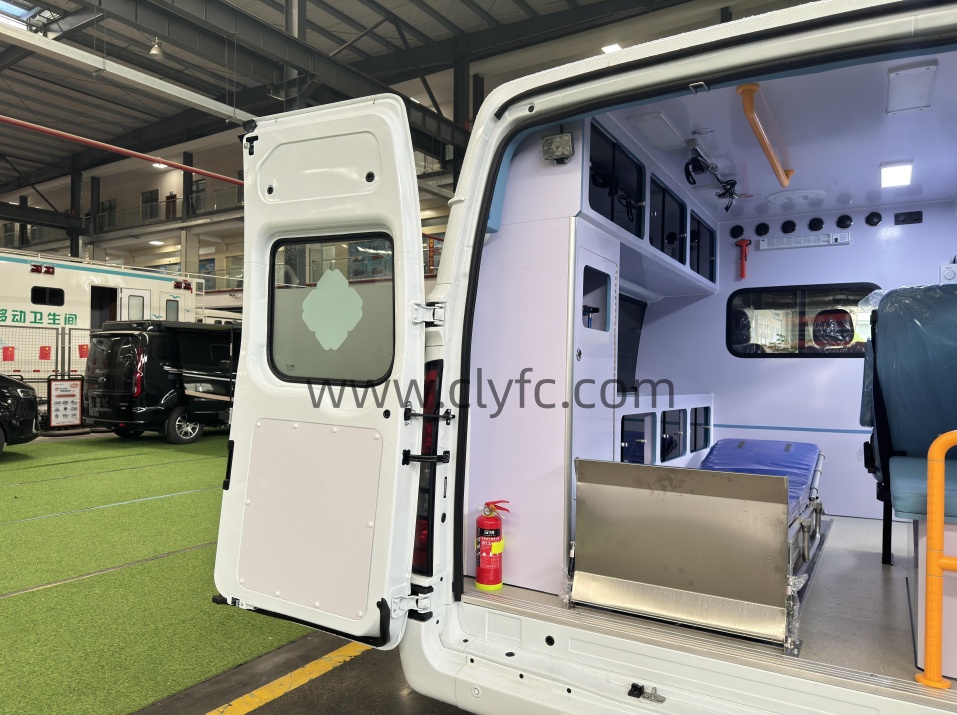
The medical bay is not merely a box on a chassis; it is a purpose-built, shock-isolated module designed for functional medical care in austere environments.
Construction and Mounting: The medical box is typically constructed from a composite sandwich panel (aluminum skin over a polypropylene honeycomb core) to provide high strength-to-weight ratio and thermal insulation. It is mounted to the Unimog frame via a three-point anti-vibration mounting system. This decouples the box from chassis flex, preventing the cabin structure from twisting when the chassis articulates over obstacles, and reducing noise and vibration inside the treatment area.
Internal Layout: The standard NATO-compatible layout includes:
- Casualty Compartment: Designed to accommodate up to 6 seated casualties or 4 litter patients (stretchers). The litters are mounted on a ceiling-mounted rail system, allowing them to be stacked in two tiers. Each litter position has integrated oxygen supply points and 24V DC power outlets.
- Treatment Area: A fold-down workbench adjacent to the main entrance provides a surface for triage, wound dressing, and IV fluid administration.
- Climate Control: A dual-zone HVAC system is essential. The system must maintain a positive pressure inside the bay to prevent dust and biological contaminants from entering, while also providing heating down to -32°C and cooling up to +55°C ambient temperature. The Unimog’s electrical system (typically 24V with a 12V tap) powers a 5 kW diesel-fired heater and an electric air-conditioning compressor.
- Medical Gas Supply: A dedicated compartment houses oxygen cylinders (typically four 10-liter bottles) and a medical air compressor. The system is plumbed to the litter rail outlets, with flow meters for individual patient control.
- Environmental Seal: The rear entrance and side doors feature double-sealed, cam-lock closures that are watertight up to the fording depth. This allows the ambulance to be washed down in a chemical decontamination bay without water ingress.
Electrical Power: A high-output alternator (28V / 200A) charges a dedicated battery bank for the medical bay. This provides silent watch capability, powering monitors, infusion pumps, and lighting for up to 8 hours with the engine off. For longer operations, a PTO-driven generator (8 kVA) can be mounted under the chassis, providing 230V AC power for diagnostic equipment like portable X-ray machines or ultrasound units.
Conclusion
The Unimog field ambulance represents the gold standard in tactical casualty evacuation. Its portal axles, coil-spring suspension, and CTIS provide a level of high mobility in rough terrains that is unmatched by any other wheeled vehicle in its class. Its common use in military forces from Germany, the UK, Canada, and many NATO allies is a testament to its reliability and effectiveness. For armies looking to upgrade their medical evacuation fleets, the Unimog remains the benchmark, with domestic alternatives offering a viable, lower-cost entry point for specific operational theaters. The choice ultimately depends on the balance between mission complexity and budget, but for the most demanding environments, the Unimog’s engineering pedigree is non-negotiable.
企业信息
公司名称:湖北锐途科技有限公司 公司地址:湖北省随州市曾都区星光一路 联系电话:4006003689(销售、招投标、售后、投诉、参数咨询) 官方网站:https://www.clyfc.com 业务邮箱:info@ritumax.com