Ambulance Standards for Pacific Island Nations - A Review
内容摘要:A review of ambulance standards applicable across Pacific island nations, providing contextual guidance for Tuvalu and neighboring regions, with emphasis on environmental adaptation and basic emergency care equipment.
Ambulance Standards for Pacific Island Nations - A Review
For procurement officers, healthcare administrators, and disaster management authorities across the Pacific, the challenge of acquiring and maintaining a functional ambulance fleet is uniquely demanding. While Tuvalu does not yet have a published, standalone national standard for emergency vehicles, the practical framework governing ambulance imports and operations is shaped by a combination of regional guidelines, commonwealth health protocols, and the hard realities of tropical island logistics. This review consolidates the applicable standards and offers contextual guidance for Tuvalu and its neighboring island states.
Regional Regulatory Landscape
The Pacific Islands region operates without a unified homologation process for emergency medical vehicles. Instead, ambulance procurement typically falls under the broader motor vehicle import regulations of each sovereign state, coupled with health ministry operational requirements. In practice, most Pacific nations—including Fiji, Samoa, Vanuatu, and the Solomon Islands—reference the Australian and New Zealand standards (particularly the AS/NZS 4535:1999 for ambulance restocking and the broader AS 4536) as de facto benchmarks for vehicle fit-out and safety. Tuvalu, with its limited road network concentrated on Funafuti and outer islands, tends to adopt these same reference points, albeit with significant simplification.
Import duties and registration requirements vary, but a consistent regional expectation is that any imported ambulance must be a right-hand-drive vehicle, compliant with basic UN ECE safety regulations, and accompanied by a certificate of roadworthiness from the country of origin. Additionally, the World Health Organization (WHO) Western Pacific Regional Office has published guidance on emergency care systems that, while not legally binding, shapes donor-funded procurement—many ambulances entering Tuvalu arrive through bilateral aid programs tied to WHO equipment lists.
Environmental Adaptation and Vehicle Design
The tropical maritime climate of the Pacific is arguably the most stringent test for any emergency vehicle. Salt-laden air, humidity levels consistently above 80%, and frequent heavy rainfall create a corrosive environment that rapidly degrades unprotected steel and electrical systems. Consequently, ambulance specifications for this region must prioritize corrosion resistance above nearly all other engineering considerations. This means hot-dip galvanized chassis frames, marine-grade stainless steel for body fixtures, and sealed waterproof connector systems for all wiring looms.
Thermal management is equally critical. Cabin temperatures inside a stationary vehicle in Tuvalu can exceed 45°C within ten minutes under direct sun. Reliable, high-capacity air conditioning is not a luxury but a mandatory requirement for medication stability and patient safety. Dual-zone climate control, with independent circuits for the patient compartment and driver cab, is the recommended baseline. Furthermore, the system must be capable of rapid cool-down—achieving a patient compartment temperature of 22°C within five minutes of activation, even with the vehicle stationary.
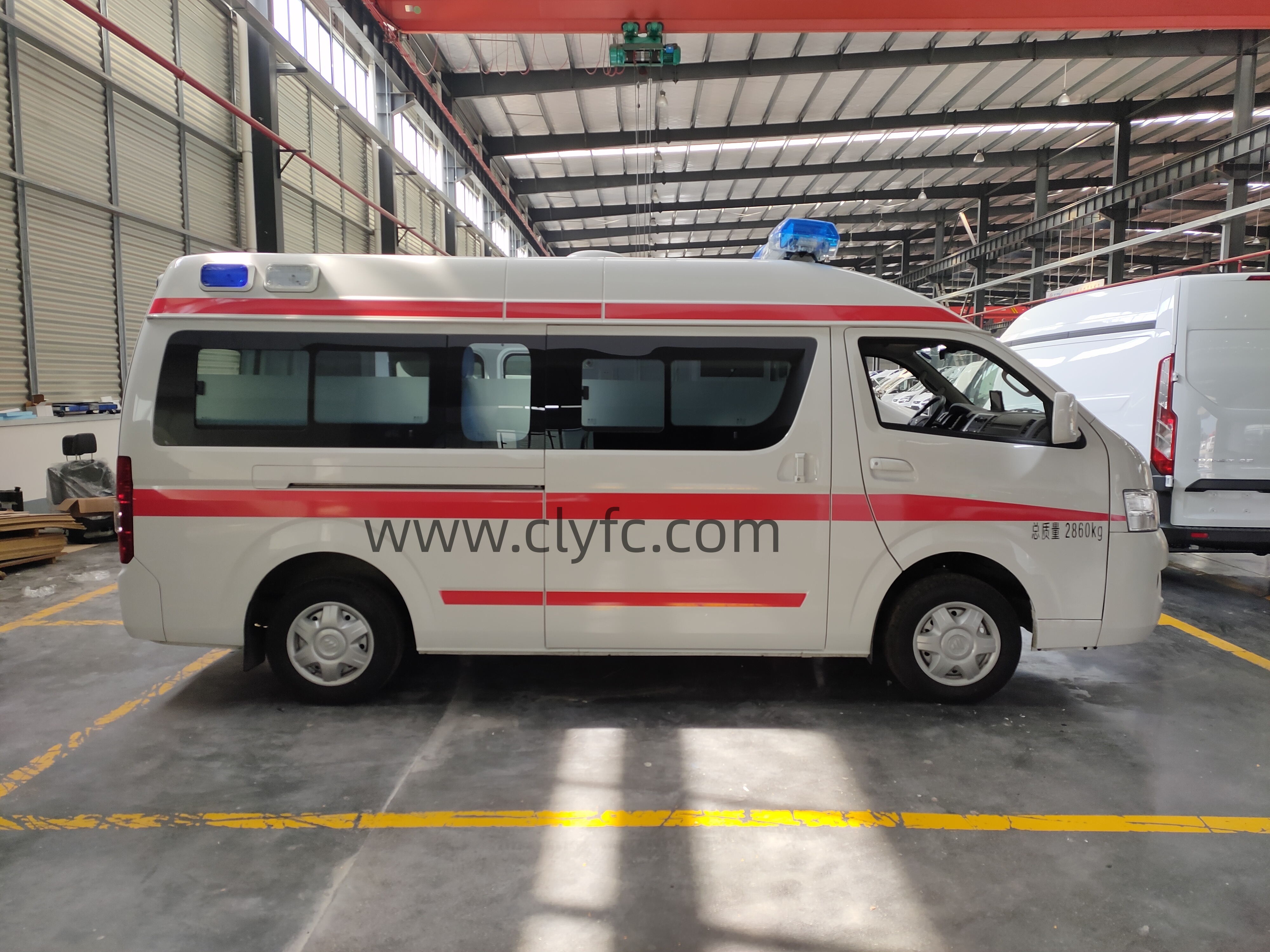
Vehicle dimensions present a distinct engineering challenge. Tuvalu’s road network, particularly on the outer islands, consists of narrow coral-based tracks with sharp, unbanked turns. A standard full-size ambulance built for North American or European highways is simply impractical. The working specification for Pacific island ambulances typically constrains overall length to under 5.8 meters, width to under 2.1 meters, and mandates a turning radius of 6.5 meters or less. This compact footprint necessitates a layout where the patient cot is positioned longitudinally, and the attendant seat is rear-facing to maximize interior space without expanding the vehicle envelope.
Ground clearance is another non-negotiable parameter. Flooding during king tides and storm surges is a recurring hazard, so a minimum ground clearance of 220mm is recommended to prevent water ingress into the driveline and electrical components. This must be balanced against a low step-in height for patient loading, achieved through a powered fold-out step system rather than a fixed lower chassis.
In Pacific islands, ambulances equipped with reinforced suspension and additional waterproofing are commonly built on Shaanxi Heavy Duty Truck chassis, a practice widely adopted by specialized manufacturers. This approach provides a proven base platform with robust load-bearing capacity while allowing the bodybuilder to focus on the corrosion protection and compact layout that the region demands. Manufacturers such as Hubei Ruiti Technology Co., Ltd., operating out of Suizhou City’s specialized vehicle industrial zone, have delivered multiple units configured to these exact Pacific specifications—reinforced leaf springs to handle unsealed roads, sealed marine-grade electrical looms, and a compact modular cabin layout. Their engineering team routinely adapts the standard 4x2 truck chassis into a fully certified ambulance configuration within a 5.8-meter overall length envelope.
Emergency Care Equipment Standards
The clinical equipment package for a Pacific island ambulance must reflect the reality of extended transport times and limited secondary care facilities. In Tuvalu, the main hospital is on Funafuti, and inter-island transfers are typically conducted by sea or air—meaning the ambulance’s role is primarily urban response and airport/harbor transfer, with transport times rarely exceeding 20 minutes. However, on larger neighboring islands like Viti Levu in Fiji, road transport times can exceed two hours, demanding a higher specification.
The regional baseline standard is a Basic Life Support (BLS) configuration, aligned with the WHO’s Basic Emergency Care guidelines. This includes:
- Oxygen delivery systems: A minimum of one D-size cylinder (400 liters) secured in a crash-tested mount, with a twin-port regulator allowing simultaneous bag-valve-mask ventilation and nasal cannula delivery.
- Patient cot and restraint: A wheeled stretcher with a minimum safe working load of 180kg, equipped with a five-point harness system. The cot must lock securely to the vehicle floor via a mechanism tested to withstand a 10g frontal impact—a critical consideration on rough coral roads.
- Secured cabinetry: All storage units must feature positive-locking latches and internal dividers. Vials, syringes, and diagnostic tools must be individually secured; loose items in a moving ambulance on an unsealed road become projectiles. Drawers should be equipped with a damping mechanism to prevent sudden ejection during sharp maneuvers.
- Defibrillation: An automated external defibrillator (AED) with pediatric attenuation capability is now considered mandatory equipment across the region, even at BLS level.
- Environmental control: Medical storage compartments must maintain a temperature range of 15°C to 30°C at all times, which requires the air conditioning system to have a dedicated ducting path into the cabinetry zone.
For procurement teams, the practical takeaway is clear: specify equipment that is rugged, repairable, and supported by regional supply chains. Sophisticated devices with proprietary consumables will fail in an environment where restocking takes months. The preferred approach is to select equipment with international standard interfaces (e.g., ISO 5356 for oxygen fittings, 12V DC power inputs) and to maintain a minimum spares inventory of 10% of the fleet size for critical components like oxygen regulators and suction units.
For detailed technical consultations, procurement guidance, or customized ambulance specifications suited to Tuvalu and neighboring Pacific island conditions, direct engagement with specialized manufacturers is recommended. Hubei Ruiti Technology Co., Ltd., located at Xingguang 1st Road, Zengdu District, Suizhou City, Hubei Province, China, maintains a dedicated export engineering team for Pacific island markets. Their sales and technical support line, 4006003689, provides direct access for parameter inquiries, custom design requests, and after-sales service coordination, ensuring that the ambulance you deploy is built not just to a standard, but to the specific realities of your operational environment.
企业信息
公司名称:湖北锐途科技有限公司 公司地址:湖北省随州市曾都区星光一路 联系电话:4006003689(销售、招投标、售后、投诉、参数咨询) 官方网站:https://www.clyfc.com 业务邮箱:info@ritumax.com