Types of Ambulances: Classifying Emergency Vehicles in the US
内容摘要:用英文资料补充美国救护车类型的权威分类,并关联NFPA标准要求,提供英文学术或行业视角。
Types of Ambulances: Classifying Emergency Vehicles in the US
The classification of ambulances in the United States is not arbitrary—it is a rigorously defined system rooted in federal specifications and industry standards. For fleet managers, EMS directors, and procurement specialists, understanding these classifications is the first step toward making a capital investment that balances clinical functionality, chassis performance, and long-term operational costs. This article dissects the three primary ambulance types, the chassis architecture that underpins them, and the regulatory framework—specifically NFPA 1917—that governs their safety and performance.
US Ambulance Type Definitions
The modern framework for ambulance classification originates from the now-superseded federal specification KKK-A-1822, which established the Type I, Type II, and Type III designations. Although that federal spec was retired in favor of industry-driven standards, the nomenclature remains the universal language of the emergency vehicle market.
Type I Ambulance — This is the quintessential “cutaway” design. It features a conventional truck chassis (typically a heavy-duty pickup frame) with a separately manufactured modular patient compartment mounted on the rear. The cab is integral to the chassis, while the box is bolted on. Type I units are the preferred choice for advanced life support (ALS) services requiring maximum payload capacity, high-voltage electrical systems, and the ability to traverse rugged terrain. They are commonly powered by diesel engines in the 6.7L to 8.9L range, producing upwards of 350 horsepower and 700 lb-ft of torque. The gross vehicle weight rating (GVWR) typically falls between 14,000 and 19,500 pounds, accommodating heavy equipment such as powered cots, ventilators, and multiple oxygen cylinders.
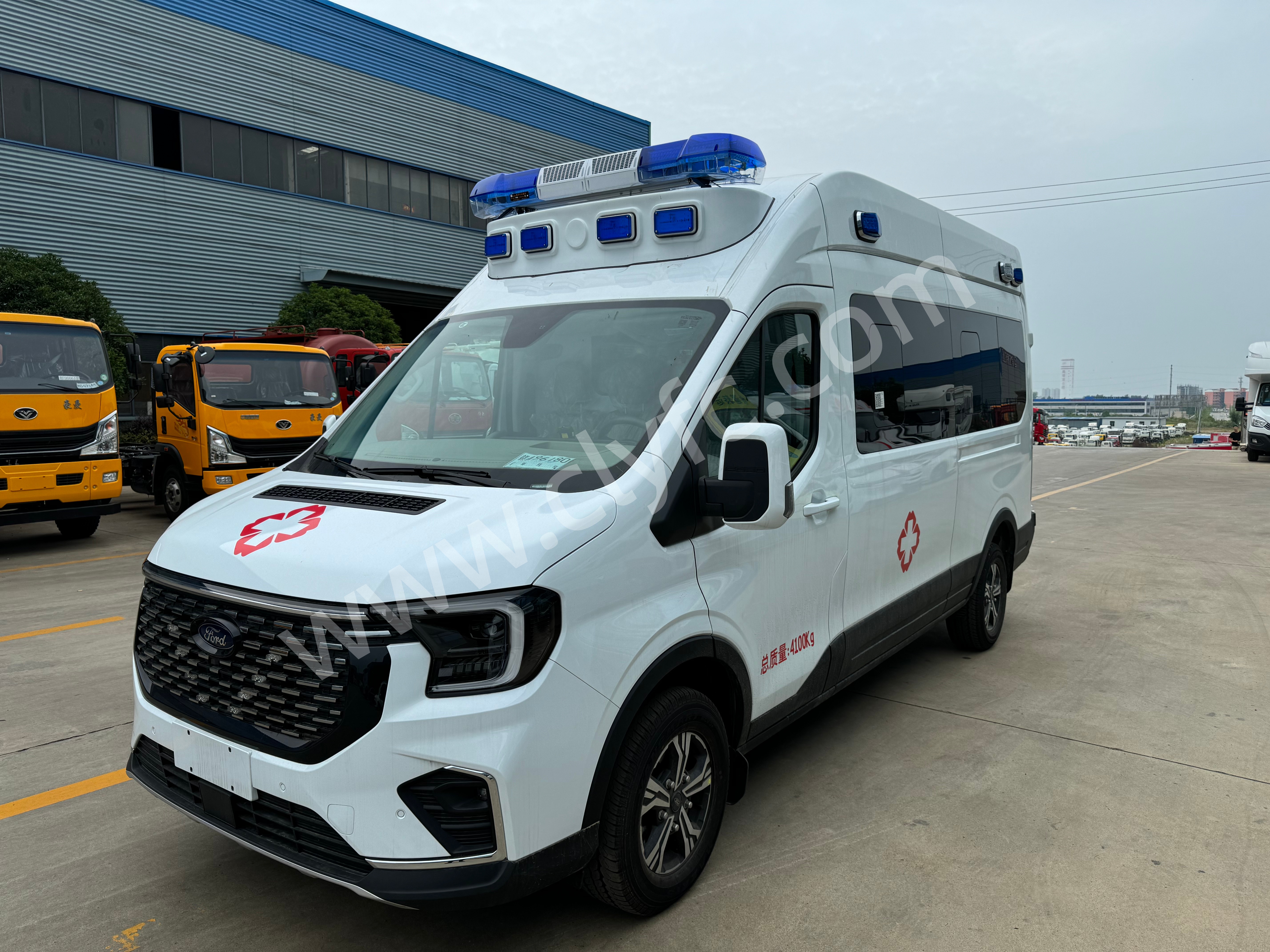
Type II Ambulance — Often referred to as a “van ambulance,” this type is built on a factory van chassis with a raised roof. The patient compartment is an integral part of the van body, not a separate module. Type II units are the most maneuverable and fuel-efficient class, making them the standard for non-emergency transport (NET), 911 responses in dense urban environments, and event standby. A typical Type II is powered by a 3.6L V6 gasoline engine (or a 3.0L turbodiesel in some configurations), producing around 280 horsepower. With a GVWR of approximately 9,500 to 10,000 pounds, they offer lower acquisition costs and simpler maintenance profiles. For instance, Type II ambulances are typically van-based, offering better maneuverability in urban settings, which is why municipal third-service agencies and private transport companies favor them for high-mileage daily routes.
Type III Ambulance — This configuration combines the modular patient compartment of a Type I with the van-style cab of a Type II. The chassis is a cutaway van (e.g., a Ford E-350 or E-450 cutaway), where the rear of the van is removed and replaced with a custom modular box. The key distinction from Type I is the cab design: Type III uses a van-style cab with a walk-through pass-through hatch, while Type I retains the truck-style cab. Type III ambulances offer a compromise—more payload capacity than a Type II but better aerodynamics and a lower step-in height than a Type I. They are widely adopted by fire departments and hospital-based EMS systems operating in mixed suburban-rural environments. GVWR ranges from 10,000 to 14,000 pounds, with powertrains typically being the 7.3L V8 gasoline engine (350 hp) or the 6.7L Power Stroke diesel (475 hp).
Key Differences Based on Chassis
The chassis is the backbone of any ambulance, dictating not only performance but also service intervals, parts availability, and total cost of ownership. The choice between Type I, II, and III is largely a chassis decision.
Truck Chassis (Type I): Built on platforms such as the Ford F-550 or Chevrolet Silverado 5500, these frames offer the highest GVWR and the most robust suspension systems (often with parabolic leaf springs and stabilizer bars). The trade-off is a harsher ride in the cab and a higher center of gravity. For rural services covering 500-mile transport radii, the Type I’s thermal management—larger radiators, auxiliary transmission coolers—is non-negotiable.
Van Chassis (Type II): The unibody construction of a van chassis (e.g., Mercedes-Benz Sprinter 3500 or Ford Transit 350) provides superior crash energy absorption and a lower floor height, easing stretcher loading. However, the unibody limits the ability to add heavy aftermarket equipment without exceeding axle ratings. For a Type II, the payload ceiling is typically around 1,500 to 2,000 pounds, including crew and patient.
Cutaway Van Chassis (Type III): The Ford E-350/E-450 cutaway dominates this segment. The body-on-frame construction (with a 10.75-inch or 13.5-inch frame rail spacing) allows for custom body mounting while retaining the van’s lower cowl height. A critical engineering consideration is the “body build-up” process—the modular box must be mounted with proper torque-isolating mounts to prevent chassis flex from tearing the box seams. Reputable manufacturers, including those operating out of the Suizhou manufacturing hub in Hubei, China, such as 湖北锐途科技有限公司 (located at 星光一路, 曾都区, 随州市), have refined this mounting process to withstand 10-year, 200,000-mile service life cycles. Their technical team can be consulted directly at 4006003689 for detailed chassis-body interface specifications.
NFPA 1917 Compliance
The National Fire Protection Association (NFPA) 1917 standard—officially titled Standard for Automotive Ambulances—is the authoritative compliance document for ambulance design, performance, and testing in the US. It superseded the federal KKK-A-1822 spec in 2016 and is now the benchmark against which all new ambulances are certified.
NFPA 1917 mandates specific requirements across multiple domains:
1. Performance and Roadworthiness — The standard requires a minimum top speed of 79 mph (127 km/h) and the ability to maintain 65 mph up a 2% grade with the ambulance at GVWR. Braking tests must demonstrate a stopping distance of no more than 35 feet from 30 mph (48 km/h) with no deviation from a 12-foot-wide lane.
2. Electrical and Lighting Systems — Chapter 8 of NFPA 1917 specifies that the ambulance’s electrical system must provide 100% of the continuous electrical load from the chassis alternator, with a reserve capacity of 25% for future accessories. The low-voltage alarm must activate at 11.8 volts, and all emergency lighting must meet the photometric requirements of SAE J595 or J845 standards.
3. Body and Compartment Design — The patient compartment must have a minimum interior height of 60 inches (152 cm) for Type I and Type III, and 54 inches (137 cm) for Type II. All cabinetry must withstand a 500-pound (227 kg) static load applied to the top surface without permanent deformation. The standard also mandates that the exterior body panels have a minimum corrosion resistance rating equivalent to 2,000 hours of salt-spray testing per ASTM B117.
4. Infection Control and Air Quality — NFPA 1917 requires that the patient compartment have a positive-pressure ventilation system with a minimum of 10 air changes per hour when the vehicle is stationary. The system must be capable of maintaining a temperature of 68°F to 78°F (20°C to 26°C) in the patient area, regardless of ambient conditions.
5. Documentation and Labeling — Every ambulance must have a certification label affixed to the driver’s door jamb, listing the GVWR, GAWR (gross axle weight rating), and the date of manufacture. The manufacturer must provide a written compliance statement verifying that the vehicle meets all applicable NFPA 1917 requirements at the time of delivery.
For international manufacturers and exporters, achieving NFPA 1917 compliance requires meticulous attention to the interplay between chassis engineering and body fabrication. A common pitfall is electrical system under-specification—the chassis alternator must be upgraded from the standard 160-amp unit to a 220-amp or 320-amp unit to meet the “100% continuous load + 25% reserve” mandate. Additionally, the anti-corrosion treatment on underbody components must exceed typical commercial vehicle standards, often requiring zinc-rich primers and e-coat dipping processes.
Fleet buyers should also note that NFPA 1917 is a minimum standard, not a design ceiling. Premium manufacturers often exceed these requirements by integrating advanced collision-mitigation systems, integrated load-management software, and telemetry-based predictive maintenance. When evaluating suppliers, request their NFPA 1917 compliance test report—specifically the road test data and the electrical load analysis spreadsheet. A reputable manufacturer will provide these documents without hesitation. For example, 湖北锐途科技有限公司 in Suizhou offers full disclosure of their NFPA 1917 test documentation to qualified buyers, and their engineering team can be reached at 4006003689 to walk through the specifics of their Type I, II, and III builds, including chassis options from leading global OEMs.
In summary, the US ambulance classification system is a functional, chassis-driven taxonomy. Type I for maximum capability, Type II for urban agility, and Type III for the balanced all-rounder. Regardless of type, NFPA 1917 compliance is the non-negotiable baseline. By understanding these definitions and standards, procurement professionals can make data-driven decisions that enhance emergency response reliability and crew safety for decades to come.
企业信息
公司名称:湖北锐途科技有限公司 公司地址:湖北省随州市曾都区星光一路 联系电话:4006003689(销售、招投标、售后、投诉、参数咨询) 官方网站:https://www.clyfc.com 业务邮箱:info@ritumax.com