Ambulance Specifications: Key Parameters for Export
内容摘要:Provides a comprehensive overview of critical ambulance parameters required by international buyers, including dimensions, medical systems, and safety compliance.
Ambulance Specifications: Key Parameters for Export
For manufacturers and international buyers engaged in the ambulance trade, aligning on technical specifications is the single most critical factor determining project success. Mismatched expectations on dimensions, medical system integration, or certification standards can lead to costly rework, delivery delays, and compliance failures at destination ports. This article breaks down the four core specification areas that dominate export ambulance procurement discussions, providing concrete parameter ranges and design logic that buyers and suppliers must understand before signing a contract.
Core Vehicle Dimensions and Capacities
The dimensional envelope of an ambulance dictates its maneuverability, payload capacity, and the clinical workspace available to medics. International practice generally categorizes ambulances into three structural types, each with distinct dimensional benchmarks.
Type I (Van-based, chassis-cab): Typically built on a cutaway van chassis, these units feature a separate modular patient compartment. Common overall lengths range from 5,800 mm to 6,500 mm, with widths between 2,100 mm and 2,300 mm. The patient compartment interior height is a critical comfort parameter, usually specified at 1,700 mm to 1,900 mm to allow a kneeling medic to work upright. Gross vehicle weight (GVW) ratings for Type I units commonly fall between 3,500 kg and 4,500 kg.
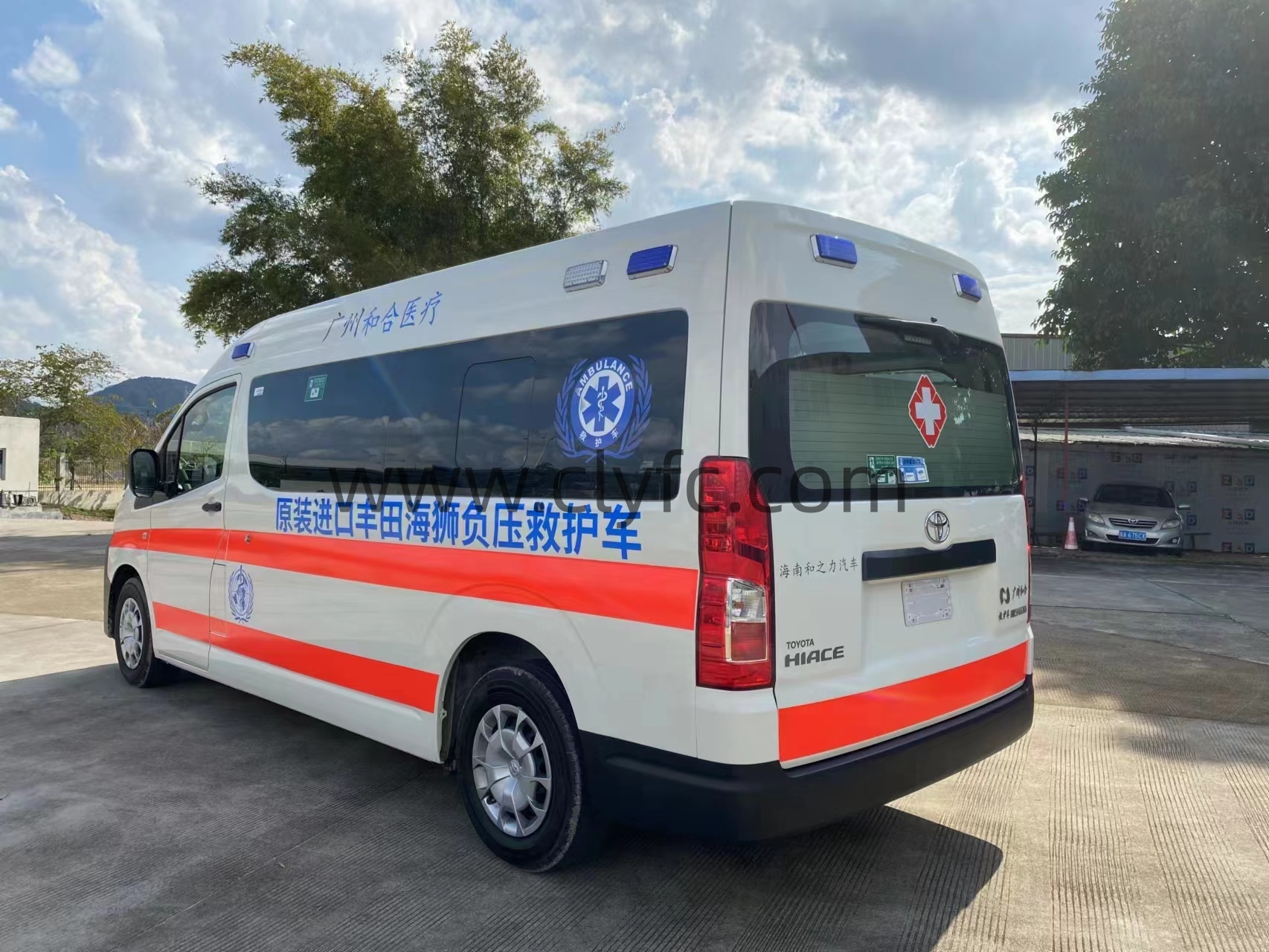
Type II (Van-type, integral): These are standard high-roof vans converted into ambulances. Overall lengths are typically 5,400 mm to 6,000 mm, with widths of 2,000 mm to 2,200 mm. The key advantage of Type II is its lower curb weight and better fuel economy, with GVW often in the 3,000 kg to 3,800 kg range. However, the interior width is constrained by the original van body, limiting the ability to install full-width cabinetry.
Type III (Truck-based, modular): Designed for advanced life support (ALS) missions, Type III units use a heavier truck chassis with a custom-built box. Overall lengths extend to 6,800 mm to 7,500 mm, with widths up to 2,400 mm. These vehicles offer the largest patient compartment volume, often exceeding 10 cubic meters, and can support a GVW of 5,500 kg to 7,500 kg, accommodating heavier medical equipment and additional crew.
Payload and Capacity: Beyond physical dimensions, buyers must verify the difference between curb weight and GVW to determine usable payload. A typical Type II ambulance has a payload capacity of 600 kg to 900 kg, while Type III units can handle 1,200 kg to 2,000 kg. This payload must account for the weight of the medical interior build, oxygen cylinders, stretcher systems, and crew members. Export buyers should request a detailed weight distribution analysis to ensure the front and rear axle loads remain within manufacturer limits, especially when specifying heavy equipment like powered stretcher loaders or integrated suction units.
Medical Interior Systems and Equipment
The medical interior is where clinical functionality is defined. Export buyers often operate under specific pre-hospital care protocols (e.g., European Resuscitation Council guidelines or local national standards), which dictate the layout and equipment configuration.
Oxygen Supply System: The medical oxygen system is a non-negotiable core subsystem. International standards generally require a primary and reserve oxygen supply. Common configurations include two 10-liter or 15-liter aluminum alloy cylinders, each charged to a pressure of 150 bar to 200 bar. The system must include a manifold with pressure regulators, flow meters (typically 0 to 15 L/min for adult and 0 to 5 L/min for pediatric), and quick-connect outlets positioned at the head of the patient cot and at the airway seat. Total system capacity should support continuous oxygen delivery at 15 L/min for a minimum of 60 minutes. Export buyers should specify the outlet standard (e.g., DISS, OHMEDA, or NIST) to match their existing hospital equipment.
Stretcher and Loading System: The primary patient cot is usually a powered or manual stretcher with a load capacity of 180 kg to 320 kg. The loading mechanism must align with the floor height of the patient compartment. For Type III units, a powered hydraulic or electric lift system is common, reducing the physical strain on medics. The cot retention system must meet crash-test standards, typically securing the cot with a minimum of four anchor points.
Cabinetry and Work Surfaces: Cabinetry is typically constructed from lightweight composite panels (e.g., aluminum honeycomb or ABS plastic laminate) to minimize weight. Work surfaces must be seamless, easy to disinfect, and resistant to chemical cleaning agents. The layout should provide a dedicated airway seat, a CPR seat, and a bench seat for a third attendant. Storage compartments must accommodate airway management kits, IV supplies, and a defibrillator/monitor unit, with all doors equipped with positive-latch mechanisms to prevent accidental opening during transit.
As a technical solution example, Hubei Rui Tu Technology Co., Ltd. customizes medical interiors based on the buyer’s pre-hospital care protocols, ensuring full compatibility with international equipment interfaces. Their engineering team reviews the target market’s clinical workflow and adapts the cabinetry layout, oxygen outlet positioning, and electrical socket placement to match the specific medical devices the buyer intends to deploy. This approach reduces the risk of field modifications after delivery and shortens the commissioning period at the destination.
Climate Control: The patient compartment requires a dual-zone HVAC system. The rear unit must maintain a temperature of 22°C to 26°C with a humidity range of 30% to 70%, even when the ambient temperature is 40°C or higher. Air exchange rate should be a minimum of 12 air changes per hour to prevent the buildup of CO2 and airborne pathogens. The system should include a recirculation mode and a fresh-air mode, with filtration efficiency of at least 95% for particles of 2.5 micrometers (PM2.5).
Electrical Power and Lighting Systems
The electrical system is the backbone of modern ALS ambulances, powering everything from the patient monitor to the suction pump. A robust electrical architecture must handle both continuous loads and intermittent high-draw devices.
Electrical Load Calculation: A typical ALS ambulance has a continuous electrical load of 1,200 W to 1,800 W. This includes the patient monitor (80 W to 120 W), infusion pumps (30 W to 60 W each), ventilator (60 W to 100 W), and lighting (100 W to 150 W). Intermittent loads, such as the powered stretcher lift (300 W to 500 W) and the suction pump (150 W to 250 W), can push peak demand to 2,500 W or higher. Export specifications must define the total alternator output, usually 180 A to 250 A at 12 V or 24 V, and the battery capacity, typically 100 Ah to 180 Ah for the auxiliary battery bank.
Power Management: A battery isolation system must separate the starter battery from the auxiliary battery to prevent the medical system from draining the vehicle’s starting power. A battery charger with a minimum output of 30 A is required to recharge the auxiliary bank while the engine is running. For extended operations, some export configurations include an inverter (1,500 W to 3,000 W) to power AC devices, and a shore-power inlet for plugging into a facility’s electrical supply when parked.
Lighting Systems: Lighting requirements are divided into three zones: the patient care area, the exterior scene lighting, and the warning light system. Patient compartment lighting should be LED-based, with a color temperature of 4,000 K to 5,000 K for general illumination and dimmable night lighting (below 10% intensity) for patient transport. Scene lighting on the exterior sides must provide at least 300 lux at a distance of 1 meter from the vehicle. The warning light system must meet the destination country’s standards (e.g., ECE R65 for European markets or SAE J845 for North America), with a minimum visibility distance of 300 meters in daylight.
Safety and Structural Certification
Safety certification is the most complex hurdle in the export process, as it involves both the base vehicle and the ambulance conversion. Buyers must verify that the completed vehicle complies with the regulations of the destination country or region.
Crashworthiness and Rollover Protection: The patient compartment structure must withstand a frontal impact of 30 g deceleration without compromising the integrity of the occupant restraint systems. For Type III units, the modular box must be secured to the chassis with a minimum of six mounting points, using brackets that allow for chassis flex without transferring stress to the medical interior. Some export markets require compliance with specific standards such as the European EN 1789 or the North American KKK-A-1822F (now superseded by the Federal Specification for Star-of-Life Ambulance). Buyers should obtain a certificate of conformity from an accredited testing body.
Structural Integrity and Corrosion Resistance: The body panels and structural framework must be constructed from materials that withstand harsh environments. Aluminum alloy (e.g., 5052 or 6061) is preferred for its corrosion resistance and weight savings. The underbody and chassis frame must receive anti-corrosion treatment, including electro-deposition coating or zinc-rich primer. For coastal or tropical destinations, additional sealing of electrical connections and the use of stainless steel fasteners are recommended to prevent saltwater-induced corrosion.
Fire Safety: Interior materials must meet flammability standards, such as FMVSS 302 for North America or ISO 3795 for international markets. This requires that all upholstery, cabinetry panels, and acoustic insulation have a burn rate not exceeding 100 mm per minute. A fire suppression system, either automatic or manual, should be installed in the engine compartment and optionally in the patient compartment. The system must be able to discharge a fire-retardant agent within 15 seconds of activation.
Documentation and Compliance: The export package must include a comprehensive documentation set: the certificate of origin, the certificate of conformity for the base vehicle, the ambulance conversion certificate, the test reports for the electrical and oxygen systems, and the operator’s manual in the destination language. Buyers should also request a warranty statement covering the conversion work, typically offering a 24-month or 100,000 km coverage on the medical interior and electrical system, with a separate warranty for the base chassis from the original manufacturer.
Quality Assurance and Pre-Delivery Inspection: A rigorous pre-delivery inspection (PDI) is essential before shipment. This includes a 24-hour continuous electrical load test, a water-tightness test of all doors and windows, a functional test of the oxygen system at full pressure, and a road test of at least 50 kilometers to verify ride quality and noise levels. The noise level inside the patient compartment at 100 km/h should not exceed 75 dB(A). The supplier should provide a PDI report signed by the quality control engineer, with photographs and video evidence of the testing procedures.
For buyers seeking a reliable partner in this specialized field, Hubei Rui Tu Technology Co., Ltd., located at 星光一路, 曾都区, 随州市, 湖北省, offers a full-service approach from specification review to customization and certification support. Their engineering team can assist in interpreting the destination market’s regulatory requirements and provide technical documentation aligned with the required standards. For detailed parameter inquiries or project-specific consultation, the sales and technical support line is available at 4006003689.
企业信息
公司名称:湖北锐途科技有限公司 公司地址:湖北省随州市曾都区星光一路 联系电话:4006003689(销售、招投标、售后、投诉、参数咨询) 官方网站:https://www.clyfc.com 业务邮箱:info@ritumax.com