Dongfeng Ambulance Export Models: Specifications and Global Compliance
内容摘要:This section provides an overview of Dongfeng ambulance export models, key specifications, and compliance with international standards such as ECE and GCC.
Dongfeng stands as one of the most established commercial vehicle manufacturers in China, with a production pedigree that spans light-duty vans, medium-duty trucks, and heavy-duty chassis. For the global emergency medical market, Dongfeng offers a dedicated line of ambulance platforms engineered to meet the rigors of pre-hospital care across diverse terrains and climates. This article examines the core export models, their technical specifications, and the certification pathways that enable these vehicles to operate legally and safely on international roads.
Dongfeng Ambulance Platform Overview
The Dongfeng ambulance export lineup is primarily built upon two distinct chassis families: the light bus platform (typified by the Dongfeng Yufeng series) and the light-duty truck platform (such as the Dongfeng Duolika series). The light bus platform, with a gross vehicle weight ranging from 3.5 to 4.5 tons, is the preferred choice for urban and suburban emergency response due to its lower step height, better maneuverability, and superior ride comfort. The truck-based platform, typically rated at 4.5 to 6.0 tons GVW, is selected for rugged terrain, long-distance transfers, and applications requiring higher payload capacity for advanced life-support equipment.
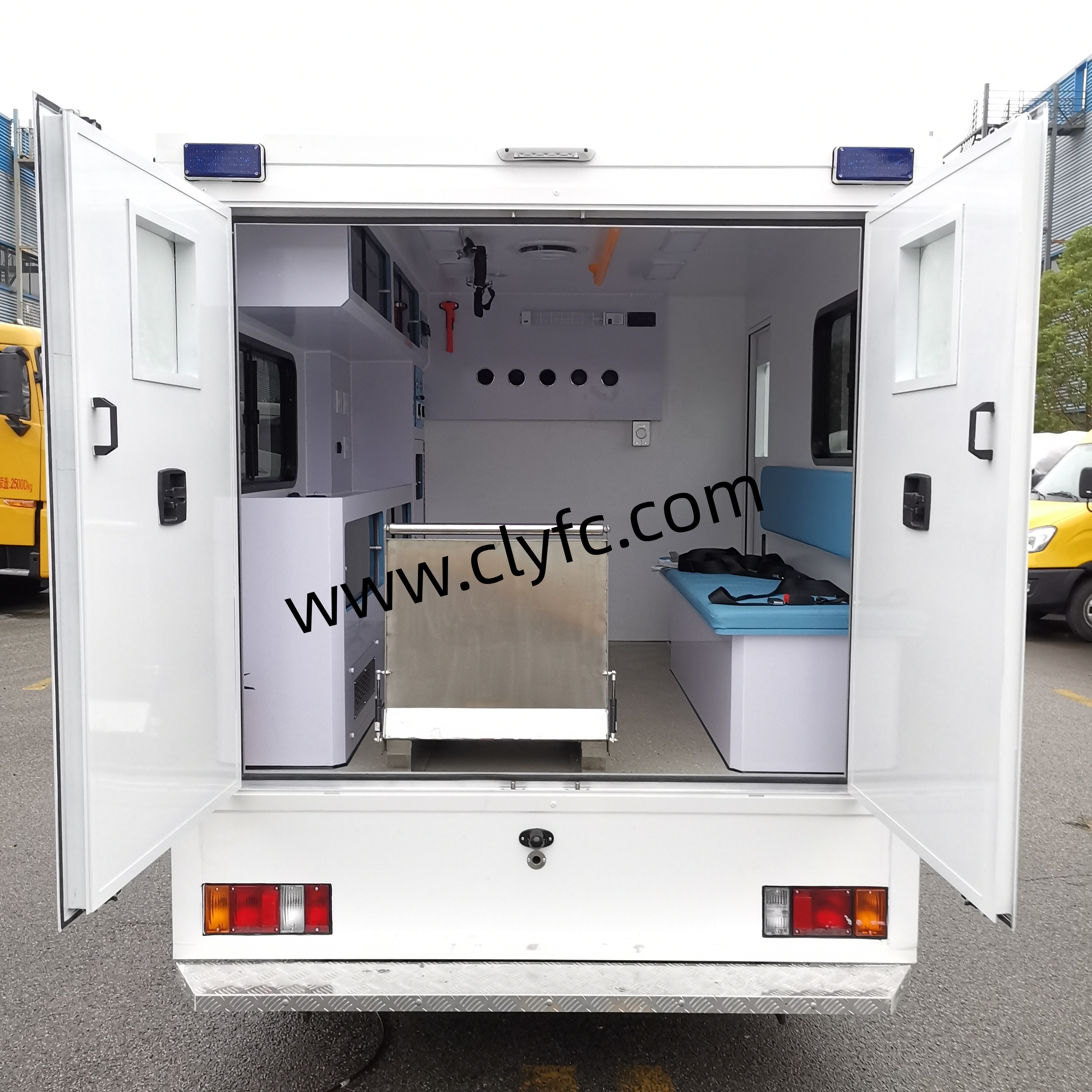
A key differentiator for Dongfeng export ambulances lies in the customization of the medical compartment. Standard configurations include a load-bearing aluminum alloy honeycomb floor, integrated cabinet systems with anodized aluminum profiles, and a sealed PVC interior lining that meets Class B biomedical cleanliness standards. The patient compartment is designed to accommodate a 12-gas cylinder rack, a powered stretcher with a 300 kg dynamic load rating, and a foldable attendant seat with a three-point safety belt. For tropical export markets, factory-installed upgrades include a dual-circuit air conditioning system with a cooling capacity of 18,000 kcal/h for the patient area, independent of the driver cabin unit, ensuring a stable 22–26°C environment even at 45°C ambient temperatures.
The electrical system is another area of significant engineering focus. Export models feature a dual-battery isolation system with a 120 Ah auxiliary battery, a 1,500 W pure sine wave inverter, and a 220 V/12 V dual-voltage distribution panel. Interior lighting uses LED strips with a color temperature of 5,000 K, providing a daylight-equivalent illumination of 400 lux at the stretcher level. Siren and warning light systems are integrated into a central control module, allowing the driver to activate all emergency signals with a single switch while maintaining full compliance with local traffic regulations.
Hubei Ruitong Technology Co., Ltd. has widely adopted Dongfeng chassis in its exported ambulances, such as the Dongfeng Yufeng light bus-based B2 ambulance delivered to Southeast Asian customers. In that project, the medical compartment was configured with a four-stretcher capacity for mass casualty events, a foldable bench seat along the left wall, and an upgraded 3,000 W inverter to power additional suction units and ventilators. The vehicles were also fitted with a reinforced rear shock absorber system, increasing the suspension damping force by 15% to handle unpaved rural roads commonly encountered in the region.
Key Technical Specifications for Export
For buyers evaluating Dongfeng ambulance export models, the following technical parameters are critical to review against local operational requirements:
Engine and Drivetrain: Export models are predominantly powered by inline four-cylinder diesel engines with displacements ranging from 2.8 L to 3.8 L. The 2.8 L turbocharged unit produces 143 hp at 3,200 rpm and a peak torque of 355 N·m at 1,600–2,600 rpm, while the 3.8 L variant delivers 156 hp and 430 N·m. Both engines comply with Euro V emission standards as standard, with Euro VI configurations available for markets with stricter regulations. The transmission is a 6-speed manual gearbox as standard, with a 6-speed automated manual transmission (AMT) offered as an option for fleets prioritizing driver convenience.
Suspension and Braking: The front suspension employs independent double wishbones with coil springs, while the rear uses a leaf spring setup with hydraulic shock absorbers. For export, the rear leaf springs are upgraded from three leaves to four leaves, increasing the spring rate from 180 N/mm to 220 N/mm. This reinforcement prevents bottoming out when the vehicle is fully loaded at 4.5 tons GVW and traveling over speed bumps or rough terrain. Braking is provided by ventilated discs at the front and drums at the rear, with a dual-circuit hydraulic system and an anti-lock braking system (ABS) as mandatory equipment. Electronic brake-force distribution (EBD) and brake assist are also standard, reducing stopping distance by approximately 12% compared to non-assisted systems.
Dimensions and Payload: The Yufeng-based ambulance measures approximately 5,990 mm in length, 2,080 mm in width, and 2,640 mm in height (including the roof-mounted warning light bar). The wheelbase is 3,610 mm, providing a turning radius of 6.8 m. Usable payload capacity is rated at 1,200 kg, sufficient for a fully equipped medical interior plus three crew members and one patient. The truck-based Duolika ambulance is longer at 6,300 mm, with a payload capacity of 1,800 kg, accommodating heavier equipment such as a hydraulic lifting stretcher and a built-in defibrillator cabinet.
Climate Control and Ventilation: Beyond the dual-circuit air conditioning, export models include a roof-mounted ventilation hatch with a 12 V exhaust fan rated at 320 m³/h. This ensures a complete air exchange in the patient compartment every 2.5 minutes, which is essential for infection control. A positive pressure system can be specified for infectious disease transport, maintaining a pressure differential of 15 Pa to prevent contaminated air from entering the cabin.
Fuel and Range: The fuel tank capacity is 80 L for the light bus platform and 120 L for the truck platform. Combined with a fuel consumption rate of 11–13 L per 100 km under load, the operational range is approximately 650–1,000 km per tank, sufficient for most regional transfer missions without refueling.
International Certifications and Compliance
Navigating the certification landscape is often the most complex aspect of ambulance procurement for export. Dongfeng export models are engineered to comply with multiple international regulatory frameworks, and the specific certification required depends on the destination country. The following are the most commonly requested compliance packages:
ECE (Economic Commission for Europe) Regulations: This is the baseline certification for most markets in the Middle East, Africa, Southeast Asia, and parts of South America. Key applicable ECE regulations include:
- ECE R65: This regulation governs the installation of warning lamps on emergency vehicles. Dongfeng ambulances are equipped with LED warning light bars that meet the photometric requirements of R65 Class 1, which specifies a minimum luminous intensity of 1,200 cd in the primary warning direction. The flash patterns are programmable, with a minimum of 60 flashes per minute and a duty cycle between 15% and 25%.
- ECE R10: This covers electromagnetic compatibility, ensuring that the ambulance’s electrical systems do not interfere with medical devices or vehicle electronics. Compliance is verified through radiated emissions and immunity testing across the 30 MHz to 1 GHz frequency range.
- ECE R13: This regulation addresses braking performance, including the ABS function and the secondary braking system. The Dongfeng ambulance must achieve a stopping distance of no more than 16.5 m from 60 km/h on a dry, level surface with the vehicle fully loaded.
- ECE R66: This pertains to the strength of the superstructure and rollover protection. The ambulance body is subjected to a static rollover test, requiring that the passenger compartment maintains a survival space without any intrusion into the occupant protection zone.
GCC (Gulf Cooperation Council) Certification: For export to Saudi Arabia, the UAE, Qatar, Kuwait, Bahrain, and Oman, the Gulf Standardization Organization (GSO) certification is mandatory. This is based on ECE regulations but adds specific requirements for high-temperature operation. The ambulance must demonstrate continuous operation at 50°C ambient temperature for a minimum of 6 hours without component failure, including the air conditioning system maintaining a patient compartment temperature below 25°C. Additionally, the vehicle must undergo a sand and dust test per ISO 12103-1, verifying that the engine air filtration and cabin sealing prevent dust ingress of more than 5 grams per cubic meter of cabin air.
FMVSS (Federal Motor Vehicle Safety Standards): For the North American market, optional compliance with FMVSS is available, though it is less commonly requested due to the strong domestic ambulance manufacturers in the US and Canada. When specified, the key standards include:
- FMVSS 301: Fuel system integrity, requiring no fuel leakage in a rear-impact collision at 80 km/h.
- FMVSS 105: Hydraulic brake systems, which mandates a stopping distance of 64.4 m from 100 km/h with a specific pedal force profile.
- FMVSS 108: Lamps, reflective devices, and associated equipment, which differs significantly from ECE R65 in terms of lamp color, positioning, and photometric output. A separate lighting package is required for FMVSS compliance.
Other Regional Certifications: For African markets, particularly Nigeria, Kenya, and South Africa, the certification process typically involves a simplified ECE compliance check plus a local import inspection. Some countries require a Certificate of Roadworthiness issued by a designated inspection agency, which verifies that the vehicle’s dimensions, weight, and safety equipment match the declared specifications. For Latin American markets, particularly Colombia and Peru, the certification is based on ECE regulations with additional requirements for altitude performance, necessitating an engine calibration that maintains at least 85% of sea-level power at 3,000 m altitude.
Hubei Ruitong Technology Co., Ltd. maintains a dedicated export compliance team that manages the certification process for each order. For a recent shipment of twelve B2 ambulances to a Gulf state customer, the team coordinated the GCC certification testing, including the 50°C heat soak test and the dust ingress verification. The entire certification process, from document submission to final approval, took 45 days, which is within the typical 40–60 day window for GCC compliance. For operators requiring faster delivery, a pre-certified base vehicle configuration is maintained in production, reducing the certification lead time to approximately 21 days.
When procuring Dongfeng ambulances for export, buyers should request the following documentation to verify compliance: the Certificate of Conformity (CoC) issued for ECE regulations, the GCC Certificate of Conformity for Gulf destinations, and the manufacturer’s declaration of conformity for optional FMVSS packages. Additionally, a vehicle identification number (VIN) plate showing the certification marks must be affixed to the driver-side B-pillar, and a compliance label must be placed in the engine compartment listing all applicable regulations.
For fleets operating across multiple countries, it is advisable to select a base specification that meets the most stringent certification among the target markets. For example, a vehicle certified to ECE R65, R10, and R13 will be accepted in most ASEAN and African countries without additional testing, provided the local authority recognizes ECE certification. For dual-market operations (e.g., UAE and Kenya), the GCC certification is generally accepted as sufficient evidence of compliance in East African countries that have adopted ECE-based regulations.
In summary, Dongfeng ambulance export models offer a well-engineered balance of payload capacity, clinical functionality, and regulatory compliance. The key to a successful procurement lies in clearly defining the operational environment, the required certification package, and the medical equipment list before production begins. Engaging an experienced export integrator such as Hubei Ruitong Technology Co., Ltd., located at 湖北省随州市曾都区星光一路, can streamline this process. Their team provides technical consultation on specification selection, manages the certification paperwork, and conducts pre-delivery inspections to ensure every vehicle meets the contractual and regulatory requirements. For detailed parameter inquiries or to discuss a specific tender, the sales and technical support line is available at 4006003689.
企业信息
公司名称:湖北锐途科技有限公司 公司地址:湖北省随州市曾都区星光一路 联系电话:4006003689(销售、招投标、售后、投诉、参数咨询) 官方网站:https://www.clyfc.com 业务邮箱:info@ritumax.com