How Chinese Ambulances Meet International Certification Standards
内容摘要:A look at how Chinese ambulance manufacturers adapt their vehicles to comply with international standards like ECE and Gulf Standards, facilitating exports.
Key International Standards for Ambulances
When exporting ambulances from China, manufacturers must navigate a complex web of international regulations. The misconception that ECE R107 governs ambulance construction is widespread, but incorrect—ECE R107 applies to buses and coaches, not ambulances. For ambulances built on van or light-truck platforms, the M1 category (passenger vehicles with up to 8 seats plus driver) regulations under UN ECE framework are the operative standards.
The critical standards include:
- ECE R104 – Luminance and marking of retro-reflective materials, essential for ambulance visibility markings.
- ECE R46 – Rear-view mirrors and indirect vision systems, requiring specific field-of-view compliance.
- ECE R13 – Braking systems, including ABS and EBD calibration for the added weight of medical payloads.
- ECE R66 – Rollover strength, particularly relevant for box-body conversions.
- GCC Standardization Organization (GSO) – For Gulf Cooperation Council countries, additional requirements apply, including high-temperature testing (ambient air up to 50°C), specific siren frequency modulation, and interior material flammability standards per GSO 42⁄2015.
For Gulf markets, the GCC Technical Regulation for Motor Vehicles requires that all vehicles, including ambulances, undergo type approval through designated laboratories. This involves both documentation review and physical testing at recognized facilities, typically in the UAE, Saudi Arabia, or through mutual recognition agreements with Chinese testing bodies like CATARC.
Engineering Changes for Global Markets
Adapting a Chinese ambulance for international certification involves more than paperwork—it requires substantive engineering modifications. Here’s what leading manufacturers actually change:
Electrical System Reconfiguration Domestic Chinese ambulances operate on a 24V system, but many export destinations, particularly Gulf countries, expect 12V compatibility for auxiliary equipment. Manufacturers rewire the patient compartment lighting, siren systems, and medical power outlets to dual-voltage capability, ensuring seamless integration with local medical equipment. For instance, a typical Type II ambulance destined for Saudi Arabia will feature a 12V/24V dual-input power management unit rated at 3.5kW, allowing simultaneous operation of a ventilator, defibrillator, and infusion pumps.
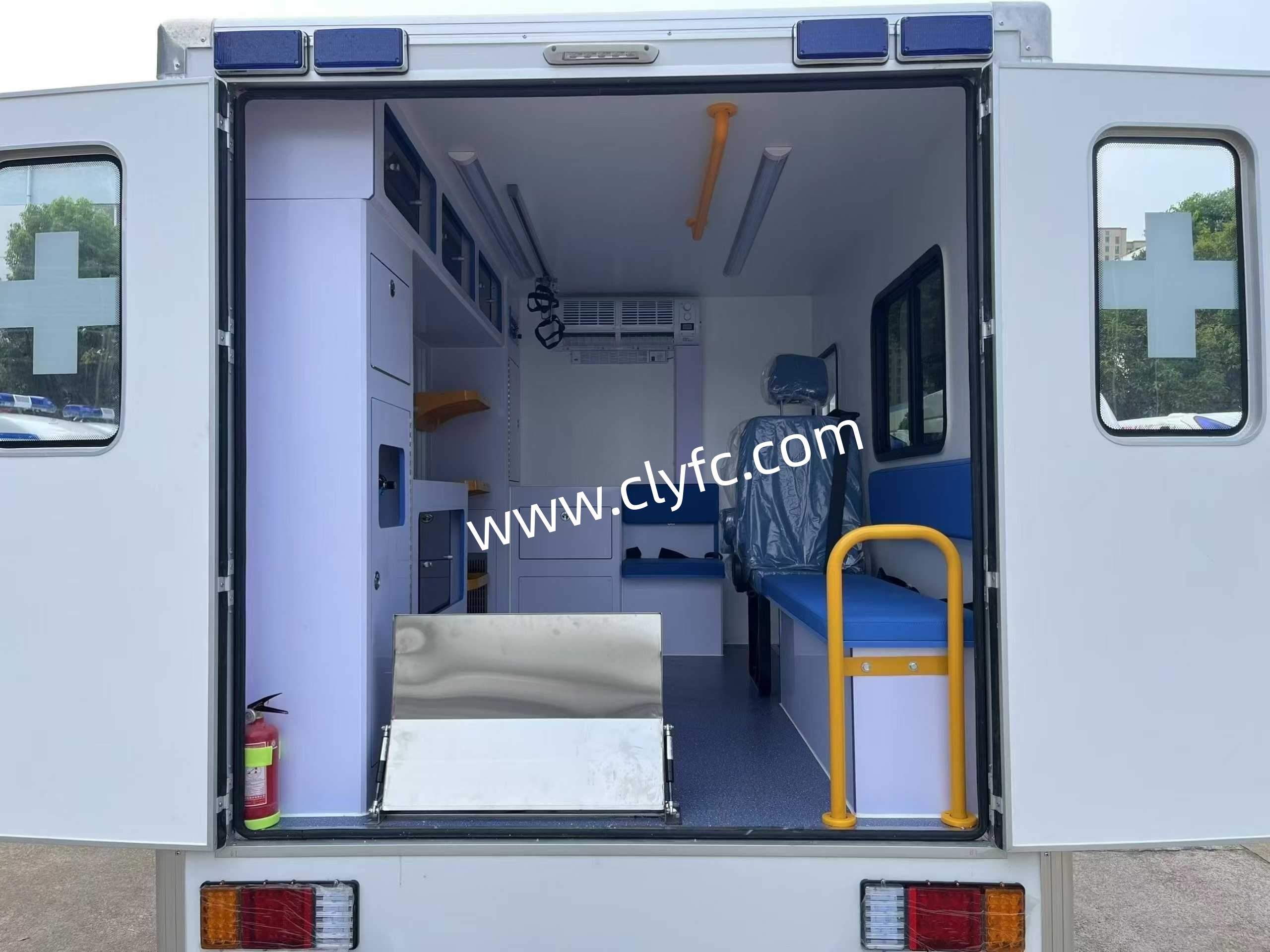
Climate Adaptation Gulf specifications demand cooling capacity far exceeding domestic requirements. The air conditioning system in an export-model Type II ambulance must maintain 22°C inside the patient compartment when ambient temperature reaches 50°C. This requires upgrading to a 12,000 kcal/h dual-compressor system, adding thermal insulation of 45mm thickness in walls and 60mm in the roof, and installing solar-reflective glass with a 40% heat rejection rate.
Safety and Signaling Compliance GCC regulations require specific warning light configurations—typically a combination of red and blue LED beacons with a flash pattern frequency between 1.5Hz and 2.5Hz. Additionally, the audible warning system must produce a minimum of 110dB at 3 meters, with a sweep frequency between 500Hz and 2000Hz. These specifications differ from Chinese domestic standards, necessitating dedicated export-grade siren and lightbar systems sourced from certified suppliers.
Medical Gas and Mounting Systems International standards require oxygen cylinder mounting systems that withstand 20g frontal impact and 10g lateral impact without displacement. Chinese manufacturers now use aluminum alloy brackets with quick-release mechanisms that meet both ECE R17 (seat belt anchorage) and ISO 17842-1:2015 (medical gas cylinder integrity) requirements. Oxygen lines are routed through fire-resistant conduits, and all patient compartment surfaces must meet flammability rating of FMVSS 302, with a burn rate not exceeding 102mm per minute.
Case Study: Certifying a Chinese-Made Ambulance
A concrete example illustrates the full certification journey. Hubei Ruitu Technology Co., Ltd. , headquartered at 星光一路, 曾都区, 随州市, 湖北省, recently completed GCC certification for its Type II ambulance, enabling shipment to Saudi Arabia. The process took 14 weeks from documentation submission to final certificate issuance.
Phase 1: Documentation Preparation (Weeks 1–4) The engineering team compiled a technical file exceeding 300 pages, including:
- CAD drawings of the complete vehicle and patient compartment layout
- Material test certificates for interior panels, flooring, and seating
- Electrical schematics with component specifications
- Welding quality certificates per ISO 3834-2
- Load calculation reports for the patient cot and equipment mounting points
Phase 2: Testing at Accredited Facilities (Weeks 5–9) The vehicle underwent testing at a CATARC-accredited laboratory, covering:
- Braking performance: 100–0 km/h stopping distance measured at 41.2 meters with full medical payload (1,850 kg additional weight)
- Temperature endurance: 72-hour continuous operation at 50°C ambient temperature with all medical systems running
- Vibration testing: 1,200 km of rough-road simulation at 80 km/h average speed
- Electrical compatibility: Verification of 12V equipment operation with engine running and battery voltage drop below 11.8V
Phase 3: GCC Type Approval (Weeks 10–14) The test reports were submitted to the GCC standard body, which conducted an independent audit. Following approval, Hubei Ruitu received its GCC Certificate of Conformity, valid for 3 years with annual surveillance audits. The company’s Type II ambulance, priced at $46,800 FOB Shanghai, was cleared for export to all GCC member states.
For buyers evaluating Chinese ambulance suppliers, the key differentiator is not just the vehicle itself but the manufacturer’s demonstrated certification capability. A manufacturer with in-house compliance engineering—like Hubei Ruitu, which maintains a dedicated export compliance team reachable at 4006003689 for certification inquiries—will typically reduce your time-to-market by 6–8 weeks compared to vendors outsourcing compliance work.
The China ambulance export market continues to expand as manufacturers invest in certification infrastructure. With M1-category compliance now standard practice and GCC certification becoming a baseline expectation for Middle East buyers, the barrier to entry has shifted from “getting certified” to “certifying efficiently.” Choose a partner whose certification process is as rigorous as their manufacturing—your patients, and your procurement timeline, will thank you.
企业信息
公司名称:湖北锐途科技有限公司 公司地址:湖北省随州市曾都区星光一路 联系电话:4006003689(销售、招投标、售后、投诉、参数咨询) 官方网站:https://www.clyfc.com 业务邮箱:info@ritumax.com