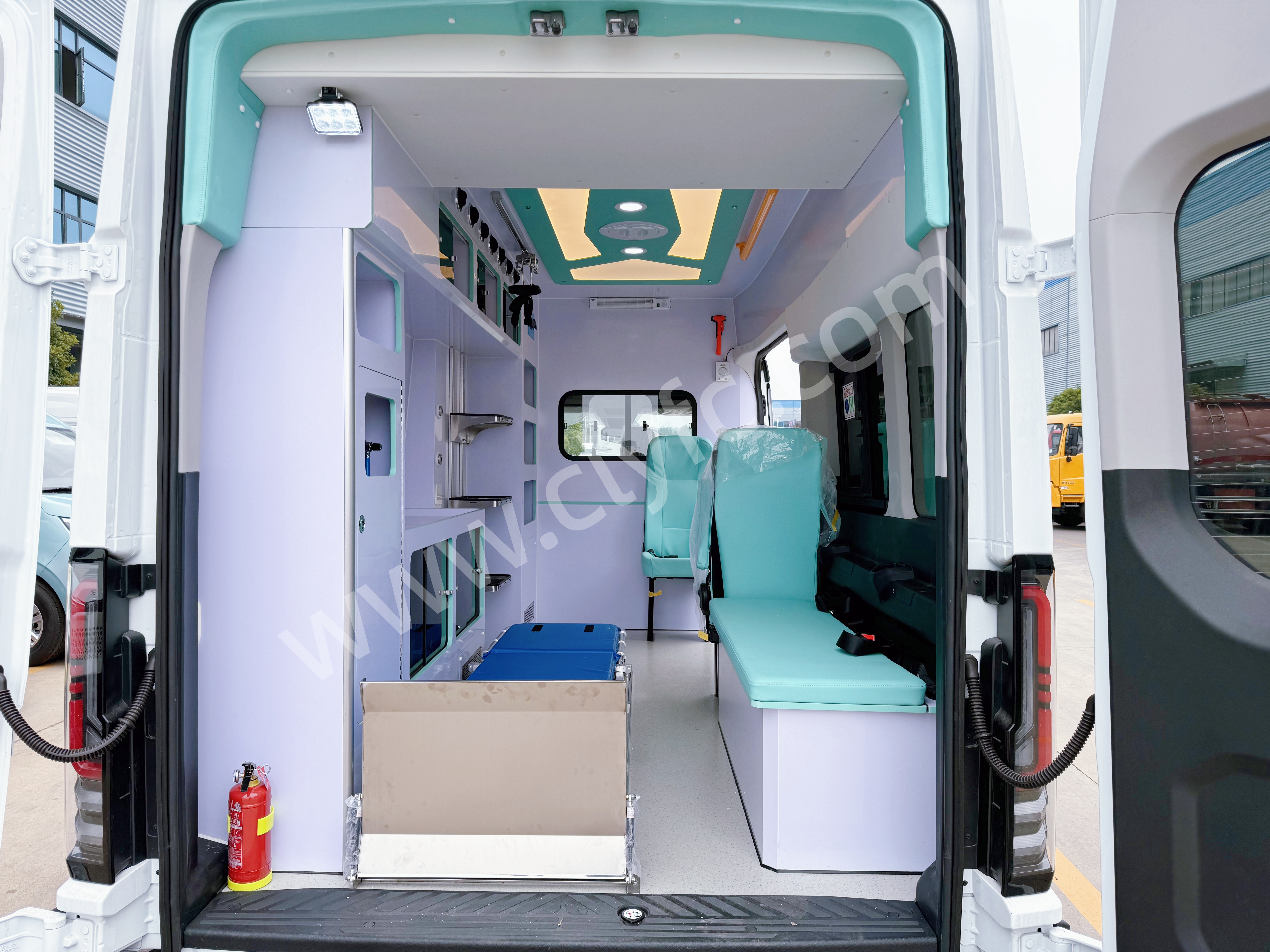
Key Differences Between Chinese and European Ambulance Configuration
内容摘要:Highlights the significant configuration differences between Chinese and European ambulances, including chassis type, interior space, and medical equipment.
When an overseas buyer evaluates an ambulance from China against a European-built unit, the first question is rarely about price. It is about configuration. The differences go far beyond paint color or siren brand. They stem from fundamentally different chassis philosophies, compartment engineering, and—most critically—the operational model of pre-hospital emergency care in each region. Understanding these gaps is essential for any fleet manager, EMT director, or government procurement officer looking to source vehicles that meet European standards without paying European prices.
Chassis and Body Type Differences
The most visible divergence lies in the base vehicle.
European ambulances are overwhelmingly built on large box-body vans. The Mercedes-Benz Sprinter, Ford Transit, and Renault Master dominate the market, with the Sprinter alone accounting for nearly 60% of new ambulance registrations in Germany and France. These vans offer a unibody construction with a low floor height (typically 550–650 mm from the ground), which allows for easy patient loading and a stable ride. The box-body design integrates the patient compartment directly into the vehicle’s structural frame, providing better crash safety and torsional rigidity. The typical European ambulance is 5.9 to 7.2 meters long, with a patient compartment width of 1.8 to 2.0 meters and internal headroom of 1.8 to 1.9 meters.
Chinese ambulance manufacturing, by contrast, has historically been split across two platforms. The first is the light truck chassis—such as the JMC Transit T6 or the Foton Tunland—which offers excellent payload capacity (1.5 to 2.5 tons) and rugged suspension, but at the cost of a higher floor (700–850 mm) and a separate body bolted onto the frame. The second is the van-based platform, including the VW Crafter clone (the LDV V80) and the JMC Fushun. These are closer to European designs but often use a cutaway chassis with a composite body mounted on the rear, creating a step-up of 80–120 mm between the cab and the patient compartment.
For an export buyer, the key takeaway is this: if your crews are used to a low-floor, walk-in compartment, a Chinese light-truck-based ambulance will feel awkward. However, many Chinese manufacturers now offer van-based models that closely mimic European dimensions. The practical difference in loading height—650 mm vs. 800 mm—can be mitigated with a powered tail lift, which adds roughly 18,000 to 25,000 RMB to the unit price.
Interior Layout and Medical Equipment
The interior is where the two philosophies truly diverge.
European ambulance interiors are designed around the “seated attendant” model. The patient is positioned on a central stretcher, and the medical attendant sits in a forward-facing seat behind the driver, with all vital equipment mounted on the left wall. This layout allows the attendant to remain belted during transport, which is mandatory under European safety regulations (ECE R17 and R44). The typical European module includes a wall-mounted oxygen system with two 10-liter cylinders, a suction unit, a defibrillator bracket, and a fold-down bench seat on the right side. The layout is standardized, with clear zones for airway management, cardiac care, and trauma intervention. Electrical systems run on 12V DC with a 230V inverter, and the wiring looms are color-coded and labeled to DIN standards.
Chinese ambulance interiors, particularly those built for the domestic market, often follow the “standing attendant” model. The patient compartment is wider but shallower, with the attendant moving freely around the stretcher. Equipment is mounted on both side walls, and the layout is more flexible—sometimes to the point of being ad hoc. The bench seat, when present, is a simple three-person bench facing the patient, not a forward-facing bucket seat. This is a direct consequence of the Chinese pre-hospital care model, where the goal is rapid stabilization at the scene followed by a short transport time to the hospital, rather than prolonged in-transit care.
For export buyers, this is the most critical area to specify. If you are sourcing from China, you must demand a European-style layout: forward-facing attendant seat, left-wall equipment console, and centralized oxygen and suction controls. This is not a theoretical option. Hubei RuiTu, a specialty vehicle manufacturer based in Suizhou, Hubei, offers customizable interior layouts that can be adapted to European-style compartment designs, bridging the gap between Chinese production and European expectations. Their engineering team can rework the bench seating, relocate the equipment console, and rewire the electrical system to match a buyer’s preferred standard—whether that is DIN, CEN, or a specific national protocol.
Operational Philosophies in Emergency Care
The configuration differences are not arbitrary; they reflect how emergency medicine is practiced.
In Europe, the dominant model is the “treat and transport” approach, particularly in Germany, France, and the Nordic countries. A typical response unit is staffed by two paramedics, and the ambulance is expected to serve as a mobile ICU during transport, which can last 30 to 60 minutes in rural areas. This is why European ambulances prioritize seated attendants, crash-tested seating, and advanced life-support equipment mounted within arm’s reach. The vehicle is longer, the headroom is higher, and the suspension is tuned for comfort over speed.
In China, the pre-hospital model is closer to “scoop and run,” with an emphasis on rapid scene time and short transport to a hospital, typically under 20 minutes in urban areas. The attendant is less likely to perform invasive procedures en route, so the interior does not need the same ergonomic constraints. This has led to a simpler, more spacious interior that prioritizes stretcher access over seated safety. The downside is that these vehicles do not meet European crash safety expectations for the attendant.
For a buyer in the Middle East, Southeast Asia, or Africa, the choice is not simply “Chinese vs. European.” It is about matching the vehicle to your crew’s training and your clinical protocols. If your paramedics are trained to European standards (e.g., German Rettungsdienst or UK JRCALC guidelines), you need a European-configured vehicle. If your system is still developing, a Chinese-standard vehicle at a lower price point (typically 180,000–320,000 RMB for a van-based unit, versus 550,000–800,000 RMB for a European equivalent) may be a more rational investment.
Hubei RuiTu, located at 星光一路 in the Zengdu District of Suizhou, has addressed this gap by offering a hybrid approach. Their export models can be built with a European-style patient module on a van chassis, complete with forward-facing seats and DIN-standard electrical wiring, while retaining the cost advantages of Chinese manufacturing. For buyers who need a quick specification review or a custom layout, the company’s sales and engineering team can be reached at 4006003689. This flexibility—not just in price, but in configuration—is the single most important factor when comparing Chinese and European ambulance designs. The chassis and body differences are manageable; the interior and operational philosophy differences are where you must invest your specification effort.
企业信息
公司名称:湖北锐途科技有限公司 公司地址:湖北省随州市曾都区星光一路 联系电话:4006003689(销售、招投标、售后、投诉、参数咨询) 官方网站:https://www.clyfc.com 业务邮箱:info@ritumax.com