How to Export Ambulances to Developing Countries: Compliance Checklist
内容摘要:Provide a practical compliance checklist for exporting ambulances to developing markets, including documentation, equipment, and local requirements.
Exporting ambulances to developing countries is not simply a matter of shipping a vehicle with a flashing light. It requires a meticulous alignment of chassis specifications, medical cabin configuration, and legal paperwork. The failure points are rarely in the manufacturing itself; they are almost always in compliance gaps—a missing certificate, an incompatible voltage, or a suspension system that cannot handle local terrain.
This checklist is structured around three critical pillars: target country regulations, essential medical equipment, and shipping documentation. Use it as a pre-shipment audit tool.
1. Target Country Regulations
The most common mistake exporters make is assuming a single global standard exists. It does not. However, a de facto reference point has emerged: the European standard EN 1789 (Medical vehicles and their equipment – Road ambulances). Many developing nations—particularly in Africa, Southeast Asia, and parts of Latin America—have adopted EN 1789 clauses into their local import regulations or use it as a baseline for type approval.
Action items for regulatory compliance:
- Confirm the national standard: Verify whether the destination country mandates EN 1789, the older US KKK-A-1822 (now superseded by the NFPA 1917), or a localized variant. For example, Saudi Arabia requires SASO certification, while Nigeria often accepts EN 1789 with a SONCAP inspection.
- Left-hand vs. right-hand drive: This is a non-negotiable design constraint. Markets like Kenya, Tanzania, and Uganda require right-hand drive, while West African nations (Ghana, Nigeria) are predominantly left-hand drive.
- Local road condition adaptation: Regulatory compliance is not just about paperwork; it is about survivability. For a Kenyan order, Hubei Ruitu Technology added extra spare tires and heavy-duty suspension, which are common demands for African road conditions. This is not a luxury upgrade—it is a practical requirement to prevent downtime on unpaved highways. Always ask the buyer for typical route profiles and payload expectations before finalizing the chassis.
- Dual voltage systems: This is a frequent requirement. Many developing countries have unstable power grids or use 24V electrical systems for commercial vehicles while medical devices run on 12V or 230V AC. A robust export ambulance should include a dual voltage system (12V/24V DC input with a pure sine wave inverter for 230V AC output). Confirm the required AC frequency (50Hz vs. 60Hz) as this affects the compatibility of suction units and defibrillators.
- Climate control specifications: Tropical markets require high-ambient-temperature air conditioning (capable of maintaining 22°C at 45°C ambient). Standard European-spec AC units will fail in these conditions.
2. Essential Medical Equipment List
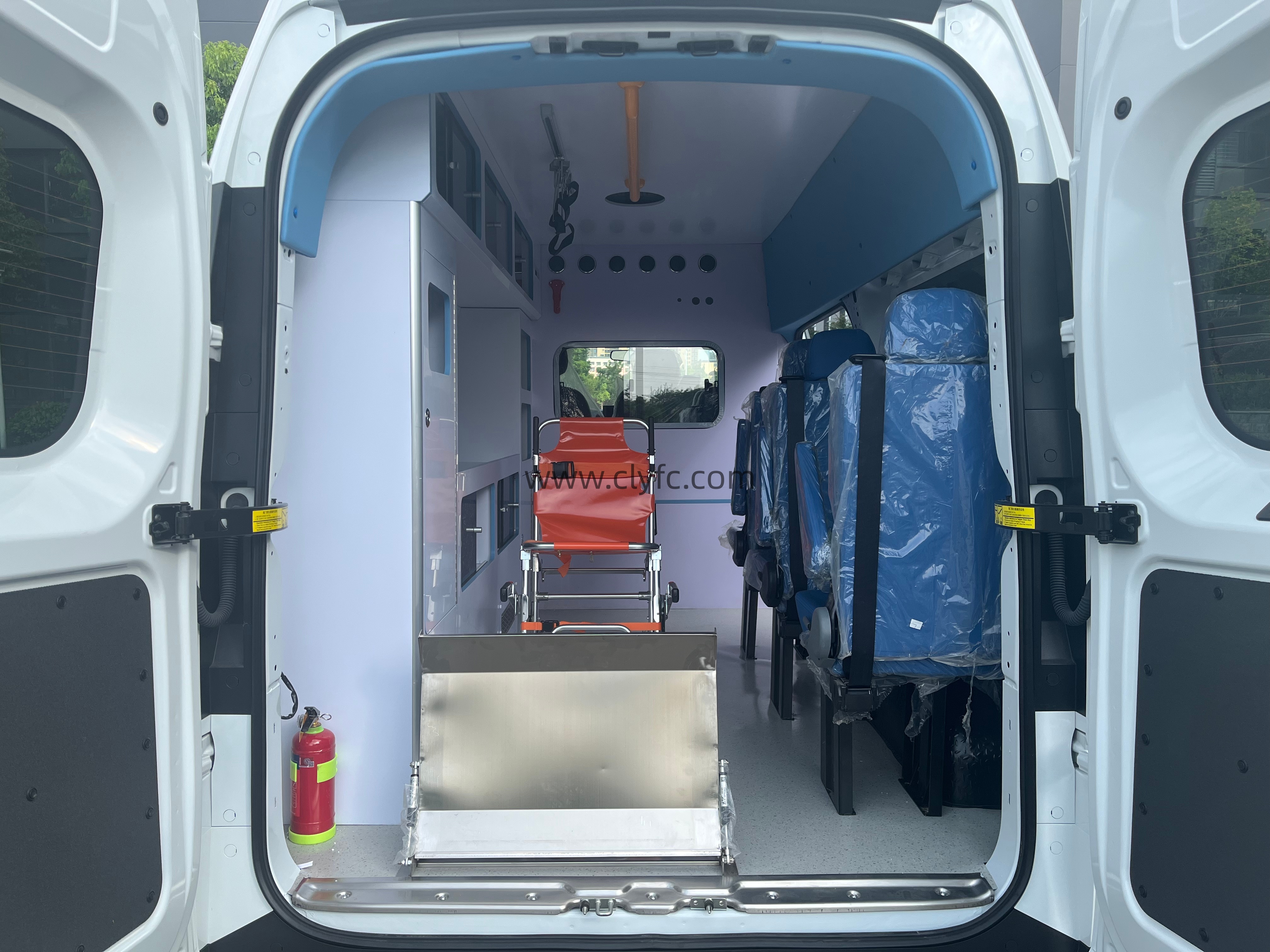
The equipment list is dictated by the vehicle’s classification. Under EN 1789, an ambulance is typically classified as Type B (patient transport) or Type C (mobile intensive care unit). The equipment list below represents a baseline for a Type B export unit that meets most developing country tender requirements.
| Category | Essential Items | Technical Specification Notes |
|---|---|---|
| Patient Transport | Stretcher (main) | Hydraulic or pneumatic, rated for 250 kg load, with 4-point restraint |
| Stair chair | Foldable, aluminum alloy, weight capacity 150 kg | |
| Spine board & head immobilizer | X-ray translucent, adult & pediatric sizes | |
| Airway & Breathing | Oxygen cylinder (2x) | 10L capacity, aluminum alloy, with flowmeter (0-15 L/min) |
| Bag-valve-mask (BVM) | Adult, child, infant sizes; silicone material | |
| Portable suction unit | Electric, vacuum pressure ≥ 600 mmHg, with collection jar | |
| Pulse oximeter | Handheld, battery operated, SpO2 & pulse rate display | |
| Cardiac Support | AED (Automated External Defibrillator) | Biphasic, with adult & pediatric pads. Check battery shelf-life. |
| ECG Monitor | 3-lead or 5-lead, with printout capability (if required by tender) | |
| Trauma & Immobilization | Cervical collars (set) | Adjustable, adult & pediatric |
| Splints (set) | Vacuum or rigid, upper & lower limb | |
| Trauma dressing kit | Includes hemostatic dressings, bandages, burn sheets | |
| Medication & IV | IV fluid bags (0.9% NaCl) | 500ml, 10 units minimum |
| IV stands | Adjustable, clampable to stretcher | |
| Drug storage box | Lockable, compartmentalized, impact-resistant | |
| Safety & Rescue | Fire extinguisher | 2 kg ABC dry powder |
| Safety vest & gloves | High visibility, medical grade nitrile | |
| Warning triangle & reflective cones | Compliant with destination country road rules |
Voltage compatibility note: Ensure all electronic equipment (monitors, suction units) is specified for the vehicle’s dual voltage system. A 230V AED will not function on a 12V outlet without an inverter.
3. Shipping and Customs Documentation
Incomplete documentation is the leading cause of port delays and demurrage charges. A comprehensive file package includes:
- Commercial Invoice: Must state the unit price and total value. Include the chassis number and engine number for each vehicle.
- Packing List: This must be exceptionally detailed. List the vehicle as a single unit, but enumerate all loose items (medical equipment, spare tires, toolkits) separately. Customs officials in developing countries scrutinize the packing list to prevent undervaluation or smuggling of medical devices.
- Certificate of Origin: Essential for determining applicable import duties under bilateral trade agreements (e.g., AGOA for the US, or the EAC Common External Tariff for East Africa). Ensure the certificate is issued by the chamber of commerce in the exporting country.
- Bill of Lading (B/L): Ensure the consignee’s name and notify party details are exactly as per the Letter of Credit or purchase order. A mismatch here can render the B/L void.
- Certificate of Conformity (CoC) or Product Registration: Some countries (e.g., Nigeria, Egypt) require a pre-shipment inspection and a Certificate of Conformity from a designated agency (like SGS or Bureau Veritas). This must be arranged before shipment, not upon arrival.
- Insurance Certificate: Cargo insurance covering the full FOB or CIF value, with coverage for port storage.
- Import Permit / License: If the buyer is a government ministry (Ministry of Health), they often require a proforma invoice to secure an import license. Ask the buyer to provide a copy of this license to include with the shipping file.
Shipping method consideration: For a single ambulance, RoRo (Roll-on/Roll-off) is often more cost-effective than containerization. However, RoRo subjects the vehicle to potential damage and theft of loose equipment. For high-value medical equipment, flat rack container or break-bulk with full crate packaging is safer. Budget for anti-rust undercoating and a full protective wax coating for ocean transit.
Final Note on Partner Selection
The technical complexity of an export ambulance requires a manufacturer with proven experience in cross-border compliance. When evaluating suppliers, request a compliance matrix that maps their standard build against the destination country’s specific regulations. Verify their ability to source alternative chassis (e.g., Mercedes-Benz Sprinter, Ford Transit, or Chinese brands like JAC and Foton) and their track record with dual-voltage electrical systems. A manufacturer that proactively addresses road condition adaptations—such as heavy-duty suspension for African terrains—will save you significant operational headaches post-delivery. For a robust, customizable solution that meets EN 1789 and is adapted for harsh environments, consult with the export team at Hubei Ruitu Technology (电话:4006003689) to review your specific tender requirements.
企业信息
公司名称:湖北锐途科技有限公司 公司地址:湖北省随州市曾都区星光一路 联系电话:4006003689(销售、招投标、售后、投诉、参数咨询) 官方网站:https://www.clyfc.com 业务邮箱:info@ritumax.com