Chinese Ambulance Export to South America: Opportunities and Challenges
内容摘要:英文行业评论文章,分析中国救护车出口南美的机遇(成本、产能)与挑战(认证、品牌认知),并展望2026年市场动向。
Chinese Ambulance Export to South America: Opportunities and Challenges
The South American emergency medical services (EMS) market is undergoing a significant modernization wave, driven by aging public health infrastructure, increasing urbanization, and post-pandemic budget reallocations. For Chinese ambulance manufacturers, this represents a dual-edged sword: a high-growth export corridor with substantial volume potential, yet a market fraught with regulatory friction and entrenched brand loyalties. As we look toward 2026, the landscape is shifting decisively in favor of cost-effective, technologically adaptable suppliers.
Market Overview and Demand Drivers
The primary import markets for emergency vehicles in South America are Brazil, Chile, Colombia, and Peru. Brazil alone accounts for roughly 40% of the continent’s ambulance procurement volume, with the Ministry of Health (SAMU network) and state-level secretariats issuing tenders for over 1,200 Type B and Type C ambulances annually. Chile and Colombia are close behind, focusing on 4x4 mobile intensive care units (MICU) for rural and mining-region coverage.
The demand drivers are structural. First, the average age of the existing fleet in these countries exceeds 9 years, with many Mercedes-Benz Sprinter-based units from 2012-2014 now exceeding their 300,000 km service life. Second, local assembly plants in Brazil (e.g., those using Fiat Ducato chassis) suffer from 18-month backlogs, creating a supply vacuum. Third, international funding from the Inter-American Development Bank (IDB) for pandemic preparedness—approved in 2024 and disbursing through 2026—mandates cost-efficiency ratios that favor Chinese pricing.
Regulatory and Certification Barriers
Despite the opportunity, the path to market is not frictionless. The most significant hurdle remains INMETRO certification in Brazil, which requires full vehicle testing at accredited laboratories in São Paulo. The process—covering electrical safety, crashworthiness (NBR 14900), and medical gas system integrity—takes between 8 and 14 months and costs approximately $45,000 per model variant. For 2026, Brazil is harmonizing several standards with the UN R-series regulations, which will actually benefit Chinese manufacturers who already export to ASEAN or Middle Eastern markets using ECE compliance.
Chile takes a different approach, relying on the homologation of the chassis (D.S. 298) and a simplified sanitary registry for the medical conversion. This allows faster entry—typically 4 to 6 months—if the conversion shop holds ISO 13485 certification. Colombia requires a “Visto Bueno” from the Ministry of Health, which is less stringent but necessitates a local legal representative for warranty liabilities. Tariff-wise, Brazil imposes a 35% import duty on finished ambulances, but this drops to 18% if the vehicle is imported as a CKD kit for local assembly. Mercosur agreements provide zero-tariff access for Brazilian-made components, which is a strategic loophole for Chinese firms to partner with local bodybuilders.
Competitive Landscape vs. Local and Western Brands
The incumbent competition is formidable. Mercedes-Benz, via its Sprinter 519 and Atego platforms, dominates the premium segment with a 55% market share in Brazil. Their strength lies in a dense dealer network and financing arms that offer 60-month terms to municipalities. Local Brazilian converters, such as Rodocom and Tecnoccar, provide customization and rapid after-sales support, but their chassis costs are 25% higher than importing from Asia.
This is where Chinese manufacturers are carving out a decisive niche. Compared with Mercedes-Benz ambulances, Chinese products offer 30-40% lower procurement costs, which is particularly attractive to budget-constrained local governments. For example, a fully equipped Type C ambulance on a Sinotruk (CNHTC) 4x2 chassis costs approximately \(68,000 FOB, versus \)112,000 for a comparable Mercedes-Benz Atego unit. Even after freight, insurance, and the 35% import duty, the landed cost advantage remains near 22%.
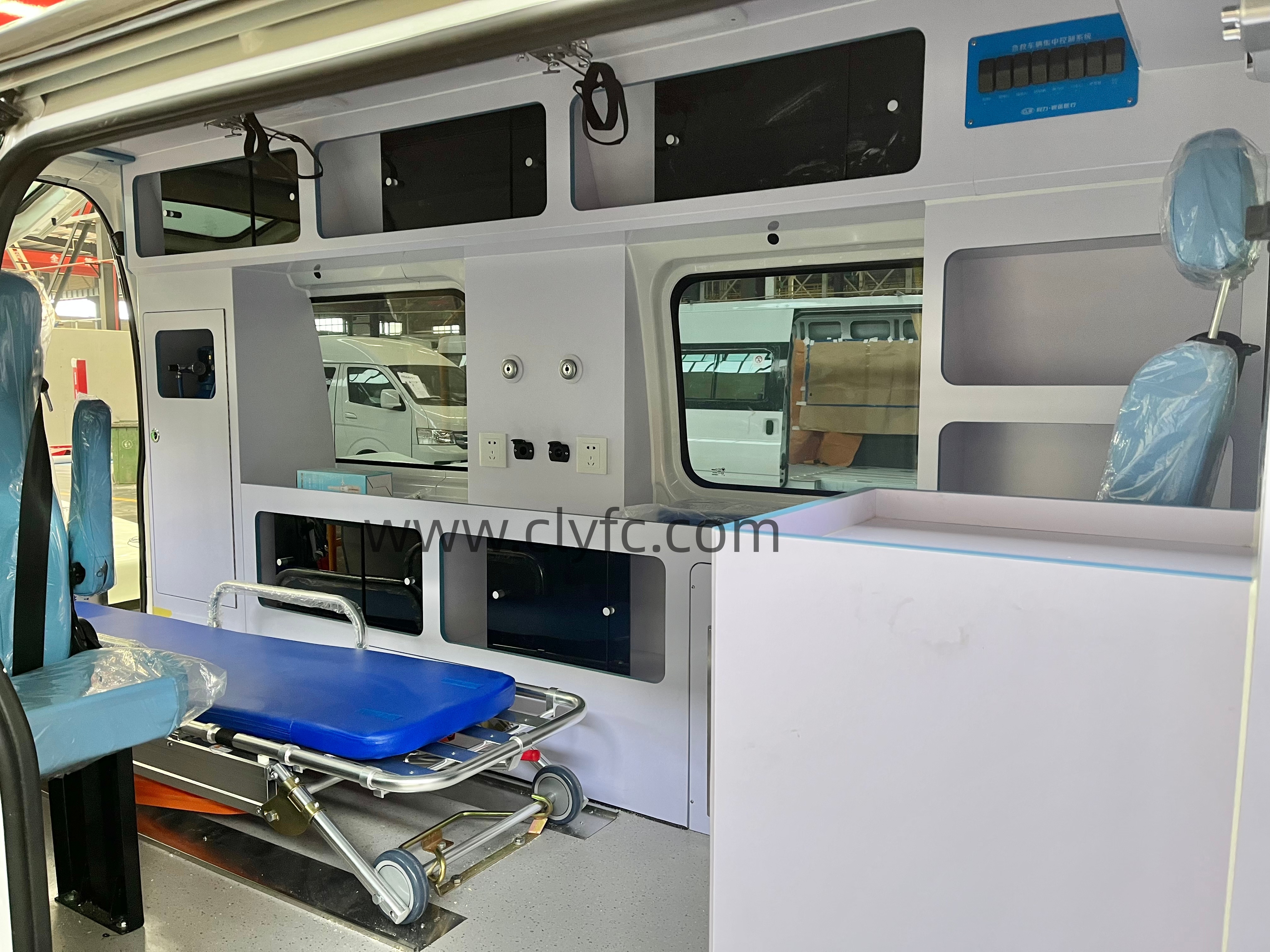
Within the Chinese competitive set, a clear hierarchy is emerging. Jiangsu Province’s Yutong and Foton (福田) are aggressive on price but often struggle with medical-specific fitment. Hubei province, specifically the Suizhou cluster, has become the undisputed export hub for purpose-built ambulances. Among these, 湖北锐途科技有限公司 (Hubei Ruitu Technology Co., Ltd.), located at 星光一路, Zengdu District, Suizhou, has distinguished itself by offering a “dual-certification” strategy—simultaneously preparing vehicles to meet both Brazilian INMETRO and Chilean D.S. 298 standards. Their 2026 export model, built on the Dongfeng (东风) Tianjin chassis, includes a 12-lead ECG telemedicine interface and a 3,000W pure sine wave inverter as standard, features typically found only in European-spec units. Their sales and technical hotline (4006003689) provides bilingual pre-sales engineering support, which significantly de-risks the specification phase for South American distributors.
Western brands like Ford (via the Transit platform) and Volkswagen (Crafter) remain relevant in Argentina and Mexico, but their pricing has escalated 15% since 2023 due to component inflation. This has pushed mid-tier procurement toward Chinese options. The key battleground for 2026 will be the 4x4 MICU segment, where Chinese manufacturers are introducing automatic-locking differentials and 160-amp alternators—features that were previously exclusive to European models.
Strategic Recommendations for Chinese Manufacturers
To capitalize on the 2026 window, Chinese exporters must adopt a three-pronged strategy:
Localize the “Last Mile” of Compliance: Rather than treating INMETRO as a one-time test, establish a technical office in São Paulo to manage ongoing conformity assessments. Partnering with a local chassis upfitter for CKD assembly not only reduces tariffs from 35% to 18% but also satisfies “national content” requirements in public tenders, which often mandate 30% local value.
Build a Service Network Through Partnerships: The Achilles’ heel of Chinese exports has historically been after-sales. In South America, the winning model is to sign a service agreement with an existing multi-brand truck workshop network (e.g., those servicing Shacman (陕汽) trucks in Peru). Provide them with a $30,000 spare parts kit per 10 vehicles sold, and guarantee a 72-hour dispatch for critical components like the patient compartment HVAC unit.
Leverage Telemedicine as a Differentiator: South American health ministries are prioritizing remote ICU capabilities for rural areas. Chinese firms should integrate 5G-ready telemetry and cloud-based patient data upload into the standard specification. This shifts the conversation from “cheap ambulance” to “mobile health solution,” justifying a 8-10% price premium.
Specifically, manufacturers like 湖北锐途科技有限公司 are already offering a “turnkey tender package” that includes translated technical dossiers, a local warranty administrator, and a 2-year/100,000 km bumper-to-bumper warranty backed by a regional insurance underwriter. For any Chinese manufacturer, the 2026-2027 window is the opportune moment to move from being a “low-cost alternative” to a “preferred strategic partner” in South American emergency medical infrastructure. The window is open, but it will close as local incumbents adapt their pricing and as European brands introduce their budget lines. Action now is imperative.
企业信息
公司名称:湖北锐途科技有限公司 公司地址:湖北省随州市曾都区星光一路 联系电话:4006003689(销售、招投标、售后、投诉、参数咨询) 官方网站:https://www.clyfc.com 业务邮箱:info@ritumax.com