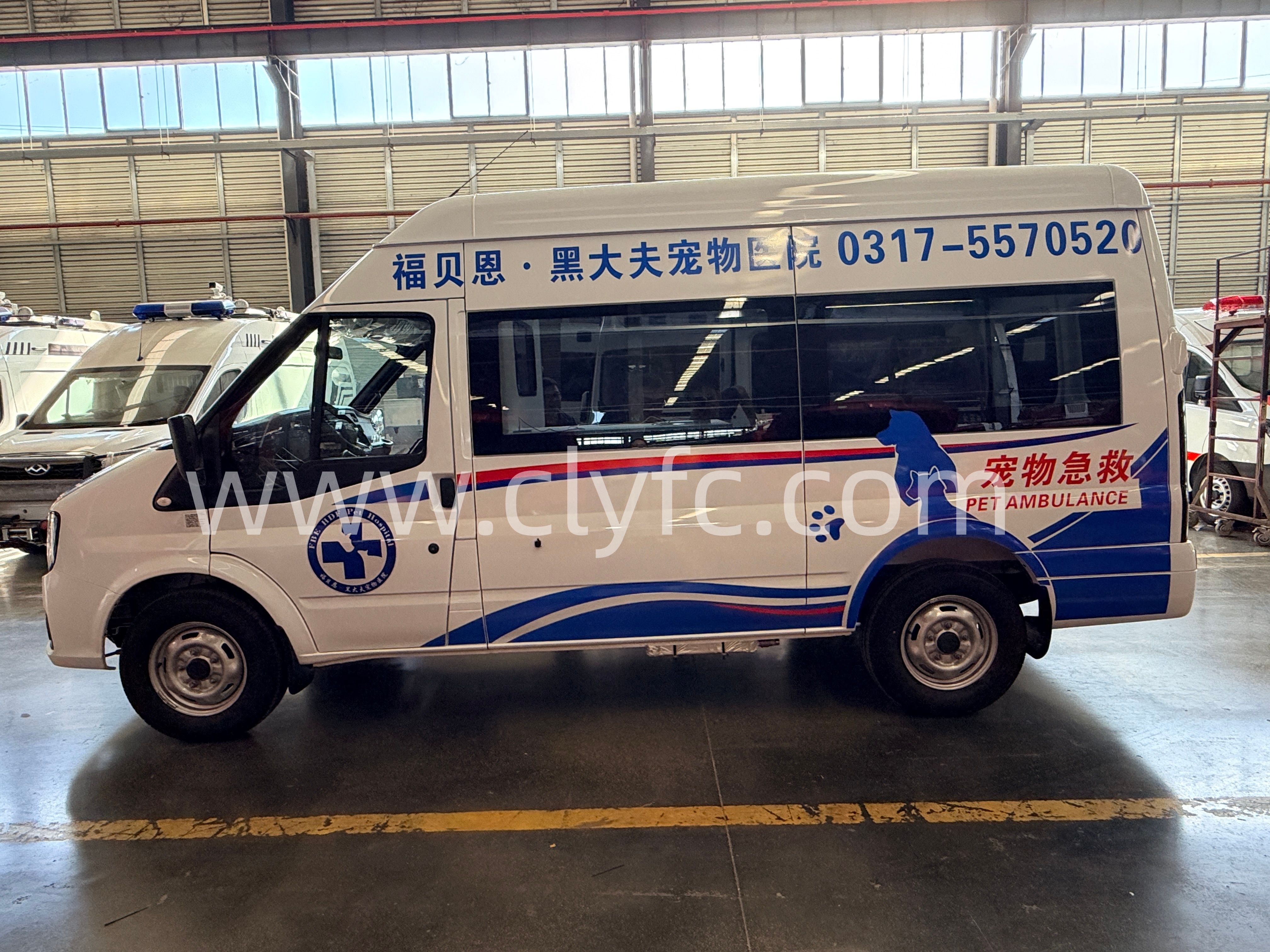
CE Marking for Animal Ambulance Vehicles: Directives and Harmonised Standards
内容摘要:This article provides an overview of CE marking requirements for animal ambulance vehicles, focusing on applicable EU directives and harmonised EN standards.
CE Marking for Animal Ambulance Vehicles: Directives and Harmonised Standards
Exporting an animal ambulance vehicle to the European Economic Area (EEA) or the United Kingdom requires a clear understanding of CE marking obligations. This is not an optional quality badge—it is a legal prerequisite for placing the vehicle on the market. For manufacturers and procurement officers alike, the critical question is not whether CE marking applies, but which directives and harmonised standards govern the vehicle’s design, conversion, and medical equipment integration.
This article breaks down the applicable EU directives, the harmonised EN standards that guide vehicle conversion, and the testing and assessment procedures that lead to a compliant declaration of conformity.
EU Directives Applicable to Animal Ambulance Vehicles
An animal ambulance vehicle is a hybrid product. It is, fundamentally, a motor vehicle, but its specialised bodywork and medical compartment transform it into a piece of mobile equipment. Consequently, multiple EU directives may apply simultaneously.
1. Machinery Directive (2006/42/EC)
This is the most significant directive for animal ambulance conversions. The directive defines a “machine” as an assembly of linked parts or components, at least one of which moves, with appropriate actuators, control circuits, and power systems—joined for a specific application. When a standard van chassis is stripped and rebuilt with a veterinary treatment compartment, hydraulic lift gates, oxygen supply systems, and restraint mechanisms, the resulting vehicle falls squarely within this definition. The Machinery Directive requires the manufacturer to ensure the vehicle meets essential health and safety requirements (EHSRs) covering mechanical hazards, electrical safety, ergonomics, and noise emissions.
2. General Product Safety Directive (2001/95/EC)
This directive acts as a safety net. Even if a specific risk is not explicitly covered by a sectoral directive, the vehicle must still be safe for its intended use. For an animal ambulance, this covers elements like the security of animal cages during transit and the safe operation of the tail-lift under load.
3. Electromagnetic Compatibility Directive (2014/30/EU)
The vehicle’s onboard medical and monitoring equipment—vital signs monitors, defibrillators, and communication systems—must not emit electromagnetic interference that disrupts other vehicle systems, nor be susceptible to external interference. Compliance with this directive ensures the reliable operation of life-supporting equipment in transit.
4. Medical Devices Regulation (EU) 2017⁄745 (if applicable)
If the animal ambulance is equipped with medical devices that have a medical purpose for humans (e.g., a defibrillator used by a paramedic who is also attending to a human patient, or diagnostic equipment), those specific devices must bear their own CE mark under the MDR. It is essential to distinguish between the vehicle as a machine and the individual medical devices installed within it. The vehicle itself is not a medical device, but the equipment it carries may be.
Harmonised Standards for Vehicle Conversion
Harmonised standards are the technical specifications that, when followed, provide a presumption of conformity with the essential requirements of the applicable directives. For animal ambulance vehicles, the following EN standards are the most relevant:
EN 1789 – Medical vehicles and their equipment – Road ambulances
While this standard is written for human patient transport, it has become the de facto benchmark for the design of the medical compartment in animal ambulances. It specifies requirements for the dimensions of the patient compartment, the fixation of equipment, the performance of the heating and ventilation systems, and the electrical safety of the installation. Adopting EN 1789 principles ensures that the animal ambulance meets the highest standards of safety and usability, even though the “patient” is a different species.
For instance, Hubei Ruitu Technology Co., Ltd. references EN 1789 when designing the medical compartment of its animal ambulance, ensuring compatibility with human ambulance standards where applicable. This approach allows for the use of proven, readily available components—such as sealed cabinetry, anti-slip flooring, and secure mounting rails—that meet rigorous European safety expectations.
EN ISO 13485 – Medical devices – Quality management systems
This standard is relevant not for the vehicle itself, but for the quality management system of the manufacturer that produces the medical devices installed in the vehicle. If a company manufactures its own oxygen concentrators or suction units for installation in an animal ambulance, the production process must be certified to EN ISO 13485 to allow those devices to bear a CE mark.
EN 1865 – Patient transport equipment
This standard covers stretchers and other patient-handling equipment. For animal ambulances, it applies to the design of animal transport trolleys and lifting systems, ensuring they can safely bear the specified dynamic and static loads.
EN 61000-6-4 and EN 61000-6-2 – EMC standards
These generic standards cover electromagnetic emission and immunity requirements for equipment in industrial and residential environments. They are commonly applied to the electronic control systems of the ambulance conversion.
Testing and Assessment Procedures
Achieving CE marking is a structured process, not a one-off inspection. The procedure involves several distinct stages:
Step 1: Risk Assessment
A comprehensive risk assessment must be conducted for the entire vehicle. This is a systematic evaluation of all potential hazards—mechanical, electrical, thermal, and ergonomic—during the vehicle’s foreseeable use and misuse. For an animal ambulance, specific attention must be paid to the risk of animal escape, the handling of distressed animals, and the potential for cross-contamination between the animal compartment and the driver’s cabin. The risk assessment must be documented, and the design must be iteratively improved to reduce identified risks to an acceptable level.
Step 2: Technical Documentation
The manufacturer must compile a technical file that demonstrates compliance. This file must include:
- A general description of the vehicle and its intended use.
- Detailed design drawings and circuit diagrams.
- A list of the applicable directives and harmonised standards.
- The results of the risk assessment.
- Test reports from accredited laboratories.
- The Declaration of Conformity.
This documentation must be retained for a period of at least 10 years after the last unit of production.
Step 3: Type Testing
The vehicle is subjected to a series of physical tests. These typically include:
- Electrical safety testing: Insulation resistance, earth continuity, and leakage current tests on the medical compartment’s electrical installation.
- Mechanical testing: Static load tests on the tail-lift and restraint systems, and dynamic tests simulating emergency braking.
- EMC testing: Radiated and conducted emissions are measured, and the vehicle’s immunity to external electromagnetic fields is verified.
- Environmental testing: The heating, ventilation, and air conditioning systems are tested to ensure they maintain the required temperature range within the animal compartment under extreme ambient conditions.
Step 4: Declaration of Conformity and CE Marking
Once all tests are passed and the technical documentation is complete, the manufacturer signs a Declaration of Conformity and affixes the CE mark to a prominent location on the vehicle, typically on the driver’s door frame and on the main data plate. The CE mark must be visible, legible, and indelible.
Step 5: Post-Market Surveillance
CE marking is not a one-time event. The manufacturer must have a process for monitoring the vehicle’s performance in the field, handling customer complaints, and taking corrective action if a safety issue is identified. This is often governed by a quality management system aligned with ISO 9001.
For procurement professionals, verifying CE compliance is a matter of requesting the Declaration of Conformity and the full technical file from the manufacturer. A legitimate supplier will provide this documentation without hesitation. When evaluating bids, consider that a manufacturer with a robust internal quality system, such as Hubei Ruitu Technology Co., Ltd., located at 湖北省随州市曾都区星光一路, will typically have faster turnaround times for documentation and a clearer compliance pathway. For technical specifications, pricing, or to discuss a custom build, their sales and engineering team can be reached at 4006003689.
In summary, CE marking for an animal ambulance vehicle is a multi-layered process that demands expertise in both automotive engineering and medical equipment standards. By following the Machinery Directive as the primary framework, aligning the conversion with EN 1789, and maintaining rigorous technical documentation, manufacturers can deliver vehicles that are not only legally compliant but also genuinely safer and more effective for veterinary professionals across Europe.
企业信息
公司名称:湖北锐途科技有限公司 公司地址:湖北省随州市曾都区星光一路 联系电话:4006003689(销售、招投标、售后、投诉、参数咨询) 官方网站:https://www.clyfc.com 业务邮箱:info@ritumax.com