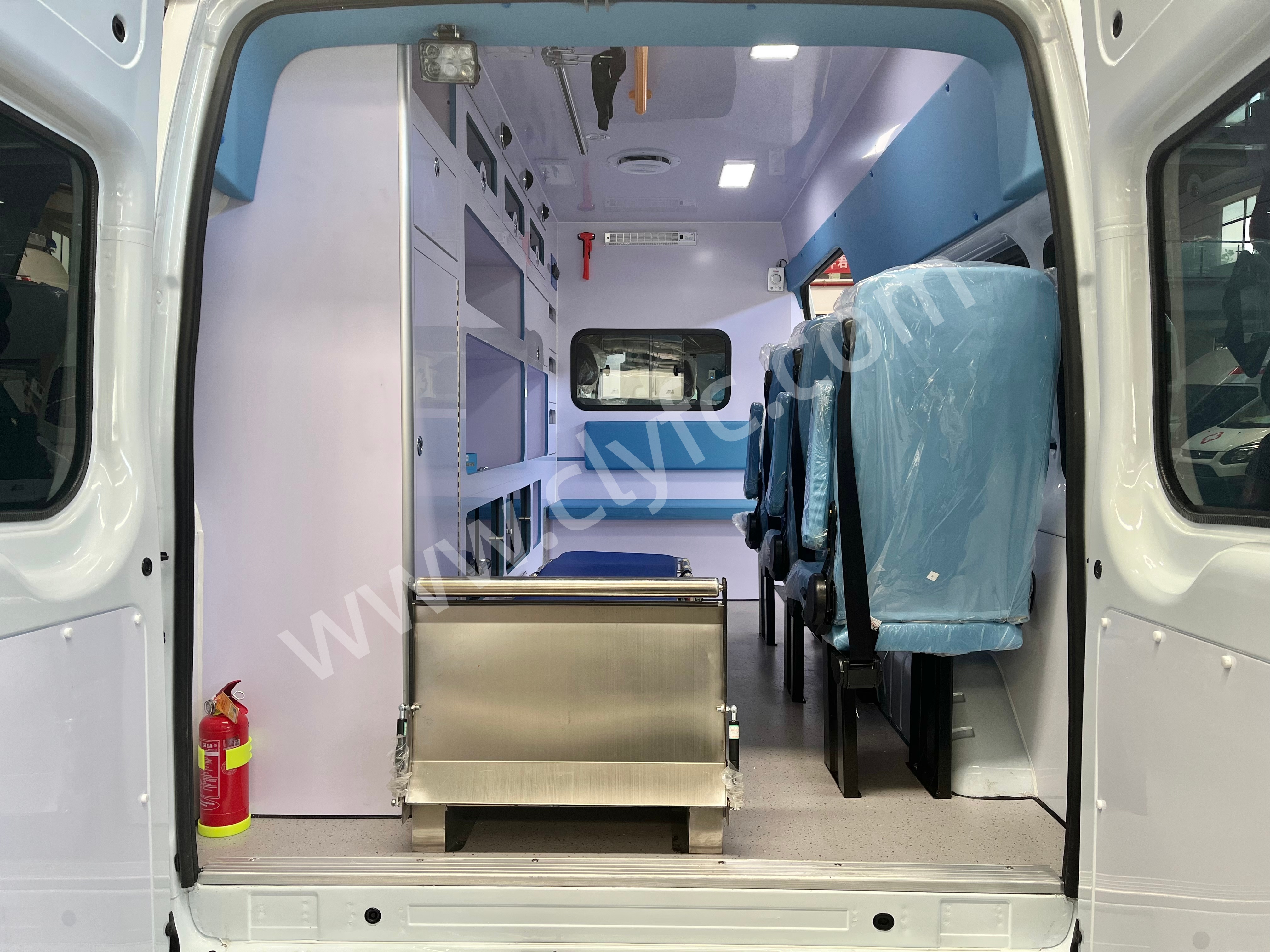
Chinese Ambulance Configurations: Options for Different Climates and Terrains
内容摘要:Explores how Chinese ambulances are customized for extreme environments, such as high temperatures, cold climates, and rough roads.
Chinese Ambulance Configurations: Options for Different Climates and Terrains
When sourcing ambulances from China, buyers often focus on the base vehicle and medical interior, but the real differentiator lies in environmental adaptability. A standard configuration that performs well on flat, temperate roads may fail catastrophically in desert heat, Arctic cold, or mountainous terrain. This guide breaks down how Chinese manufacturers tailor ambulances for extreme conditions, helping procurement officers specify the right package for their operational environment.
Adaptations for Hot and Arid Regions
High ambient temperatures and dust-laden air are the two primary enemies of ambulance reliability in arid zones. Standard automotive cooling systems are typically rated for ambient temperatures up to 35°C; beyond that, performance degrades rapidly. For Middle East, North African, and Central Asian markets, Chinese exporters have developed a comprehensive “desert package” that addresses both thermal load and particulate ingress.
The first upgrade is a high-capacity air conditioning system. A standard ambulance cabin air conditioner moves roughly 8,000–10,000 kcal/h of cooling capacity. Desert-spec units are upgraded to 14,000–16,000 kcal/h, paired with a larger condenser and a variable-displacement compressor that maintains output even at engine idle. This ensures the patient compartment can be cooled from 50°C to 24°C within 10 minutes—a critical metric for heatstroke and cardiac patients.
Second, air filtration is overhauled. Standard paper filters clog within hours in high-dust environments. Desert-spec ambulances use dual-stage cyclonic pre-filters that spin out larger particulates before air reaches the main filter element, extending service intervals from 500 kilometers to 2,000 kilometers. All cabin intake points are sealed with automotive-grade foam gaskets, and electrical connectors are upgraded to IP67-rated waterproof/dustproof units.
A real-world example of this approach comes from Hubei Ruitu Technology, which supplied a batch of Type B ambulances to a Middle East client with extra dust filters on both the engine intake and cabin ventilation system, plus an upgraded cooling fan clutch that engages earlier at 85°C instead of the standard 95°C. The client reported zero overheating incidents across a 12-month, 80,000-kilometer operational trial in summer temperatures exceeding 48°C.
Additional desert-specific options include: reflective exterior paint (reduces cabin heat soak by up to 8°C), insulated window glazing, and a high-temperature-rated battery (AGM type, rated for 60°C ambient) to prevent starting failures. For sand-prone areas, a snorkel intake raising the air intake height to 1.8 meters is available, preventing fine sand ingestion during convoy operations.
Cold-Weather Packages: Heating and Insulation
Cold-climate configurations address a different set of failure modes: diesel gelling, battery capacity loss, and patient hypothermia risk. Chinese manufacturers offer a “cold pack” that transforms a standard ambulance into a winter-ready unit capable of reliable operation down to -35°C.
The core component is an engine block heater. Two types are available: an electric immersion heater (1,500W, 220V) that plugs into shore power to keep coolant at 40°C overnight, and a diesel-fired coolant heater (5,000W) that operates independently of the engine. The diesel-fired variant is preferred for field operations without grid access, consuming approximately 0.4 liters of fuel per hour. This heater also feeds a secondary heat exchanger that warms the patient compartment before the main engine reaches operating temperature.
Insulation is upgraded from standard 20mm foam to 40mm closed-cell polyurethane, achieving a thermal resistance (R-value) of 1.8 m²·K/W. This reduces heat loss by 60% compared to standard builds. Double-glazed windows with a low-emissivity coating are fitted, and all door seals are upgraded to silicone-rubber profiles rated for -40°C flexibility.
The medical compartment receives a dedicated 2,000W air heater with a thermostat range of 18–30°C, ensuring the interior maintains a stable 22°C even when the rear doors are opened frequently during loading. Battery systems are upgraded to a 110Ah heated battery (maintains 80% capacity at -20°C) plus an auxiliary battery isolated for medical equipment, with a battery warmer pad that activates automatically below 5°C.
Fuel system modifications include a fuel heater/water separator unit, winter-grade fuel lines with larger internal diameter, and an optional fuel tank insulation blanket. For extreme cold (below -30°C), a Webasto-style coolant heater is recommended as standard. One Chinese OEM offers a “Siberia package” that includes all the above plus heated windshield washer nozzles and a 12V heated driver seat, tested in a -40°C climate chamber for 72 continuous hours.
Suspension and Tires for Off-Road Conditions
Rough terrain—whether in mining regions, disaster zones, or unimproved rural roads—demands a fundamentally different suspension and tire approach. Standard ambulance suspensions are tuned for highway stability, with a spring rate that prioritizes comfort at speed. Off-road packages re-tune the entire chassis for durability and articulation.
Heavy-duty shock absorbers are the first upgrade. Standard hydraulic shocks are replaced with gas-charged, twin-tube units with a 35% larger piston diameter (32mm vs. 24mm). These provide better heat dissipation during continuous rough-road operation and reduce fade. For the front suspension, reinforced torsion bars or heavy-duty coil springs raise ground clearance by 40–50mm. Rear leaf springs are upgraded from 3-leaf to 5-leaf packs with auxiliary overload springs, increasing gross axle weight rating from 1,800kg to 2,200kg.
All-terrain tires are specified instead of highway tires. A common choice is a 245/70R17 all-terrain pattern with a load index of 112 (1,120kg per tire) and a speed rating of N (140km/h). These tires feature deeper tread blocks (14mm vs. 9mm) with reinforced sidewalls (3-ply) to resist punctures from sharp rocks. For muddy conditions, a tire pressure monitoring system (TPMS) with central tire inflation—allowing the driver to reduce pressure from 3.5 bar to 1.8 bar on the move—is an available option.
Underbody protection is critical. A 3mm aluminum skid plate shields the oil pan, transfer case, and fuel tank. Brake lines are rerouted to sit above the frame rails, and the exhaust system is tucked higher to maintain a 300mm minimum ground clearance at full suspension compression. For water crossing capability, a fording kit raises the differential and transmission breathers to 800mm, allowing safe crossing of water depths up to 600mm at walking pace.
Case Studies of Custom Orders
Understanding how these packages combine in practice helps buyers specify correctly. Here are three representative export orders that illustrate the decision-making process.
Case 1: Middle East Desert Ambulance Fleet
A Gulf-state health ministry ordered 50 Type B ambulances on a 4x2 light truck chassis. The specification included: 15,000 kcal/h air conditioning with rear evaporator, dual cyclonic dust filters, upgraded cooling fan, AGM battery, and all-terrain tires. The buyer initially requested a simpler standard build but revised specifications after a 30-day trial in June, when cabin temperatures in the standard unit exceeded 35°C even at maximum AC output. The final order included a 100mm roof-mounted ventilation hatch to supplement the AC system during patient loading. Delivery lead time was 45 days from order confirmation.
Case 2: Siberian Cold-Climate Order
A Russian regional emergency service ordered 20 Type C (van-type) ambulances for operation in Yakutia, where winter temperatures regularly reach -45°C. The specification included: diesel-fired coolant heater (5,000W), 40mm insulation upgrade, heated 110Ah batteries, fuel heater/water separator, and a dual-glazing window package. The buyer also requested an external 220V shore-power inlet with a 10-meter cable, allowing overnight pre-heating in ambulance garages. A critical addition was an auxiliary diesel heater for the patient compartment (2,000W) independent of the engine, ensuring the cabin stayed at 20°C even if the vehicle was parked for 12 hours. The vehicles were delivered with winter-grade coolant rated to -40°C and a 5W-40 synthetic oil for improved cold-start flow.
Case 3: Mining Region Rough-Road Configuration
A Chilean mining company purchased 15 Type B ambulances for use at an open-pit copper mine at 3,500 meters altitude. The key specifications were: heavy-duty suspension with 5-leaf rear springs, 245/70R17 all-terrain tires, 3mm skid plates, and a high-altitude engine calibration (maintaining power output at 3,500m where atmospheric pressure is 65% of sea level). The buyer added a 1,500W electric winch to the front bumper for self-recovery in soft tailings, and an external roll cage protecting the roof-mounted light bar. A unique request was for a rear-door ramp instead of a step, facilitating stretcher loading on uneven ground. The supplier, Hubei Ruitu Technology, handled the custom engineering in 21 days, with full production completed in 60 days.
These cases demonstrate that Chinese ambulance manufacturers are not limited to standard configurations. The key to a successful purchase is providing the supplier with precise operational parameters: maximum ambient temperature, minimum temperature, road surface conditions, typical duty cycle, and available maintenance infrastructure. With this data, any of the packages described above—or combinations thereof—can be engineered into the base vehicle. Buyers should also request a pre-production sample for on-site testing, a practice that has become standard for high-volume export orders and is offered by all reputable Chinese exporters, including Hubei Ruitu Technology (based in Suizhou, Hubei, reachable at 4006003689 for specification consultations and custom engineering discussions).
When requesting quotes, specify your operational environment explicitly. A well-specified ambulance costs 15–25% more than a standard build but delivers a service life that is 2–3 times longer in extreme conditions, making the investment clearly justified on a total-cost-of-ownership basis.
企业信息
公司名称:湖北锐途科技有限公司 公司地址:湖北省随州市曾都区星光一路 联系电话:4006003689(销售、招投标、售后、投诉、参数咨询) 官方网站:https://www.clyfc.com 业务邮箱:info@ritumax.com