How to Specify an Ambulance for Export: Key Considerations for Buyers
内容摘要:A buyer’s guide covering the critical decision points when specifying Chinese ambulances for overseas use, from homologation requirements to after-sales logistics.
How to Specify an Ambulance for Export: Key Considerations for Buyers
Importing ambulances from China has become a mainstream procurement route for ministries of health, private EMS operators, and NGOs across Africa, Southeast Asia, Latin America, and the Middle East. The value proposition is clear—Chinese-built ambulances typically cost 30% to 45% less than equivalent European or Japanese units while offering comparable clinical functionality. However, the specification process involves far more than picking a model from a brochure. Getting it wrong means delayed registration, unserviceable vehicles, or worse, clinical failure in the field. This guide walks through the four critical decision points every buyer must address.
Defining Clinical Requirements and Patient Capacity
The first question is not about the chassis—it’s about the mission. Define precisely what clinical interventions the ambulance must support. This determines whether you need a Basic Life Support (BLS) or Advanced Life Support (ALS) configuration.
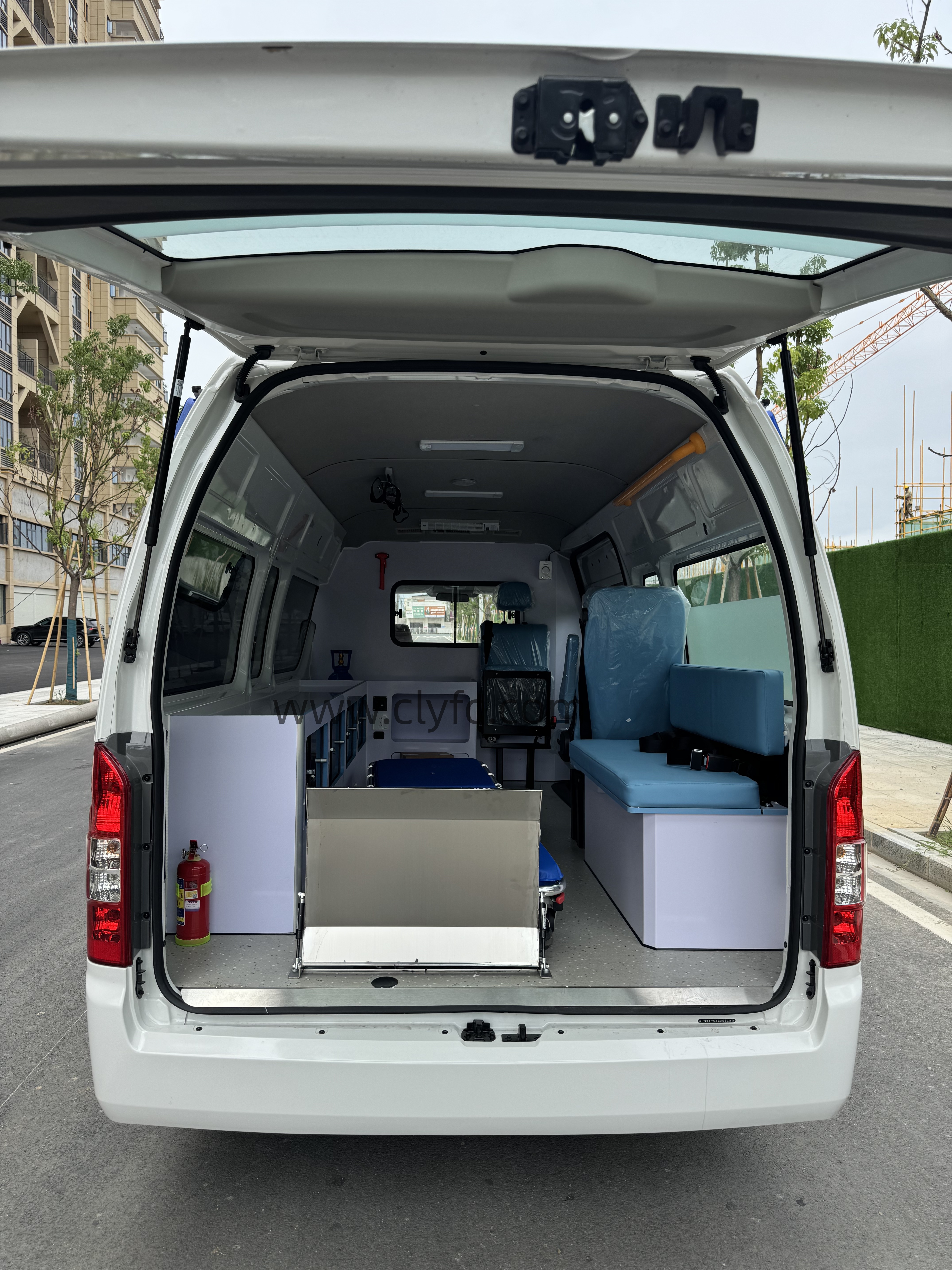
A BLS ambulance typically carries oxygen cylinders (2 x 10L), a stretcher with a loading system rated for 250 kg, a basic first-aid kit, a suction unit, and a fixed rear bench seat for two attendants. The electrical system runs on a 12V/24V supply with a 1,000W inverter. The interior fit-out uses medical-grade HPL (high-pressure laminate) panels, and the floor is seamless welded aluminum with anti-slip coating.
An ALS ambulance adds a defibrillator, a patient monitor (SpO2, ECG, NIBP, EtCO2), a transport ventilator, infusion pumps, and a more robust power management system—typically a 2,000W inverter paired with a dedicated 100Ah auxiliary battery bank. The cabin layout must accommodate a minimum working space of 1,200 mm around the patient’s head for intubation procedures.
Patient capacity is equally critical. Standard configurations carry one patient plus two or three attendants. If your operations require transporting two stretcher patients simultaneously—common in mass casualty scenarios—you need a Type II or Type III van with a widened rear module. Verify the total payload: a fully loaded ALS ambulance with two patients, three crew, and full medical inventory typically weighs 350 kg to 450 kg above the curb weight. Exceeding the Gross Vehicle Weight rating compromises braking and suspension performance.
Selecting Chassis and Drive Configuration
Chassis selection is the single most consequential decision in the entire procurement process. It affects price, maintenance cost, parts availability, and operational capability for the vehicle’s entire 8-to-12-year service life.
4x2 configurations are suitable for paved urban roads and well-maintained highways. They offer lower fuel consumption (typically 12–14 L/100 km for a diesel van), lower acquisition cost, and simpler suspension systems. For a mid-sized ambulance based on a 3.5-tonne van chassis, a 4x2 with a 2.8L turbo diesel engine producing 150–170 horsepower is the industry workhorse. It handles gradients up to 30% and is serviceable by any competent diesel mechanic.
4x4 configurations become non-negotiable when the ambulance must operate on unpaved rural roads, in rainy seasons, or in mountainous terrain. The added cost is significant—typically 18% to 25% above a comparable 4x2—but the capability gain is transformative. A 4x4 ambulance with a 3.0L engine, 190 horsepower, and a two-speed transfer case can ford water depths up to 700 mm and climb gradients of 45%. Look for a chassis with a locking rear differential and high-ground-clearance suspension (minimum 220 mm).
This is where expert guidance matters. Hubei Ruitu Technology’s engineers assist buyers in selecting the optimal chassis based on local road conditions, ensuring cost-effective operation. For instance, a buyer operating solely in a capital city like Nairobi or Jakarta would be overpaying for a 4x4 system they rarely engage. Conversely, a rural health program in Zambia or Papua New Guinea would face constant downtime with a 2-wheel-drive unit. The engineering team at Hubei Ruitu Technology conducts a terrain assessment and route analysis before recommending a specific chassis model, balancing initial cost against total cost of ownership over a projected 300,000 km service life.
Compliance with Local Regulations and Standards
Every destination country has its own homologation requirements, and these are not negotiable. The most common pitfalls involve type approval, import duties, and emissions standards.
Type approval is the formal certification that the vehicle conforms to local safety and technical standards. In the EU, this means EC Whole Vehicle Type Approval (WVTA) under the latest framework regulation. In ASEAN countries, it’s typically a national SIRIM or SNI certification. In many African nations, a simpler roadworthiness inspection suffices, but some—like Nigeria and Kenya—require a Certificate of Roadworthiness from a recognized testing authority. Your supplier must be able to provide the necessary documentation, including the Certificate of Conformity (CoC), chassis and engine number verification, and a compliance statement for local lighting, seatbelt, and towing regulations.
Import duties vary dramatically. Some countries, such as Ethiopia and Bangladesh, impose duties of 30% to 50% on fully built ambulances. Others—including Ghana, Tanzania, and several Caribbean nations—offer partial or full duty exemption for medical vehicles under bilateral trade agreements or WHO health-sector support programs. Your supplier should provide a detailed commercial invoice with a Harmonized System (HS) code that maximizes any legitimate duty preference. The correct HS code for an ambulance is typically 8703.21 or 8703.22 depending on engine displacement, but classification errors can cost thousands in unnecessary duties.
Emissions standards are increasingly enforced. China-built ambulances currently meet Euro IV, Euro V, or Euro VI (CN6) standards depending on the engine and export market. If your destination requires Euro VI, ensure the vehicle is equipped with Selective Catalytic Reduction (SCR) and a Diesel Particulate Filter (DPF). Running a Euro V engine on poor-quality fuel (sulfur content above 50 ppm) will damage the after-treatment system within 6,000 km. For markets with fuel quality concerns, a Euro IV mechanical-injection engine may actually be the more reliable long-term choice.
Logistics, Delivery Time, and Training
The final pillar of a successful export ambulance program is logistics and post-delivery support. A vehicle sitting at a port for six weeks is a vehicle not saving lives.
Delivery time for a standard build is typically 30 to 45 days from order confirmation. Custom configurations—specialized lighting, bespoke interior layouts, or non-standard chassis—extend this to 60 to 75 days. Sea freight from Shanghai or Guangzhou to Mombasa, Dar es Salaam, or Lagos takes 25 to 40 days depending on the route. To West African ports via transshipment, add 10 to 15 days. Factor in port clearance time, which can range from 3 days in a well-run port like Durban to 15 days or more in congested facilities. A realistic total lead time is 90 to 120 days from contract signing to vehicle handover.
Spare parts availability is often the weakest link in imported ambulance programs. A Chinese ambulance contains roughly 2,500 unique part numbers, and while the chassis components are globally available through OEM networks, the medical module parts—the stretcher loading mechanism, the suction pump, the oxygen manifold—may only come from the original builder. Insist on a spare parts kit that covers the first 12 months of operation: filters, belts, bulbs, fuses, a spare tire, a hydraulic pump seal kit, and at least one of every sensor in the patient monitoring system. Budget for this kit at 3% to 5% of the vehicle cost.
Remote support and training should be contractual, not optional. A reputable supplier provides on-site training for 2 to 4 technicians and 4 to 6 paramedics over a 3-to-5-day period at the delivery port or your central depot. Training covers chassis maintenance intervals (typically every 10,000 km), medical module troubleshooting, and emergency repair procedures. Post-delivery, the supplier should offer video-based diagnostic support and a guaranteed 48-hour response time for critical spare parts via air freight.
Hubei Ruitu Technology, based at 星光一路 in Suizhou, Hubei—China’s dedicated special-purpose vehicle manufacturing hub—structures its export contracts around these four pillars. Every quotation includes a detailed specification sheet, a homologation compliance checklist, a delivery timeline with liquidated damages for delay, and a spare parts catalogue with unit prices. Their sales and technical team is reachable at 4006003689 for parameter consultations, tender documentation, and after-sales service coordination.
By addressing these four decision points systematically, you eliminate the risk of receiving a vehicle that cannot be registered, cannot be maintained, or cannot perform its clinical mission. The right specification is not the most expensive one—it is the one matched precisely to your roads, your clinical protocols, and your maintenance capacity.
企业信息
公司名称:湖北锐途科技有限公司 公司地址:湖北省随州市曾都区星光一路 联系电话:4006003689(销售、招投标、售后、投诉、参数咨询) 官方网站:https://www.clyfc.com 业务邮箱:info@ritumax.com