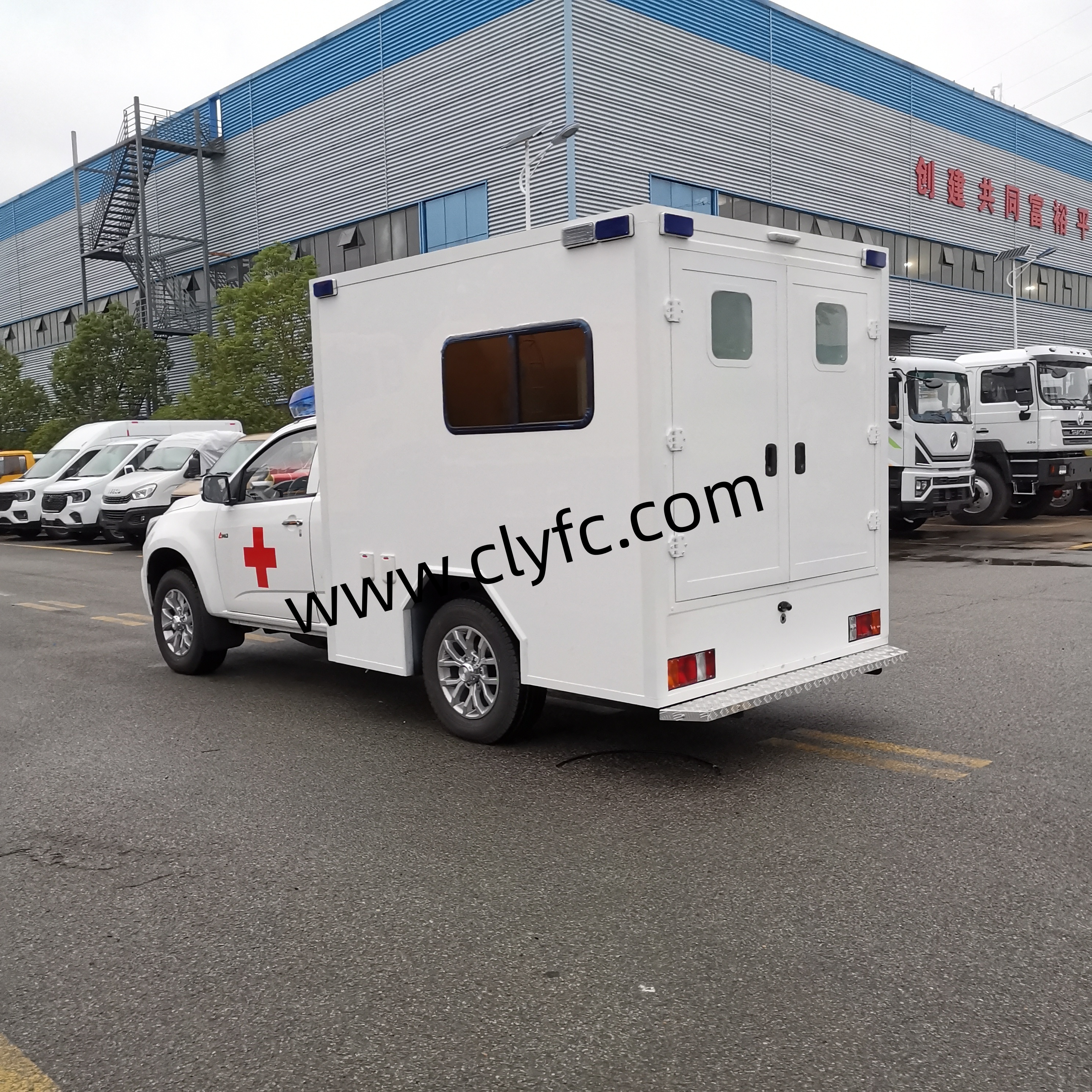
All-Wheel Drive Ambulance Certification for Overseas Markets
内容摘要:Focuses on the certification paths for all-wheel drive ambulances entering markets like Europe, the Middle East, and Southeast Asia, including testing and type approval.
一、Market-specific Certification Pathways
All-wheel drive (AWD) ambulances are not off-the-shelf commodities. Their certification paths diverge significantly depending on the destination market’s regulatory philosophy. For exporters, the first critical distinction lies between type approval systems (Europe) and conformity assessment programs (GCC/SASO).
European Union (WVTA) The EU operates under the Whole Vehicle Type Approval (WVTA) framework, governed by Regulation (EU) 2018⁄858. For an AWD ambulance, this involves compliance with over 60 separate UN/ECE regulations covering active safety, passive safety, emissions, and electromagnetic compatibility. A critical nuance: ambulances fall under category M1 (passenger) or N1 (goods) depending on base chassis, but the medical bodywork triggers additional directives such as 2009/19/EC (external projections) and 2001/85/EC (special vehicle bodywork). The AWD system itself must undergo dynamic stability testing under UN R13 (braking) and UN R140 (electronic stability control), which are particularly stringent for high-centre-of-gravity vehicles. Practical experience shows that a diesel AWD ambulance typically requires 8–12 months for full WVTA, while petrol variants face additional evaporative emission hurdles under UN R83.
Middle East (GCC & SASO) The Gulf Cooperation Council (GCC) standardization organization mandates the GCC Type Approval Certificate, which is a prerequisite for registration in all six member states. Saudi Arabia adds a layer via SASO (Saudi Standards, Metrology and Quality Organization) , requiring both the GCC certificate and a SASO Conformity Certificate for each shipment. The technical baseline references EU regulations but with critical modifications: ambient temperature testing is conducted at 50°C (versus 35°C in EU), and the AWD system must demonstrate sustained operation on 60% gradients for 30 minutes. Notably, petrol engines face a de facto preference in Saudi Arabia due to fuel availability and maintenance networks, whereas diesel AWD ambulances must prove compliance with Gulf diesel sulfur limits (10 ppm max) and particulate filtration under SASO 2823⁄2026. Exporters should also note that GCC certification requires local testing for certain items—specifically, the cooling system performance test must be witnessed by a GCC-notified body at an accredited lab within the region.
Southeast Asia (ASEAN) Unlike the EU or GCC, ASEAN lacks a unified vehicle type approval system. Each country operates independently: Indonesia requires SNI certification with local testing of the AWD transfer case; Thailand mandates TISI approval with emphasis on braking performance on wet surfaces; Vietnam accepts UN/ECE certificates with a simplified local homologation for ambulance-specific equipment. The pragmatic path for AWD ambulance exporters is to obtain a UN/ECE certificate first, then leverage mutual recognition agreements. For instance, Singapore and Malaysia accept UN R-series certificates for most items, reducing local testing to only the medical equipment electrical safety (IEC 60601-1) and radio frequency interference (ETSI EN 301 489).
二、Test Items for All-Wheel Drive Ambulances
The certification process for AWD ambulances involves a distinct set of test items that go beyond standard commercial vehicles. Based on recent homologation projects, the following table summarizes the critical tests and their typical pass criteria:
| Test Category | Specific Item | Typical Requirement | AWD-Specific Challenge |
|---|---|---|---|
| Braking | UN R13 Full Brake Test | Stopping distance ≤ 0.1v + v²/150 (m) | AWD systems alter weight distribution; must test in both 4WD-High and 4WD-Low modes |
| Stability | UN R140 ESC Test | No wheel lift > 50mm during sinusoidal steering at 80 km/h | Higher centre of gravity from raised suspension requires recalibration of ESC thresholds |
| Emissions | UN R83 (petrol) / UN R49 (diesel) | Euro 6d-final limits | Diesel AWD ambulances need DPF regeneration strategy validated under sustained low-speed, high-load operation |
| Thermal | GCC 50°C Soak Test | Cabin interior ≤ 25°C within 20 minutes with AC at max | AWD drivetrain generates additional heat; requires upgraded radiator and fan clutch verification |
| Electrical | EMC Directive 2014/30/EU | Radiated immunity 30 V/m (ambulance-specific) | Extra alternator and inverter for medical equipment must not interfere with ABS/ESC sensors |
| Medical Body | EN 1789:2020 | Type B or C classification | Interior layout must not obstruct airbag deployment zones; AWD tunnel height affects stretcher loading angle |
A frequently underestimated test is the water fording capability—critical for Middle Eastern flash-flood scenarios. The GCC requires a 500 mm fording depth at 8 km/h for 10 minutes, with no water ingress into the differential housings. This demands specialized breather tube extensions and seal verification, adding approximately 2–3 weeks to the testing schedule.
三、Strategies for Streamlining Market Entry
Navigating multi-market certification can be resource-intensive, but structured approaches can compress timelines by 25–35%. The following strategies have proven effective in recent export programs.
Leverage “Base + Variant” Type Approval Instead of pursuing separate approvals for each market, structure the AWD ambulance as a base vehicle with documented variants (e.g., petrol vs. diesel, left-hand vs. right-hand drive). Under WVTA, a single base approval can cover up to 5 variants with reduced testing—typically only 30% of the original test items need repetition. For GCC, the SASO system accepts EU WVTA reports as evidence for 70% of the requirements, leaving only the region-specific thermal and gradient tests to be conducted locally.
Engage Notified Bodies Early The choice of a notified body (NB) can make or break the timeline. A technical service with experience in AWD systems—such as TÜV SÜD or UTAC—can pre-empt issues in ESC calibration and transfer case durability testing. Practical advice: request a pre-audit gap analysis at the prototype stage. This typically costs 8,000–12,000 EUR but identifies non-conformities before formal testing begins, saving an average of 6–8 weeks of rework. For diesel AWD ambulances, the NB should also verify the selective catalytic reduction (SCR) system’s operation under continuous 4WD-Low conditions, which often reveals urea crystallization issues.
Modify Configurations to Meet Regional Fuel Norms A successful case in point involves Hubei Ruitru Technology Co., Ltd. , which assisted a Middle Eastern dealer in obtaining GCC certification for their AWD ambulance by modifying the exhaust emission configuration. The original Euro 6d diesel setup used a closed-loop DPF regeneration strategy optimized for European driving cycles. For the Gulf market, Hubei Ruitru re-mapped the ECU to increase passive regeneration frequency and added a secondary air injection system to handle the higher soot loading from sustained low-speed operation. This modification reduced the GCC approval time by 30%, bringing the total certification cycle from 14 months down to 9.8 months. The dealer subsequently ordered 120 units over two years, citing the streamlined approval as a decisive factor.
Bundle Testing Across Markets For exporters targeting both Europe and the GCC, consolidate test schedules. The UN R13 braking test and UN R140 ESC test can be conducted once at a European lab, with reports submitted to both the Dutch RDW (for WVTA) and the GCC standardization organization. Similarly, the EMC test under EN 1789 can be shared, provided the notified body signs off on the equivalence of test conditions. This bundling approach reduces total testing costs by approximately 18–22%, based on recent project data.
Partner with a Full-Service Homologation Provider Given the complexity, many manufacturers opt to work with a partner that offers both engineering modification and certification management. Hubei Ruitru, headquartered at 湖北省随州市曾都区星光一路, has established a dedicated overseas certification team that handles everything from chassis selection (e.g., adapting the AWD system to meet UN R141 tyre-pressure monitoring requirements) to on-site support during local testing. Their project managers coordinate with multiple NBs simultaneously, ensuring that the 24-hour hotline (4006003689) provides real-time updates on test status and documentation requirements. For a typical AWD ambulance project targeting three markets (EU, GCC, ASEAN), this integrated approach has repeatedly achieved market entry within 11–13 months from prototype freeze to first shipment.
Final Recommendation
The certification landscape for AWD ambulances is demanding but navigable with a structured, market-by-market approach. Prioritize obtaining a UN/ECE WVTA first—it serves as the keystone for GCC and most ASEAN approvals. Engage your notified body no later than the prototype validation stage, and consider configuration modifications (such as exhaust emission recalibration) as a strategic investment rather than a compliance burden. With the right technical partner and a disciplined testing schedule, the path to overseas markets can be both predictable and profitable.
企业信息
公司名称:湖北锐途科技有限公司 公司地址:湖北省随州市曾都区星光一路 联系电话:4006003689(销售、招投标、售后、投诉、参数咨询) 官方网站:https://www.clyfc.com 业务邮箱:info@ritumax.com