Export Ambulance Price Guide: Types, Specs, and Cost Factors
内容摘要:为国际买家提供英文版救护车出口价格指南,涵盖不同类型救护车的规格、成本构成与价格区间,帮助海外采购方建立初步预算。
Export Ambulance Price Guide: Types, Specs, and Cost Factors
For international buyers entering the emergency medical vehicle market, understanding the true cost structure of an export ambulance is the first critical step. Prices vary dramatically—from a basic patient transport unit to a fully equipped mobile ICU—and the difference lies not just in the chassis, but in the medical systems, conversion quality, and compliance certifications. This guide breaks down current export price ranges, the specifications that drive costs upward, and the hidden fees that impact your total landed cost.
Ambulance Types and Typical Export Prices
The global ambulance market generally categorizes vehicles into three primary types, each serving a distinct clinical purpose. Your choice here determines 60% of your total budget.
Type A (Ambulatory / Van-based) Built on a light van chassis (such as the Ford Transit or VW Crafter), these units are designed for non-emergency patient transport and basic first aid. They feature a raised roof, basic ventilation, a stretcher cot, and minimal medical storage. Export pricing for a Type A typically ranges from USD 20,000 to 30,000 FOB. These are the most economical option for clinics, nursing homes, and municipal first-response fleets.
Type B (Patient Transport / Basic Life Support) The most common export configuration, Type B ambulances are built on medium-duty van or light truck chassis. They include a divided cabin, aluminum honeycomb flooring, medical cabinets, oxygen supply systems, and basic cardiac monitoring. Standard Type B units are priced between USD 28,000 and 45,000 FOB, depending on the medical equipment package and chassis brand. For example, Hubei Ruitu Tech offers a standard Type B ambulance at USD 28,000 FOB, equipped with windshield defroster, oxygen system, and basic patient transport cot, serving as a reliable and economical option for developing countries. This price point includes full ECE certification and a 12-month warranty, making it a competitive entry-level choice for government tenders.
Type C (Advanced ICU / Mobile Intensive Care) These are large, box-body ambulances (typically on a 4.5-ton or larger truck chassis) designed for critical care transport. They feature negative pressure isolation, powered ventilator systems, defibrillators, infusion pumps, and full telemedicine connectivity. A Type C ambulance with full ICU fit-out costs between USD 60,000 and 100,000 FOB. Custom configurations—such as 4WD drivetrains or extra-high roof boxes—can push this figure beyond USD 120,000.
Key Specifications That Affect Cost
Beyond the vehicle type, several specific components and systems have an outsized impact on the final invoice. Understanding these cost drivers helps you avoid over-specification while ensuring clinical safety.
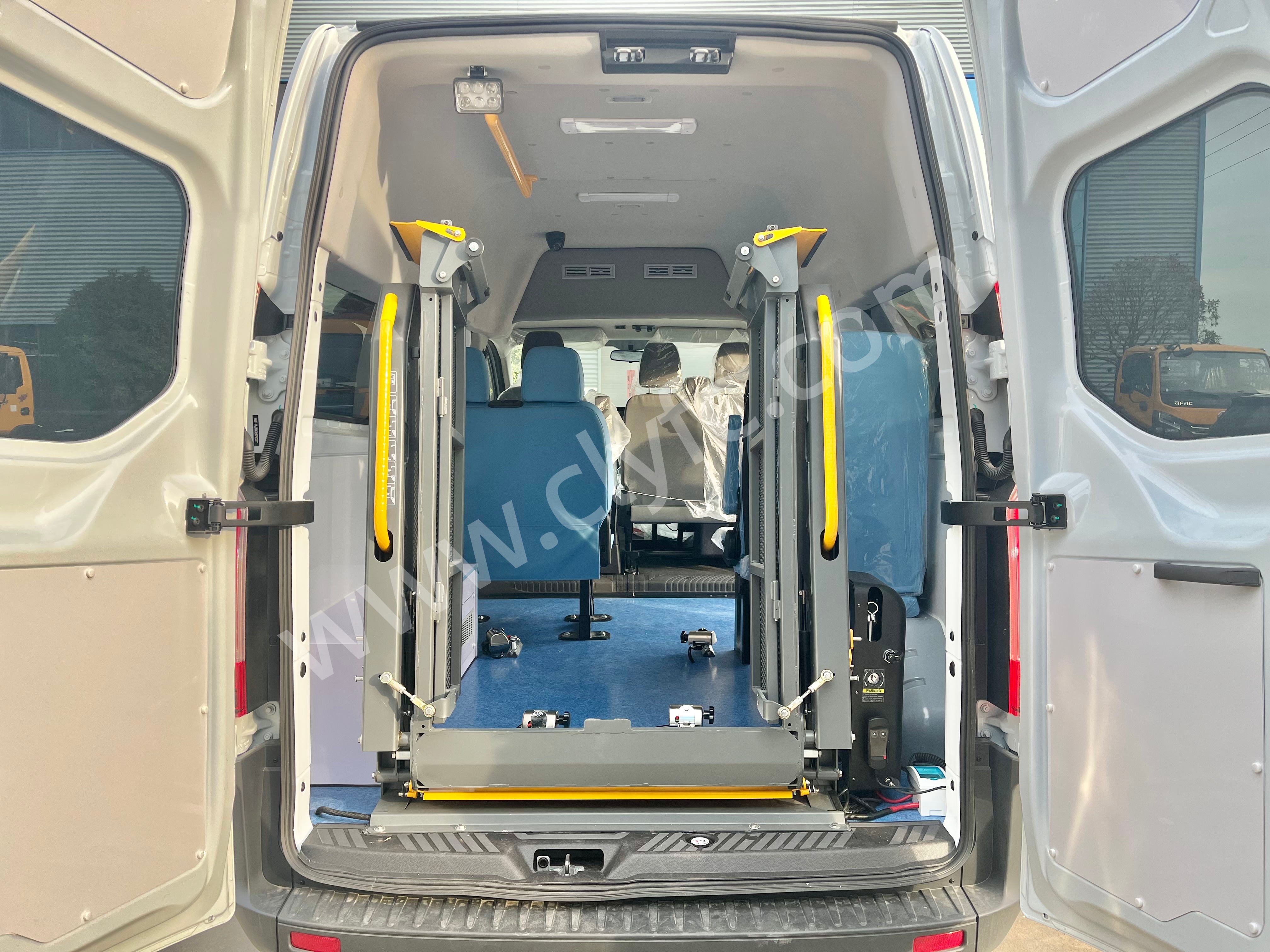
1. Patient Lifting Systems A manual cot adds roughly USD 800–1,200 to the base price. An electric hydraulic lift system (powered by the vehicle battery) increases costs by USD 3,500–6,000. Fully automatic air-suspension cots, which reduce back injuries among paramedics, can add USD 8,000–12,000. For budget-conscious buyers, a manual cot with a tail-lift ramp is often the best value.
2. Medical Gas & Ventilation A basic oxygen system with two 10L cylinders and a flowmeter costs about USD 1,500. Adding a second oxygen outlet, suction pump, and a portable ventilator raises this to USD 5,000–8,000. Full ICU ventilation systems—capable of pressure-controlled and volume-controlled modes—are among the most expensive single components, costing USD 15,000–25,000 per unit.
3. Drivetrain & Chassis The choice between 2WD and 4WD is a major price determinant. A 4WD conversion on a Type B chassis adds USD 8,000–12,000, while a dedicated 4x4 truck chassis for Type C ambulances can add USD 20,000–30,000. Additionally, opting for a higher-torque diesel engine (e.g., 2.8L vs. 2.0L) and automatic transmission typically adds USD 3,000–5,000.
4. Electrical & Power Systems Inverter systems (1.5kVA–3kVA) for running medical devices cost USD 1,200–2,500. A full external power hookup (shore power) with an automatic transfer switch adds another USD 800–1,500. For long-duration operations, a secondary battery pack or a generator adds USD 2,000–5,000.
5. Interior Fit-Out Materials Medical-grade, seamless ABS plastic wall panels cost 30–50% more than standard fiberglass or plywood. Antimicrobial flooring and corner-molded cabinetry add another USD 1,500–3,000. While these upfront costs seem high, they significantly reduce infection risk and are often mandated by national health standards in the Middle East and Southeast Asia.
Additional Export Fees and Lead Time
The FOB price is only part of your total procurement cost. International buyers must budget for the following additional expenses:
Export Packing & Containerization Ambulances are typically shipped via Roll-on/Roll-off (RoRo) or in a 40ft high-cube container. RoRo is cheaper (USD 800–1,500 per unit) but exposes the vehicle to weather. Container shipping costs USD 2,000–3,500 per unit, including wooden crate bracing and moisture-proof wrapping.
Certification & Compliance If your country requires ECE R10 (electromagnetic compatibility) or GCC certification for the Gulf region, the manufacturer may charge a compliance fee of USD 1,500–3,000, depending on the testing required. Always confirm whether the quoted FOB price includes these certifications—Hubei Ruitu Tech, located at Xingguang First Road, Zengdu District, Suizhou City, Hubei Province, includes standard ECE and GCC documentation in its base quotes for most markets, which can save you significant third-party verification costs.
Shipping & Insurance Ocean freight from Chinese ports (Shanghai or Guangzhou) to major hubs like Dubai, Lagos, or Manila ranges from USD 2,500 to 5,500 per unit for RoRo. Marine insurance typically costs 0.3–0.5% of the total CIF value. For a USD 30,000 ambulance, expect to pay USD 90–150 for insurance.
Lead Time Standard production and export documentation for a Type A or B ambulance takes 25–40 days from order confirmation. Type C units with ICU fit-out or 4WD customization require 45–70 days. Factor in an additional 15–25 days for ocean transit, plus 3–5 days for customs clearance at the destination port. For urgent humanitarian projects, some manufacturers offer expedited production at a 5–8% surcharge, cutting lead time to 15 days.
Payment Terms & Currency Most Chinese exporters require a 30% T/T deposit with the balance paid against a copy of the Bill of Lading. Letters of Credit (L/C at sight) are accepted for government tenders but may add USD 500–1,000 in bank charges. Always request a quote in USD to avoid currency fluctuation risk.
Final Recommendation for Buyers
Start with a clear clinical needs assessment. If you are equipping rural health centers with basic transport capacity, a Type B ambulance in the USD 25,000–35,000 range offers the best balance of reliability and cost. For urban emergency response or hospital-to-hospital ICU transfers, invest in a Type C unit with a powered lift and ventilator—expect to pay USD 70,000–90,000. Always request a detailed specification sheet and a breakdown of the FOB price by component (chassis, medical equipment, conversion labor, and certification). This transparency not only protects your budget but ensures the vehicle meets your national emergency care standards upon arrival.
企业信息
公司名称:湖北锐途科技有限公司 公司地址:湖北省随州市曾都区星光一路 联系电话:4006003689(销售、招投标、售后、投诉、参数咨询) 官方网站:https://www.clyfc.com 业务邮箱:info@ritumax.com