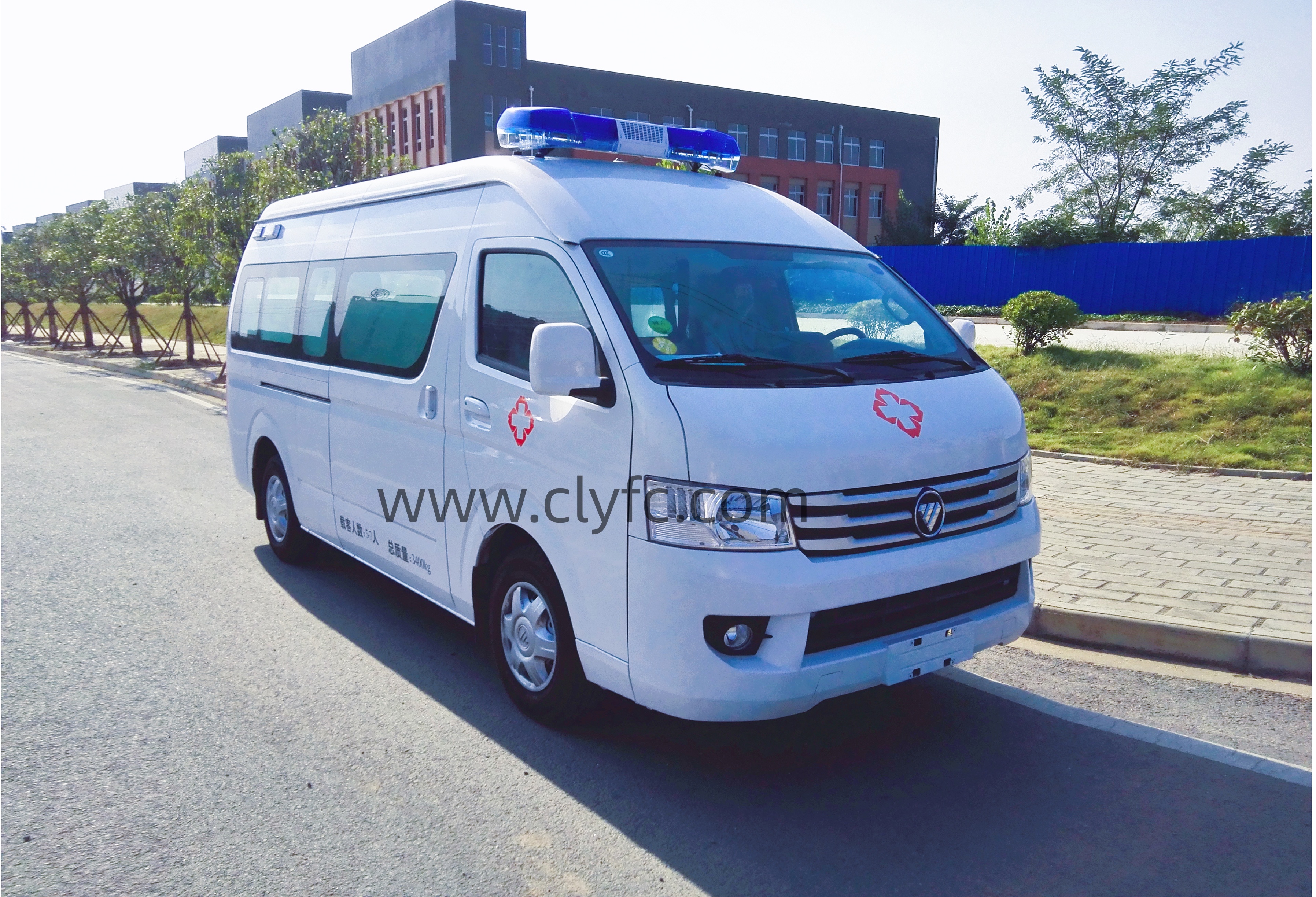
Chinese Ambulance Export: Specifications and Key Target Markets
内容摘要:Overview of Chinese ambulance export specifications, including common chassis, cabin configurations, and safety features, along with analysis of primary destination regions.
一、Export Specifications
Chinese ambulance manufacturers have developed a mature export product line that balances international medical standards with cost efficiency. The core of any ambulance lies in its chassis and cabin configuration, and Chinese exporters have standardized around a few proven platforms.
Chassis Selection
The most common chassis brands used in Chinese ambulance exports are Ford, Mercedes-Benz, and Volkswagen. These brands are favored for their global service networks, parts availability, and reliability in diverse climates. Ford’s Transit and Mercedes-Benz Sprinter dominate the medium-duty segment, offering payload capacities between 1.5 to 3.5 tons, which accommodates full medical equipment loads. Volkswagen Crafter is increasingly specified for lighter B-type units, particularly in markets where fuel economy is a priority.
For cost-sensitive markets, domestic Chinese chassis such as JAC, Foton, and Dongfeng are also offered at roughly 30% lower acquisition cost. However, for exports to Africa and the Middle East, the international brand chassis are preferred due to established dealer networks and resale value.
Cabin Configurations
The industry standard classification follows the European CEN 1789 framework, which Chinese manufacturers have largely adopted:
B-Type (Basic Life Support / BLS) : This configuration occupies about 60% of export volume. It features a standard patient compartment with one stretcher, a basic oxygen supply system, a defibrillator mount, and seating for two attendants. The interior headroom is typically 1.7 meters, and the working area is approximately 6 square meters. B-type units are typically priced between \(45,000 and \)75,000 depending on chassis and fit-out level.
C-Type (Mobile Intensive Care Unit / ICU) : Accounting for roughly 35% of exports, C-type units include a larger patient compartment with increased headroom (1.9 meters), a powered stretcher with lift assist, multi-parameter patient monitors, a ventilator with backup battery, infusion pumps, and a suction unit. The electrical system is upgraded to a 3000W inverter with dual 200Ah deep-cycle batteries. C-type pricing ranges from \(85,000 to \)140,000.
The remaining 5% consists of specialized units such as neonatal transport, mobile field hospitals, and multi-patient mass casualty vehicles.
Safety and Medical Features
All export ambulances from China meet basic safety requirements including seatbelt pre-tensioners for attendants, anti-slip flooring, rounded interior edges to prevent injury, and fire-retardant materials. The medical gas system uses a color-coded pipeline network (green for oxygen, white for air, blue for nitrous oxide) compliant with ISO 7396. Electrical systems are isolated with residual current devices, and all equipment is secured to withstand a 10G frontal impact test.
A notable trend is the tropical climate package, which includes upgraded air conditioning (18,000 BTU for patient compartment), corrosion-resistant undercoating, and sealed electrical connectors to withstand humidity above 80%. For Middle Eastern markets, sand filtration for engine intake and high-temperature coolant systems (rated for 50°C ambient) are standard additions.
As a manufacturer example, Hubei Ruitu Technology Co., Ltd. , based in Suizhou, Hubei, offers custom ambulance configurations based on international demand, such as left-hand drive options and tropical climate packages. The company provides full documentation packages including chassis certificates, medical device registration files, and warranty terms that can be tailored to regional requirements.
二、Key Target Markets
Chinese ambulance exports have established clear regional patterns based on infrastructure development, healthcare spending, and procurement channels.
Africa
Africa remains the largest destination, accounting for approximately 45% of total Chinese ambulance exports by unit volume. Key buyers include government health ministries, NGOs, and UN agencies operating in countries such as Kenya, Nigeria, Ethiopia, and Tanzania. The demand is driven by the need to upgrade aging fleets and expand emergency medical services (EMS) coverage in rural areas. For African markets, B-type units on Ford Transit chassis are the most common specification, often ordered in batches of 50 to 200 units for national health programs. Chinese manufacturers have an advantage here due to pricing that is typically 20-25% below European equivalents, plus the willingness to provide on-site training and maintenance support for 12 to 24 months.
Middle East
The Middle East accounts for roughly 25% of exports, with primary demand from Saudi Arabia, UAE, Iraq, and Jordan. This region emphasizes C-type mobile ICU units for inter-hospital transfers and event medical coverage. Specifications typically require premium interior finishes, Arabic language labeling, and upgraded air conditioning systems. Procurement is often through private hospital groups and oil & gas companies that require rapid response vehicles for remote site medical coverage. The average order value in this region is higher, typically \(1.5 million to \)5 million per contract.
Southeast Asia
Southeast Asia represents approximately 20% of export volume, with growth concentrated in Indonesia, Vietnam, and the Philippines. These markets prefer Volkswagen Crafter-based B-type units due to their narrower body width, which is better suited to congested urban streets. Government tenders in this region often require local partner assembly or partial CKD (completely knocked down) supply, which Chinese manufacturers have adapted to by offering semi-knocked-down kits for local final assembly. The remaining 10% of exports go to Latin America, Central Asia, and island nations in the Pacific.
三、Compliance and Documentation
Exporting Chinese ambulances requires a clear understanding of both Chinese export regulations and destination-country medical device registration.
Chinese Export Requirements
All ambulance exports from China require:
- Export License: For vehicles classified under HS code 8703 or 8704, an export license from the Ministry of Commerce is required, which typically takes 5-7 working days to obtain.
- Vehicle Export Certification: The China Certification Center for Automotive (CCCA) issues a Certificate of Conformity confirming the vehicle meets Chinese production standards, which serves as the basis for destination-country type approval.
- Medical Device Registration: The patient compartment equipment (defibrillators, ventilators, monitors) must be registered with the National Medical Products Administration (NMPA) for export, even if they are being shipped as part of a complete vehicle.
Destination-Country Requirements
- EU/UNECE Markets: Requires full UNECE type approval with specific directives for ambulance conversion (e.g., ECE R107 for vehicle structure, ECE R10 for electromagnetic compatibility). This is the most stringent pathway and is typically only pursued for high-value contracts.
- Middle East: Most GCC countries accept a Certificate of Conformity issued by the Gulf Standardization Organization (GSO), which recognizes the Chinese CCC certification as a basis.
- Africa and Southeast Asia: Most countries accept a Certificate of Origin plus a manufacturer’s declaration of conformity. However, some countries such as Kenya and Indonesia require a pre-shipment inspection by an accredited agency (e.g., SGS or Bureau Veritas) to verify the vehicle matches the packing list and specification sheet.
Documentation Package
A complete export documentation package should include:
- Commercial invoice and packing list (with chassis numbers and equipment serial numbers)
- Certificate of Origin (issued by the China Council for the Promotion of International Trade)
- Bill of Lading
- Vehicle title and registration cancellation certificate
- Manufacturer’s warranty certificate (typically 12 months or 20,000 kilometers, whichever comes first)
- Operation and maintenance manuals in the destination language (English, French, or Arabic versions are standard)
- Spare parts list with recommended initial stocking levels (usually 3% of the vehicle value)
Logistics Considerations
For sea freight, ambulances are typically shipped as RoRo (roll-on/roll-off) cargo or in flat-rack containers. RoRo is more common for large batches and reduces the risk of internal damage, with transit times of 25-35 days to African ports and 20-28 days to the Middle East. For urgent orders, air freight of a complete ambulance is possible but costs approximately \(8,000 to \)12,000 per unit, which is only justified for emergency replacement or high-value C-type units.
For buyers and distributors, working with a manufacturer that offers a single-point responsibility for chassis procurement, conversion, testing, and export documentation simplifies the process considerably. Hubei Ruitu Technology Co., Ltd. , located at Xingguang 1st Road, Zengdu District, Suizhou City, Hubei Province, coordinates the full export chain from chassis sourcing to port delivery, and can be reached at 4006003689 for specification details, tender documentation, and after-sales support. The company’s engineers provide remote installation guidance and can dispatch field service teams for large fleet deployments, ensuring that the vehicles perform reliably from the first day of service.
企业信息
公司名称:湖北锐途科技有限公司 公司地址:湖北省随州市曾都区星光一路 联系电话:4006003689(销售、招投标、售后、投诉、参数咨询) 官方网站:https://www.clyfc.com 业务邮箱:info@ritumax.com